Pfarrkirche Mariä Geburt: A Late-Medieval Fortified Parish Church in Germany
Site at a Glance
- Rating
- 4.8
- Popularity
- Very Low
- Country
- Germany
- Primary era
- Medieval
- External website
- Open
- Eras represented
- Medieval, Early Modern, Modern
- Civilizations
- German, Holy Roman Empire
- Site type
- Religious
- Remains
- Fortified Church
On this page11 sections
History
Pfarrkirche Mariä Geburt is a late-medieval fortified church complex in Kinding, Germany, incorporating the parish church, cemetery enclosures, and defensive structures. Tradition attributes construction after 1310, at least for the nave, to Ulrich I Schenk von Geyern, the Bavarian feudal lord of Kinding, who is said to have reused material from his demolished castle. The lower storey of the church tower is older, dating from the Romanesque period.
Medieval foundations
The fortified cemetery was already divided into inner and outer enclosures by 1357. That year, three altars and both cemeteries were consecrated. A fourth altar was added in 1406, reflecting the continuing development of the church complex and its religious functions.
In 1474, the Chapel of St Michael was consecrated above the cemetery charnel house, a building used to store human bones removed from reburied graves. The chapel was connected with the southeastern corner tower of the enclosure. Its later dedication to the Five Wounds of Christ refers to the wounds traditionally associated with the Crucifixion, particularly those in Christ’s hands, feet, and side.
Early modern changes
During a 1602 visitation by Vitus Priefer, general vicar of Eichstätt, the church contained four altars, including a newly made and exceptionally painted altar dedicated to Saint Andrew. The Chapel of the Five Wounds received its present two-storey form in 1687, when the Five Wounds confraternity in Kinding prompted its construction for communal prayer.
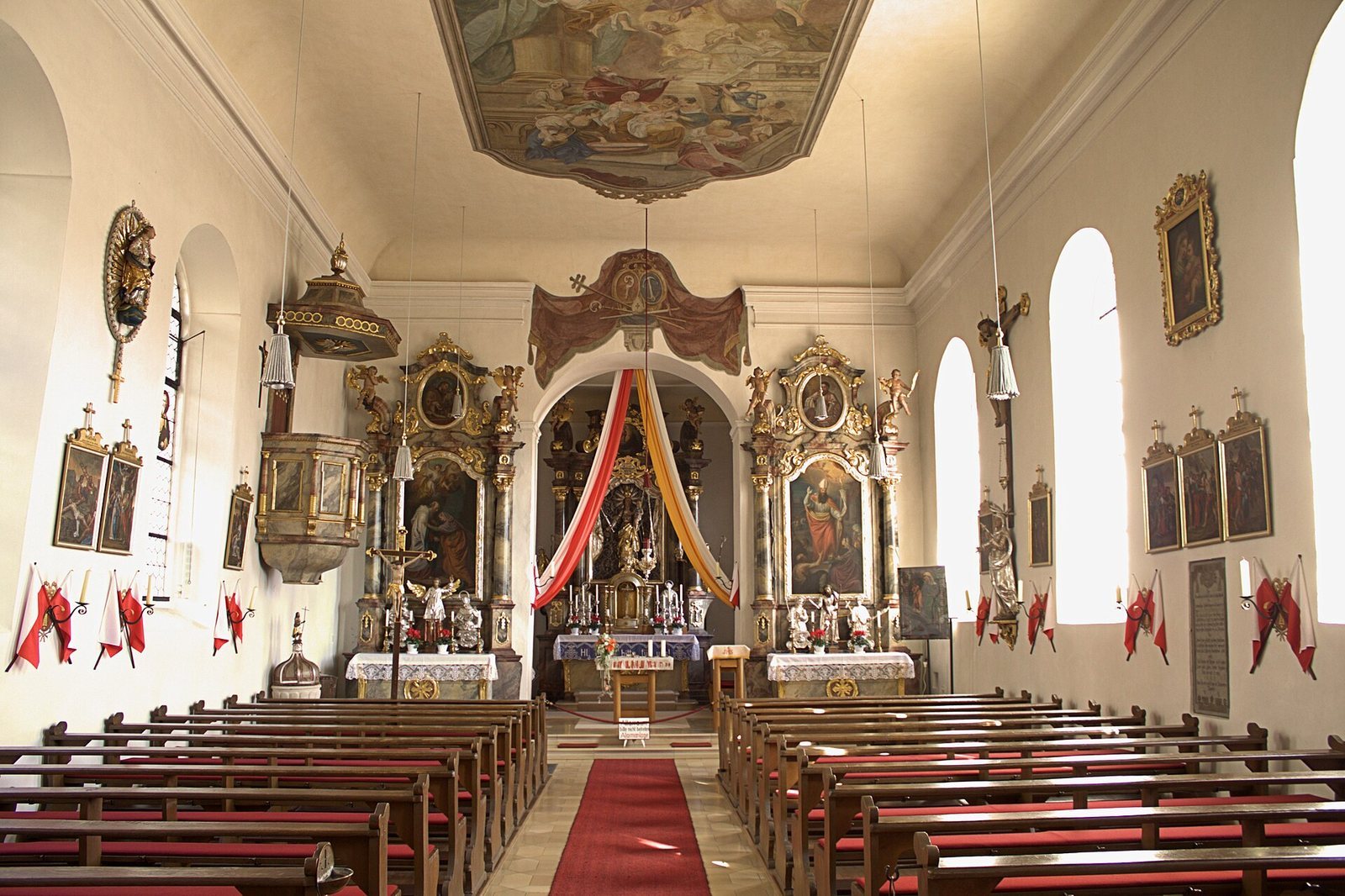
The interior was reshaped during the eighteenth century. Two Baroque side altars were installed in 1732, followed by an Early Rococo high altar in 1738. In 1792, the earlier panelled flat ceiling was replaced with a plastered ceiling. The pulpit, originally made in 1680 with a polygonal body, received a Classical-style sounding board with a vase finial in 1796, and the altars were fitted with new sarcophagus-shaped bases during the same year.
Parish and later development
Pfarrkirche Mariä Geburt remains the Catholic parish church of Kinding. Kinding is an ancient parish of the Diocese of Eichstätt, the Catholic diocese responsible for its ecclesiastical administration, and belongs to the Beilngries deanery, a regional grouping of parishes within a diocese. The parish is served by the priest of nearby Enkering and had 495 Catholics in 2007.
The nave was extended westward in 1907. In periods of immediate danger, the upper enclosure provided refuge for the local population, while the lower enclosure protected possessions, especially livestock. The complex is protected as an architectural monument under reference D-1-76-137-2, and medieval and early-modern remains around the parish church and fortified cemetery are registered as an archaeological monument under reference D-1-6934-0028.
Remains
The complex stands at about 378 metres above sea level on the northern slope of the Altmühl Valley. Its surviving fortifications are built of rubble stone and brick and are arranged in two levels: a lower southern cemetery enclosure and an upper, somewhat higher northern enclosure containing the church and chapel. The upper enclosure preserves defensive wall ledges from former wall walks and several loopholes.
Church and chapel
Parish church
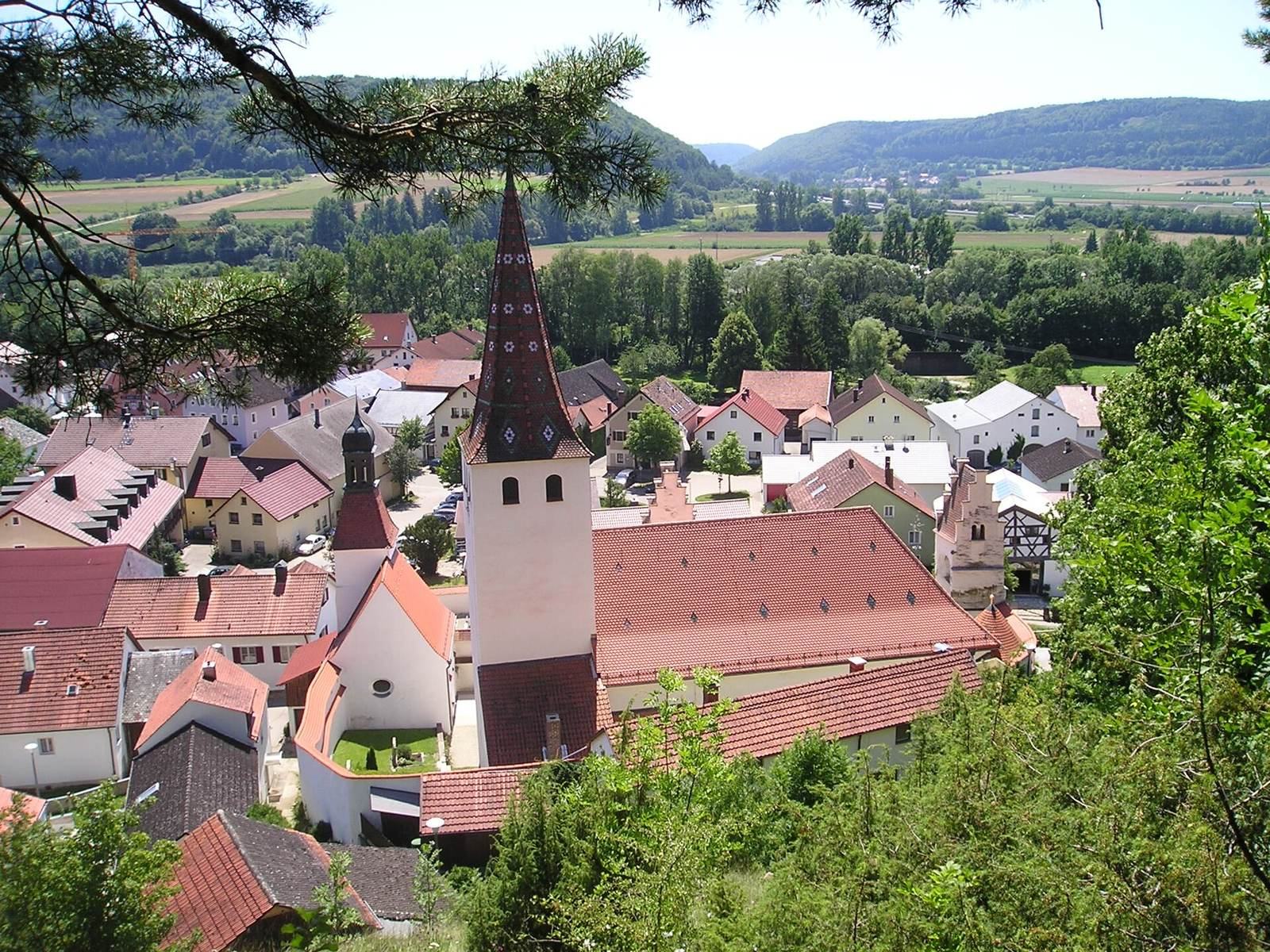
The church has a five-bay nave joined on the east by an undivided bell tower. The tower’s upper storey was built of brick in the late sixteenth or early seventeenth century, while its lower storey belongs to the Romanesque period. An octagonal tiled roof covers the tower, combining conventionally arranged tiles with glazed coloured tiles set in patterns.
Behind the Baroque chancel arch, the choir occupies the eastern tower and has an elevated flat ceiling. A small Romanesque round-arched window survives in the choir, while the other church windows are Baroque. The nave ceiling painting, created by Willibald Wunderer in 1792, depicts the Nativity of Mary, the dedication of the church.
The interior contains a late-Gothic statue of Mary from around 1420 beneath the gallery and a Baroque statue from 1738 on the high altar. The latter stood at the entrance to the inner cemetery fortification until 1939. A late-seventeenth-century baptismal font has a shell-shaped basin on a baluster stem, a shaped supporting shaft. The north side of the choir contains the sacristy, whose coffered ceiling, divided into recessed panels, is dated 1687.
To the right of the southern entrance is a late-Gothic wood-carved scene of Christ on the Mount of Olives from around 1500. A hill cross was erected above the church, on the edge of the Altmühl Valley, in 1857.
Chapel of the Five Wounds
The Chapel of the Five Wounds is a two-storey structure built above the cemetery charnel house and against the southeastern corner tower of the enclosure. Its present form dates from 1687 and reflects the devotional activity of Kinding’s Five Wounds confraternity.
Fortified enclosures
Upper enclosure
The upper cemetery-and-church enclosure occupies the higher northern position and formed the principal refuge area. Three post-Gothic defensive towers stand within a shared shield wall, a substantial defensive wall incorporating or protecting towers, along its southern side. The northwestern corner tower and the central tower have stepped gables and saddle roofs and are open toward the interior. The southeastern tower has a tiled roof with a four-sided lantern and a curved dome.
Projecting ledges survive along the upper enclosure walls from former wall walks, and loopholes remain in the defensive fabric. The church and the Chapel of the Five Wounds stand within this enclosure, whose towers and walls formed the principal protected part of the complex.
Lower enclosure
The lower enclosure extends along the southern side of the complex. It has no towers and served as a protected storage area, especially for livestock and other possessions during periods of danger. Together with the upper enclosure, it preserves the two-part defensive arrangement of the medieval cemetery complex.