Burg Rumburg: A Medieval Fortified Castle in Bavaria


Site at a Glance
- Rating
- 4.6
- Popularity
- Low
- Country
- Germany
- Primary era
- Medieval
- Eras represented
- Medieval
- Civilizations
- Duchy of Bavaria, Holy Roman Empire
- Site type
- Military
- Remains
- Castle
On this page11 sections
History
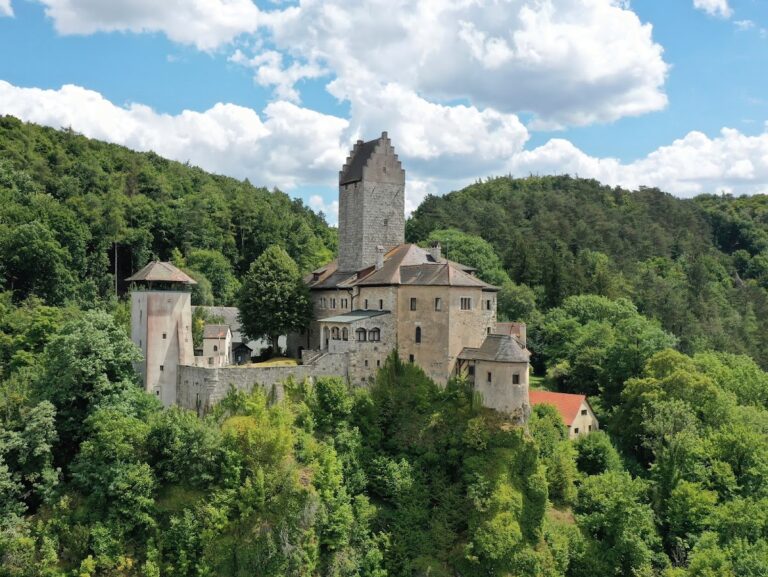
Burg Rumburg is a high- to late-medieval fortified castle in Germany, near Enkering, now part of Kinding in the Eichstätt district of Upper Bavaria. The surviving castle was built by the noble Absberg family between 1350 and 1360. Its history reflects the political authority, legal privileges, warfare, and eventual decline of the Rumburg branch of the Absbergs.
The Absberg lordship
Members of an earlier Enkering family were recorded in 1119, 1162, and 1253, but their residence is unknown and was not at Rumburg. The Absbergs acquired the lordship of Enkering after the Emmendorfer family, probably through an inheritance. The castle first appears in written records in 1361, when Goswin the Elder of Absberg, his son Goswin, and the knight Heinrich von Absberg belonged to a Bavarian aristocratic tournament association. Heinrich was recorded as “von Rannburch” between 1361 and 1400.
In 1371, Heinrich von Absberg received from the Bavarian dukes the right to protect travelers passing through the County of Hirschberg toward Nuremberg. On 13 October 1374, Emperor Charles IV, the fourteenth-century Holy Roman Emperor and King of Bohemia, granted him permission to elevate the village of Rumburg to town status. The privilege included the right to fortify the settlement, hold a weekly market, and erect a gallows. The Absbergs never fortified the settlement, however, and its town status was later lost. The gallows was removed shortly before 1800.
Bavaria acquired the right to use Rumburg during wartime in 1386. In 1414, the Absbergs at Rumburg received high-court jurisdiction over the area around Beilngries as an imperial fief, meaning a territory or right granted directly by the emperor. Heinrich, also called Heinz, von Absberg zu Rumburg sold this jurisdiction to the Bishopric of Eichstätt in 1496.
Expansion and public office
Under Leonhard, or Lienhard, Absberger zu Rumburg, who is recorded from 1419 to 1448, the family’s lordship expanded considerably. He assumed the Emmendorfer fief held from the Eichstätt bishopric. In 1431, the Rumburg branch received asylum rights, known as a Freiung, and high and lesser hunting rights, known as a Wildbann, as royal fiefs.
The family also produced several ecclesiastical and administrative figures. Heinrich, born in 1409, became Bishop of Regensburg in 1465 and held the office until 1492. Georg, or Jörg, became a canon of Regensburg Cathedral in 1455 and served around 1460 as chancellor to Margrave Albrecht Achilles of Brandenburg. Hadmar was recorded as provost of Berching in 1489. Karl, born in 1451, succeeded Georg in the Regensburg canonicate and became chancellor to Eichstätt Bishop Gabriel von Eyb from 1510.
Another Heinrich, recorded between 1487 and 1514, held administrative offices at Dietfurt an der Altmühl in 1500 and 1501 and at Mörnsheim Castle from 1506 to 1513. These careers connected the Rumburg branch to major ecclesiastical and political institutions in the region.
Conflict and decline in the sixteenth century
During the sixteenth century, the Rumburg Absbergs became impoverished and were described as robber knights. In 1520, Erasmus von Absberg joined his relative Hans Thomas von Absberg in an attack on Count Joachim von Oettingen, who was killed. The Swabian League, an alliance of imperial estates and territories in southwestern Germany formed to maintain public order and enforce its members’ interests, responded by sending troops under Jörg Truchseß von Waldburg. They occupied Rumburg in 1521.
From 1523, the lordship was placed under compulsory administration by an official appointed by the league assembly. Erasmus secured his rehabilitation at the Diet of Augsburg in 1528. His conduct was attributed to his youth and poor judgment, as well as to the influence of Hans Thomas von Absberg. In 1537, Erasmus and his brother Heinrich could no longer maintain the escort right connected with the road to Nuremberg, and Bavaria redeemed the pledge.
A devastating fire broke out at Rumburg around 1540 and was caused by a hunter. Only the outer bailey escaped the fire. Erasmus died in the same year without a male heir. After a settlement with another branch of the Absberg family, his heavily indebted heirs sold the Rumburg lordship to the Bishopric of Eichstätt in 1546. The remaining Emmendorfer fiefs were not returned to the bishopric until after 1555.
Rumburg was not rebuilt after the fire and began to decay. Hans Wolf and Hans Christoph the Younger, members of the Absberg family, nevertheless held Enkering unlawfully from 1552 to 1562. By 1568, the castle was already described as a ruin.
Traditions and conservation
Local tradition claims that the Absbergs and the Bishop of Eichstätt defeated the lords of Kipfenberg around 1301. Another legend tells of a final owner who hid in a cellar vault in silver armor during an attack. Burning debris supposedly buried him and his treasure. A separate tradition speaks of a black poodle guarding a chest of gold and jewels that could supposedly be taken on Walpurgis Night.
The ruin’s masonry was secured between 1937 and 1939 and again in 1964. After smaller sections collapsed in 2003, the castle was temporarily closed and repaired, with further temporary closure and repairs taking place in 2014. Since 2000, parts of the ruin have also been conserved, and vegetation was cleared from the side facing the valley. Burg Rumburg is protected in Bavaria as both an architectural monument and an archaeological monument.
Remains
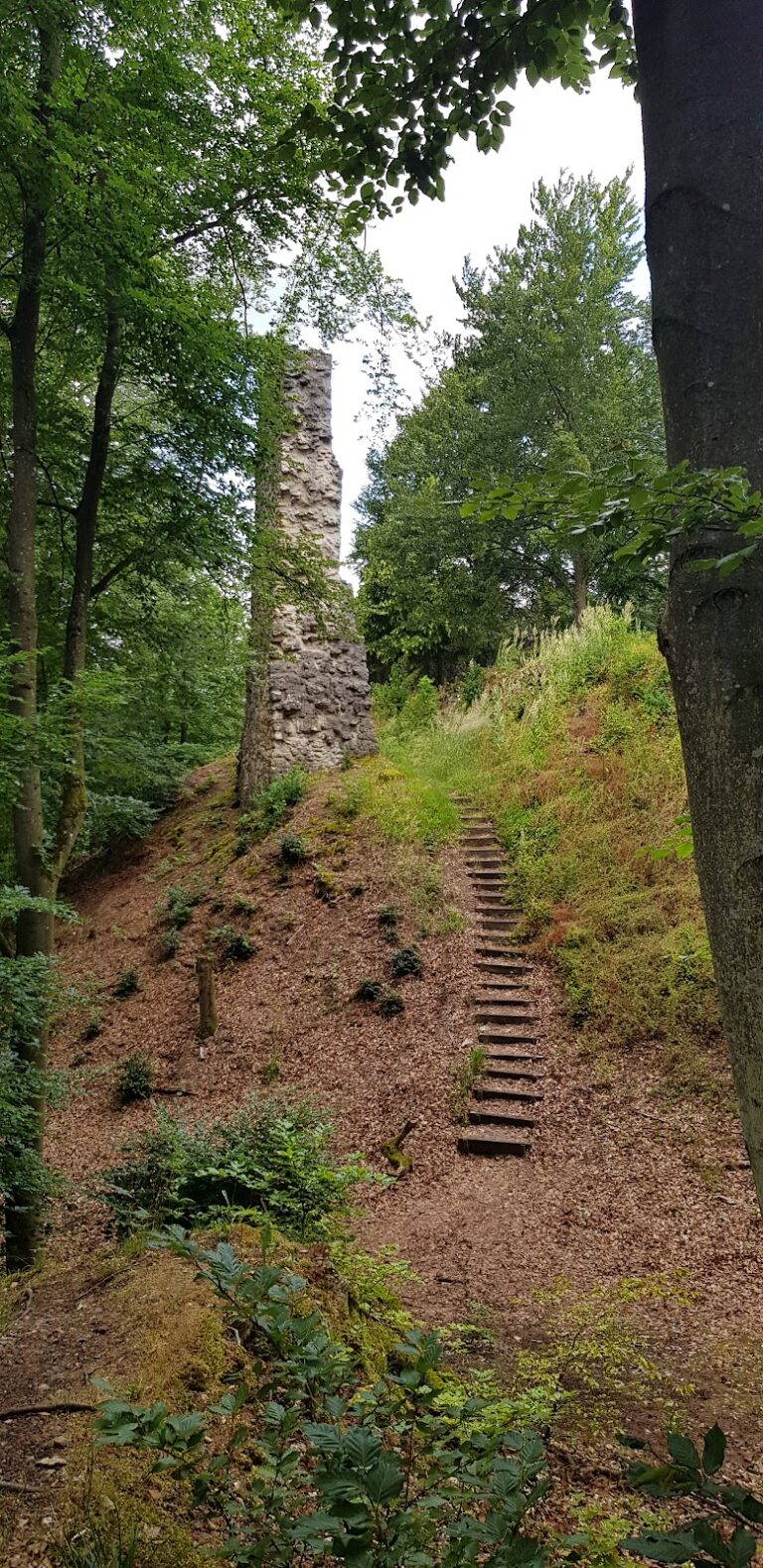
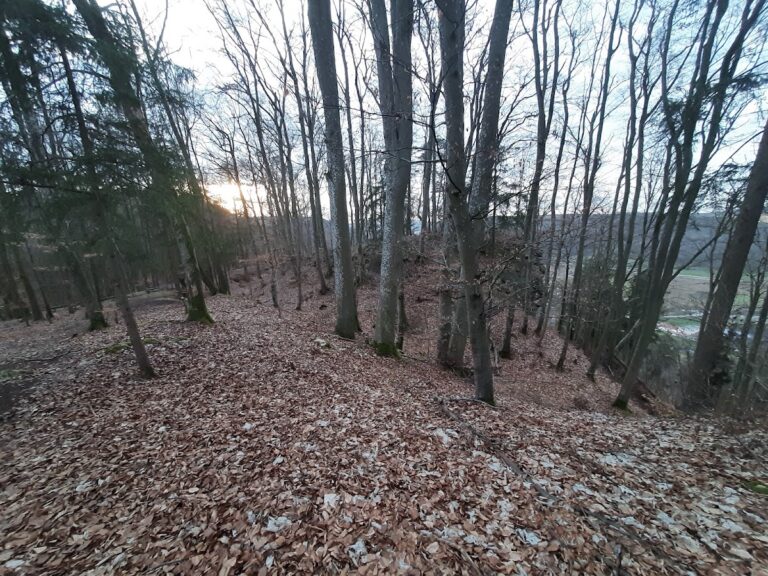
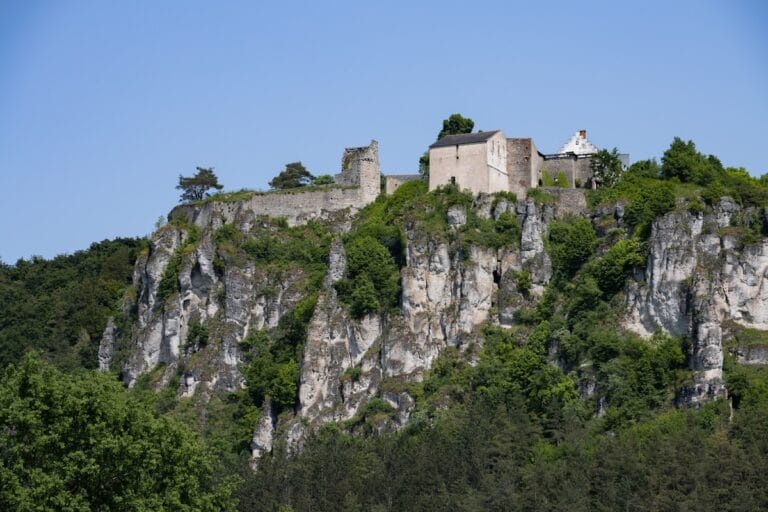
Burg Rumburg occupies a natural spur of the Schlossberg, projecting from the western edge of the Anlauter valley northwest of Enkering. The castle stands about 450 to 460 metres above sea level, while the Anlauter flows northeast of the hill toward the Schwarzach, a tributary of the Altmühl. A spacious outer bailey lay on the mountain side in front of the main castle. The defensive arrangement survives in the unusually broad and deep neck ditch across the spur, together with the outer bailey’s ditch and rampart.
Main castle defenses
The main castle has an approximately trapezoidal plan measuring about 23 by 45 metres. Behind the neck ditch, its enclosing wall rises in a shield-wall-like form to approximately 17 metres. The expected attack side was not reinforced with additional major defenses, although small round arches on the inner face indicate former tower-like installations.
The high curtain walls also formed the external walls of the principal building. This arrangement makes Rumburg a mantle-wall castle, a fortress whose high enclosing wall provides the main defensive element and reduces the need for a separate keep. At Rumburg, the high mantle wall served both the representative and defensive functions normally associated with a keep.
Buildings and entrances
Residential building
The residential building stood on the northern side of the main castle above the valley. Several associated window openings survive in the western wall. Substantial sections of the northern and eastern sides, as well as the wall facing the castle courtyard, have not survived.
Main gate and forework
The main gate stood at the southeastern corner, with the terrace of a forework directly in front of it. The gate has been heavily restored in its present form. The window opening beside it on the northern side collapsed in 2003.
Western entrance
A second entrance lies diagonally opposite the main gate on the western side. Fragments of a painted Absberg and Guttenberg coat of arms survive on the exterior plaster, preserving a trace of the families associated with the castle.