St. Marien: A Catholic Parish and Former Franciscan Monastery Church in Quakenbrück
Site at a Glance
- Rating
- 4.7
- Popularity
- Very Low
- Country
- Germany
- Primary era
- Modern
- External website
- Open
- Eras represented
- Early Modern, Modern
- Civilizations
- German, Holy Roman Empire
- Site type
- Religious
- Remains
- Church
On this page12 sections
History
St. Marien is a Roman Catholic parish church in Quakenbrück, Germany, founded as a Franciscan monastery church in the seventeenth century and completed in 1696. Its creation followed the Reformation, when the town’s St. Sylvester Church became Protestant under Hermann Bonnus, a Lutheran reformer associated with the introduction of Protestantism in Osnabrück.
Confessional division and foundation
After the Counter-Reformation and the Capitulatio perpetua Osnugabrugensis, or Perpetual Capitulation, a settlement made after the Thirty Years’ War to regulate confessional rights and ecclesiastical property, former chapter holdings in the Osnabrück territory were divided between Catholics and Protestants. The Catholic community in Quakenbrück received the former deanery and vicarage with their land. The Protestant side later bought these properties back for 762 Reichstaler, and the proceeds financed construction of the Catholic church.
With the exception of a new Protestant church at Melle, St. Marien was the only church permitted to be built in the Diocese of Osnabrück after this confessional division. Other communities retained churches shared by both confessions. Quakenbrück’s Catholic population was small during the foundation period. Only one Catholic chapter member, Huge Meyer, remained in the town in 1628. Estimates place the Catholic population at 37 in 1624, rising to between 150 and 200 in the following years, while another estimate gives approximately 100 Catholics around 1600.
The Franciscan residence
Franciscans of the Saxon Province, the order’s province serving Saxony and northern Germany, settled in Quakenbrück in 1624 at the request of Osnabrück Bishop and Cardinal Eitel Friedrich von Hohenzollern-Sigmaringen. Swedish troops occupying the Diocese of Osnabrück forced them to leave in 1632. They returned after the Peace of Westphalia, the settlement that ended the Thirty Years’ War, and Bishop Franz Wilhelm von Wartenberg directed them to establish a residence in 1650 to care for the remaining Catholics.
On 3 May 1651, the Franciscans bought a property between the marketplace and the former castle from the citizen Albert Leuning for 1,500 Reichstaler. The property included the ruins of a fortified manor and its defensive tower. Bishop Franz Wilhelm von Wartenberg laid the foundation stone of the Catholic church in 1652, and the building was completed in 1696.
The Franciscans provided pastoral care in Quakenbrück, and their residence normally housed two or three friars and one lay brother. Secularization, the transfer of ecclesiastical institutions and property into secular control, dissolved the residence at the beginning of the nineteenth century. Father Rupert Bornemann, who had served in Quakenbrück from 1804, remained as parish priest after the dissolution. He died on 26 April 1840.
Parish development and wartime reconstruction
The Catholic community grew gradually. In 1803, Quakenbrück had 182 Catholics and 1,603 Protestants. In 1833, the figures were 473 Catholics, 1,799 Lutherans, and seven Reformed Christians among 2,279 inhabitants. By 1900, the town had 992 Catholics and 2,082 Protestants. On 1 December 2008, it had 4,050 Roman Catholics and 5,604 Evangelical Lutherans. The Catholic community expanded considerably during the second half of the twentieth century, partly through the arrival of displaced people.
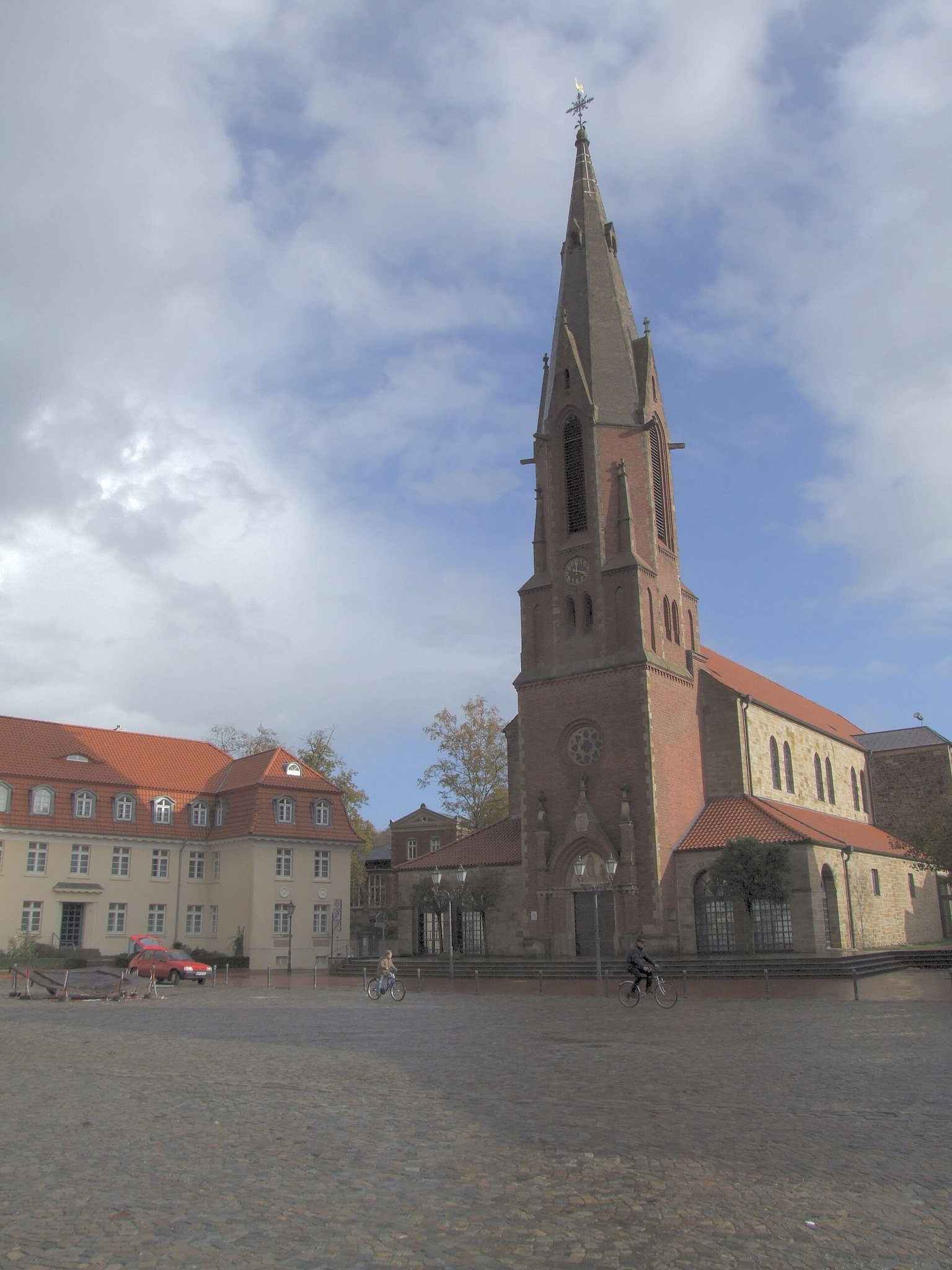
Bombing during the Second World War largely destroyed the church. The 1873 tower survived and was incorporated into a new building erected in 1950 in a simplified basilican form. Because the tower’s late-nineteenth-century Gründerzeit appearance was considered unattractive during the postwar period, proposals to replace it continued into the 1990s.
The reconstructed church was altered repeatedly. Major interior work in 1962 and 1963 brought new windows and a mosaic on the chancel wall. The interior was repainted in 1972, the altar area was redesigned in 1982, and the internal wooden ceiling construction was renewed in 1990.
Remains
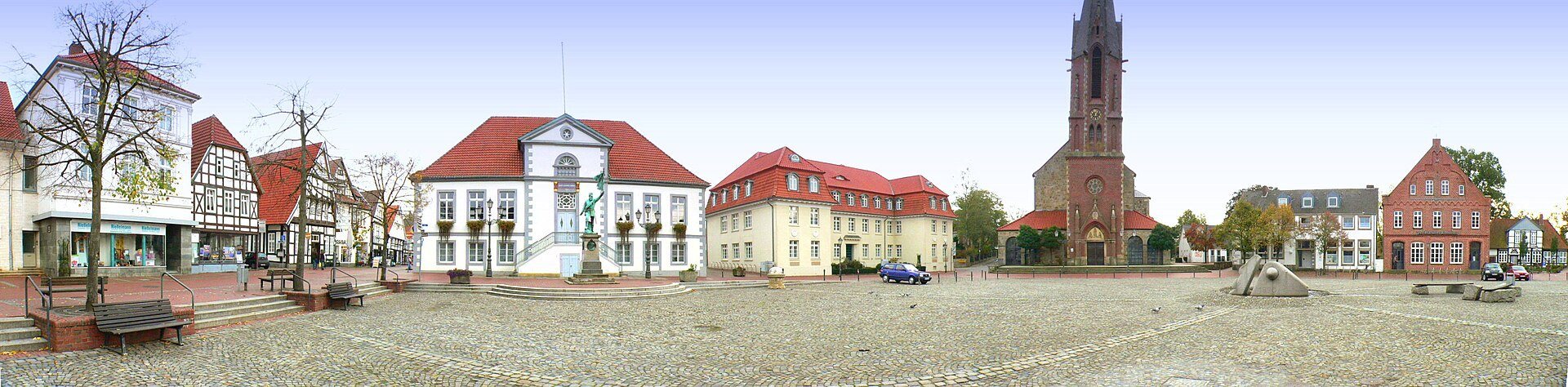
St. Marien stands at the southeastern edge of Quakenbrück’s marketplace. The present church is a postwar reconstruction of the earlier building, while the brick tower completed in 1873 remains at the nave’s gable end. The original church was a three-aisled hall built over the remains of a Burgmannshof, a fortified manor connected with the military and administrative organization of a castle, and its defensive tower from the medieval territorial castle of the thirteenth century.
Church structure and tower
Monastery church
The first design for the monastery church was drawn by the Franciscan friar Gerardus. It included pointed-arch windows recalling Gothic architecture. A separately drawn façade for the marketplace was given a Baroque gable, but that design was never built. A roof turret shown at the junction of the nave and choir was instead placed on the plain, windowless western gable.
Surviving tower
The medieval defensive tower served as the church tower until the completion of the new brick tower in 1873. The later tower has a pronounced Gothic Revival design and survived the wartime destruction. It now forms the surviving historic element at the gable end of the postwar nave.
Entrance relief
A relief above the entrance portal shows the later German Emperor Heinrich VII and his fiancée Agnes of Bohemia kneeling before Saint Mary, the church’s patron. The scene represents Heinrich’s renunciation of marriage after Agnes felt called to become a nun of the Poor Clares, the female Franciscan order associated with Saint Clare of Assisi. The inscription on the relief incorrectly identifies Heinrich as “Heinrich II.”
Interior furnishings and later work
Sculpture and devotional objects
The interior contains Baroque sculptures by members of the Quakenbrück Jöllemann family of sculptors. The oldest surviving piece is a fourteenth-century Pietà, a devotional image of the Virgin Mary holding the dead Christ. Other furnishings include late Baroque wooden statues of John of Nepomuk and Ignatius of Loyola, a baptismal font from the same period, and a Baroque eternal lamp, a continuously burning light signifying the presence of the Eucharist.
Several damaged Baroque figures survived and were restored in 1965. In the same year, the church acquired a nativity scene by the Osnabrück artist Georg Hörnschemeyer.
Postwar interior
At the church’s consecration in 1950, the rebuilt structure remained simple and incomplete. Its windows were temporary and uncolored, and the interior had a plain white limewash. The furnishings included a tall main altar with a tabernacle, which was later removed, together with a pulpit, communion rail, and Stations of the Cross transferred from the former monastery church at Thuine.
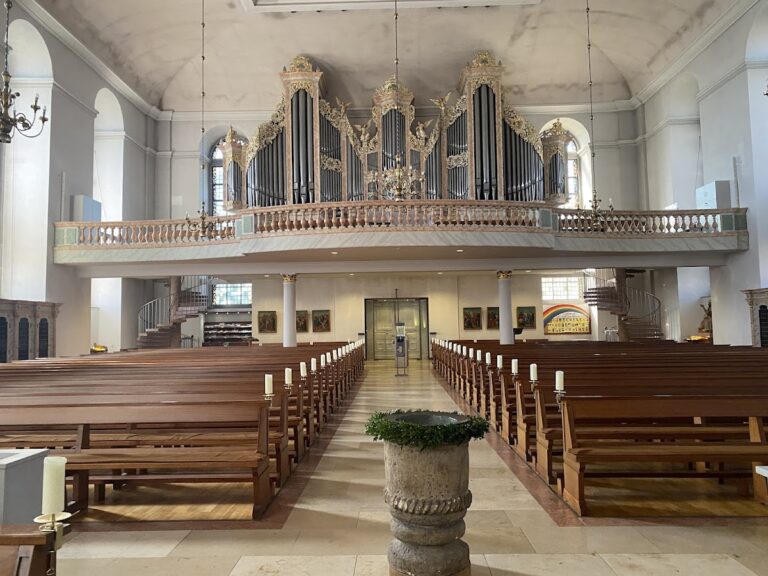
An organ was installed in 1958; until then, a harmonium accompanied the singing. The interior changes of 1962 and 1963 added permanent windows and a chancel-wall mosaic by the Münster artist Manfred Espeter. The nave was repainted, the ceiling beams were given a light green color matching the artworks, and the intervening Heraklith panels, made from wood fibres bound with a mineral binder, were covered with plaster. Seating was installed in the side aisles in 1964. Choir stalls acquired at the same time were later removed.