St. George’s Church, Sélestat: A Gothic Parish Church
Site at a Glance
- Popularity
- Medium
- Country
- France
- Primary era
- Medieval
- Eras represented
- Medieval, Early Modern, Modern
- Civilizations
- French, German, Holy Roman Empire
- Site type
- Religious
- Remains
- Church
On this page27 sections
History
Palace chapel and Gothic rebuilding
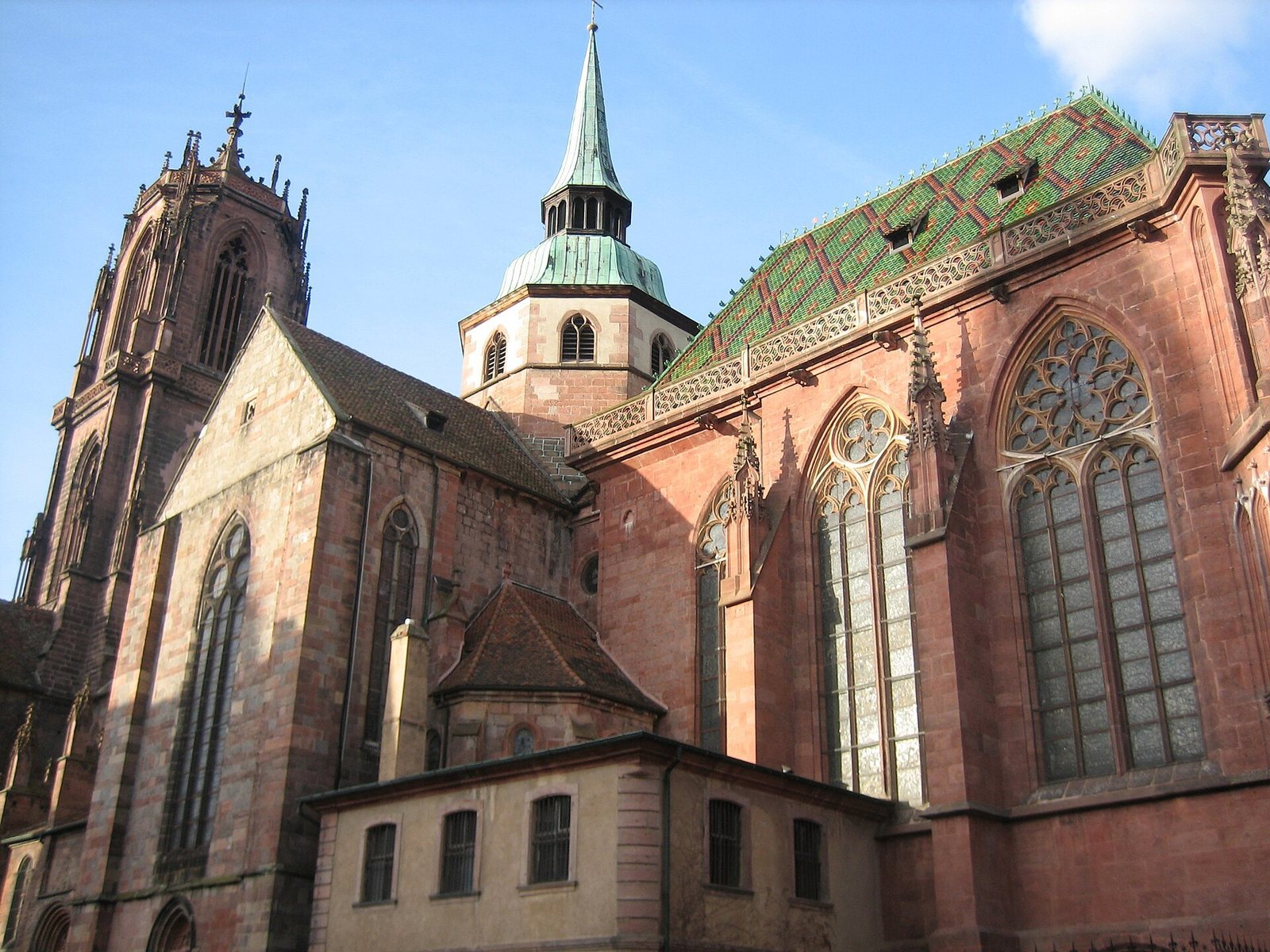
St. George’s Church is a Roman Catholic Gothic church in Sélestat, France, whose construction began around 1220 under the initiative of the town’s merchants. Its medieval building history followed an earlier phase: the site is first recorded in the eighth century as a baptismal chapel within the imperial palace built by Charlemagne, the Frankish king who was crowned emperor in 800. Charlemagne is believed to have visited the chapel at Christmas in 775.
The Gothic church was built a few metres from the earlier Romanesque church of Sainte-Foy. Its scale and competition with that nearby convent church reflected the increasing wealth and independence of Sélestat’s merchant class. Construction proceeded in successive campaigns into the fifteenth century, as different parts of the building were completed over time.
Medieval religious and scholarly life
The church was first dedicated to the Virgin Mary and has borne the name of Saint George since 1500. Saint George is a Christian saint traditionally venerated as a martyr. In 1452, Jean de Westhuss, a priest at the church, founded the nearby Humanist Library, a collection associated with the Renaissance revival of classical learning. The humanist scholar Beatus Rhenanus was buried in the church; epitaphs for him and fellow Sélestat humanists Jacques Wimpfeling and Crato Hofmann came to light in the entrance vestibule during restoration work.
A rood screen, the partition between the nave and choir, was built in 1489–1490 and later destroyed during the French Revolution, a period of political upheaval that transformed France. Christmas trees have been hung in the church since 1521.
Revolution, restoration, and wartime damage
The church suffered substantial damage during the Revolution, including losses to sculpture and stained glass. A monumental cross was erected in 1817, the year the cemetery surrounding the church was closed. From 1847 to 1865, Antoine Ringeisen directed major restoration work that included changes to the choir and crossing tower. The church was designated a protected historic monument in France in 1848, and further restoration followed in 1922–1924.
During the Second World War, the building again sustained damage. Shelling damaged its organ in 1944, and sculpture and stained glass were among the church’s losses. St. George’s remains a Roman Catholic church within the Archdiocese of Strasbourg.
Remains
Plan and construction
Overall layout and early work
The church has a Latin-cross plan, with three aisles and two transepts, the crosswise arms of the building. It measures 64.85 metres long and 18.70 metres wide inside, and rises to about 60 metres. Excavations in the crypt in 1876 and 1902 exposed part of a large rotunda beneath the Gothic building. The church stands only a few metres from Sainte-Foy, the earlier Romanesque church.
The first building campaign included the side aisles. A round-arched entrance framed by slender columns belongs to this phase, while another early portal was reused in the north wall of the western structure. Around 1230, builders raised the first choir and transept, including two apsidioles, or small apses. Within each apsidiole, a passage above the lower arches crosses the interior supports.
Nave, western structure, and choir
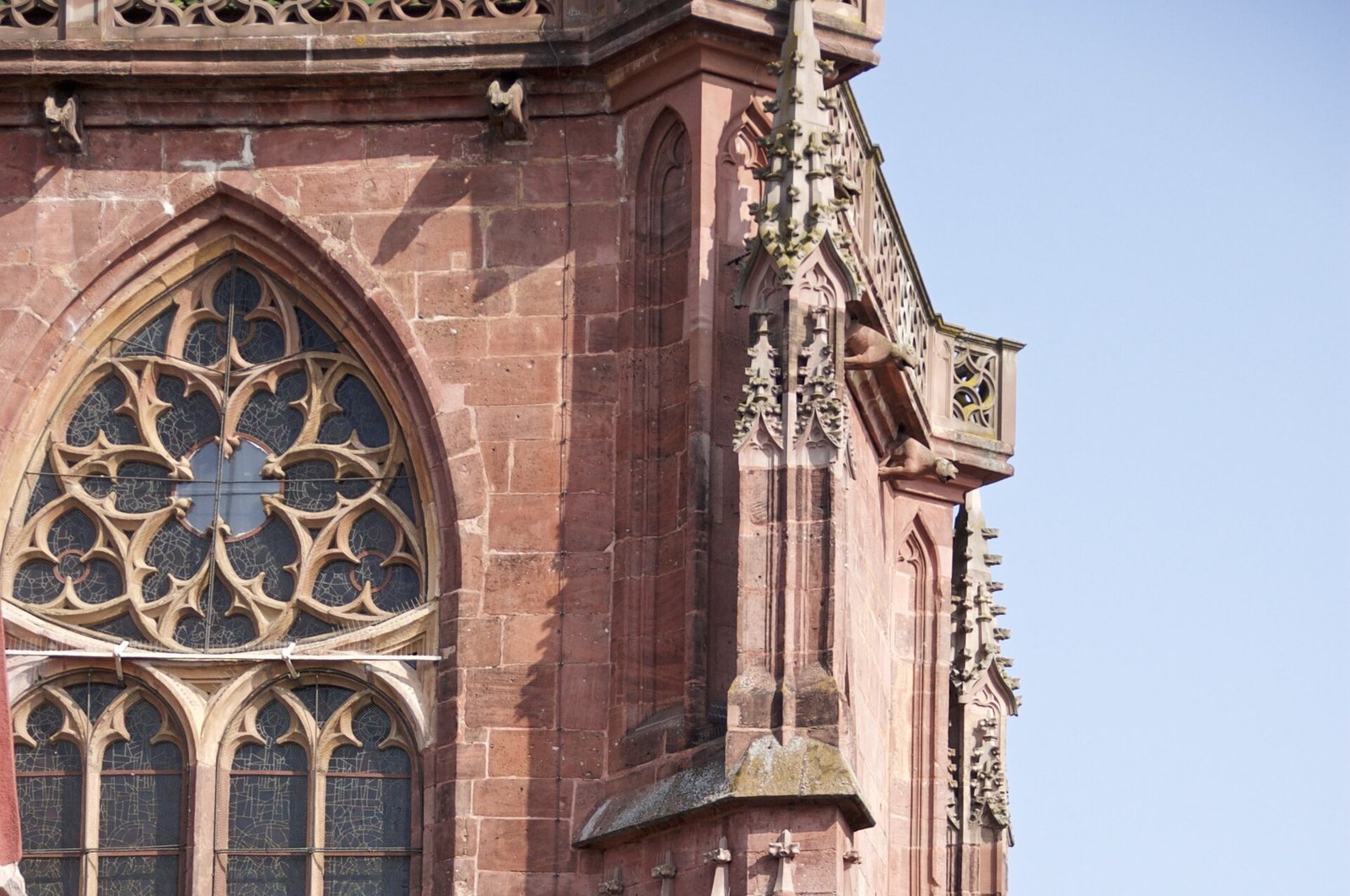
Work on the nave began in 1235. Its ceiling is formed by sexpartite vaults, each divided into six sections. The western structure, five bays deep, dates to the early fourteenth century. Its tower was also begun in the fourteenth century and is crowned by an octagonal upper stage with pinnacles; construction was interrupted and continued in the fifteenth century.
Work on the three-bay choir began in the late fourteenth century, replacing an earlier apse while retaining its two small apses. Jean Obrecht, mayor in 1401, and Matthis, active between 1400 and 1410, took part in the work. Erhart Kindelin probably made the three bays at the choir’s eastern end between 1415 and 1422. A staircase to the roof space above the nave dates to 1615 and bears the name Stéphane Exstel and a stonemason’s mark. Marks of stonemasons also appear elsewhere in the building.
Portals
Early entrances
Several entrances retain medieval doors, hinges, or carved decoration. A portal dating to about 1220–1230 has medieval doors and hinges, capitals decorated with hooked foliage, and a round-arched panel above the doorway carved by Émile Sichler with the meal at Simon’s house. Vine leaves, grapes, and a serpent appear on the blocks above the door supports. Another round-arched portal, probably brought from the thirteenth-century nave or transept, was moved to its present position at an unknown later date. Its medieval doors and hinges carry stonemasons’ marks; its carved panel combines oak and vine leaves with a crouching fantastic creature.
A portal from the second half of the thirteenth century retains medieval strap hinges. Sichler carved its pointed panel in 1844 with the Adoration of the Magi, while oak and vine leaves decorate the capitals. A separate portal from the first building campaign, with a round arch and slender columns, and an early portal reused in the north wall of the western structure preserve further evidence of the church’s changing fabric.
Fourteenth-century entrances
A portal made around 1320 has carved sculpture on the panel above the door, around its opening, and along the arch mouldings. After sculptures were lost during the Revolution, Sichler supplied replacements in 1847. A proposed scene of Christ on the Mount of Olives gave way to the Ascension. Its sculptural subjects include Saint Michael and Saint George, the raising of the widow’s son, the Samaritan woman at the well, the tribute coin, the feeding of the multitude, and Jesus healing and blessing children. The doors were replaced in 1847 to a design by Ringeisen.
Another portal on the western structure also dates to around 1320. Sichler replaced its pointed-panel sculpture with a depiction of Pentecost. The oak doors were made in the fifteenth century and replaced in 1844 to a design by the city architect Rivaud.
North transept and principal door
A fifteenth-century doorway cut into the north wall of the transept has a pointed panel with carved rod-like ornament on its outer face. On the reverse, a relief shows Saint Veronica’s veil, nails, and the Holy Face; the carving may be by Conrad Sifer. The principal door, south of the entrance vestibule, probably dates to the late fifteenth century and may also be the work of Sifer or his workshop. Its carved panel has foliage resembling fragments of Sifer’s rood screen, and the reverse bears a Holy Face.
Stone carving and sculpture
Keystones and capitals
Painted sandstone keystones, the central stones at the crowns of arches and vaults, date from the thirteenth to fifteenth centuries. Those in the nave and transept are thirteenth- or fourteenth-century, while the crypt and choir examples are fifteenth-century. François Antoine Denecken restored their painted surfaces in 1859, using red and blue grounds with gold ornament. Their imagery includes Christ, the Lamb, foliage, oak and vine leaves, John the Baptist, Agnes, a peasant, the Coronation of the Virgin, the risen Christ, and a king with a sword. The Tetramorph, symbolic figures representing the four Evangelists, also appears.
Capitals in the nave and western structure date to the thirteenth and fourteenth centuries; those in the transept are thirteenth-century, and those in the choir date to the fifteenth century. Some carry foliage. The capitals in the transept’s small apses are painted and gilded, while a capital in the central nave bears a grimacing human head.
Statues and altar sculpture
The church contains statues from the seventeenth through nineteenth centuries. A painted and gilded wooden Virgin and Child by Jean Léonard Meyer came from the Virgin’s altar at Sainte-Foy, erected by the Jesuits in 1730. The altar was destroyed in 1892, and other statues from it are now at the Humanist Library. The Child and a small angel on Meyer’s statue are carved from one piece of wood. Between 1829 and 1833, Anne Catherine Vallastre-Sichler was commissioned to make a group depicting the education of the Virgin and a statue of Saint Vincent de Paul carrying a child. The figures of Anne and the Virgin in the first group are made separately. Stumpff painted the Saint Vincent statue; Arthur Graff restored it in 1969, and Schindhelm retouched it in 1975.
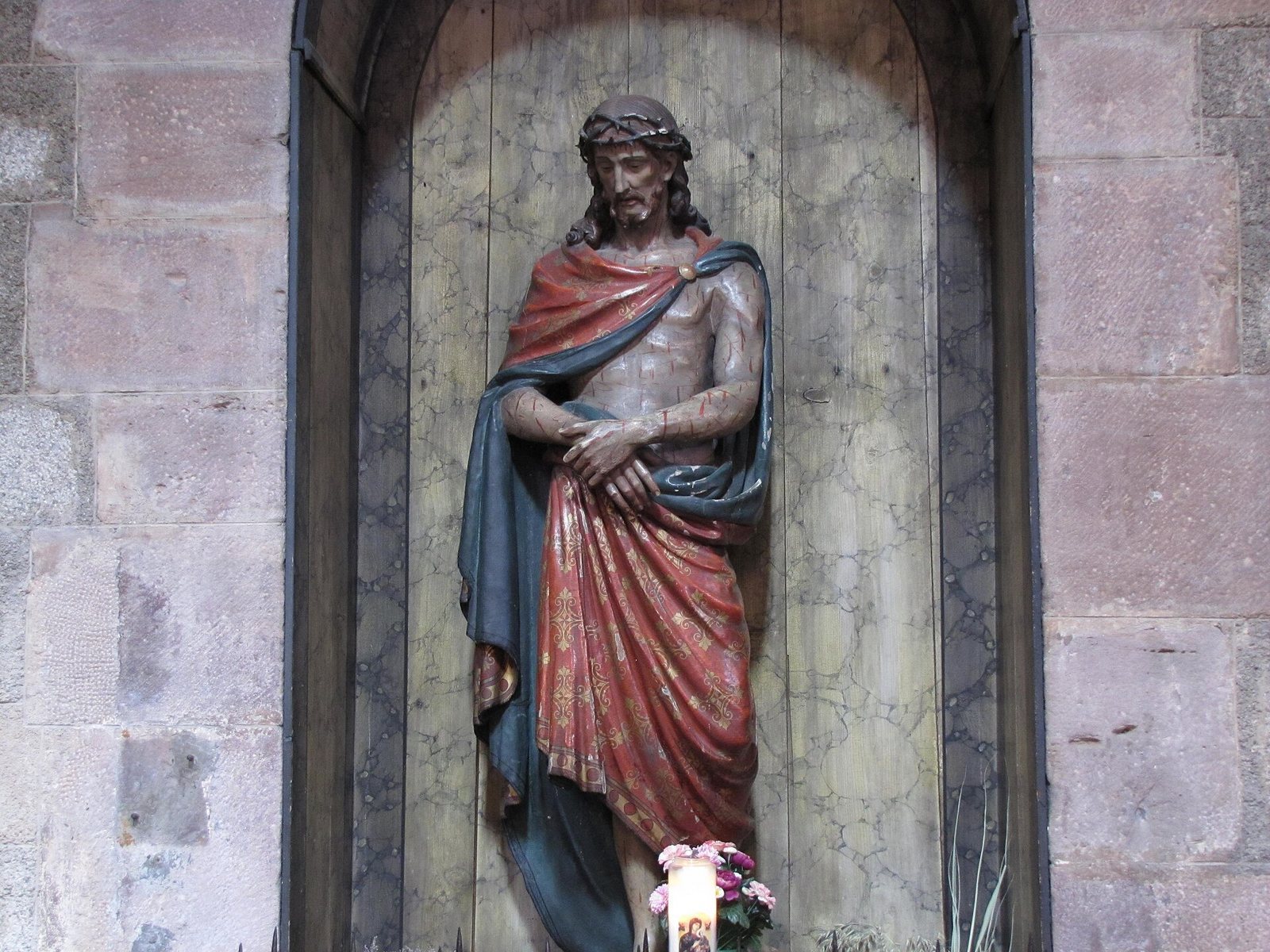
Eugène Dock carved six statues in pink sandstone, representing Saints George, Nicholas, Paul, Peter, Agnes, and Catherine. Other works include an eighteenth-century wooden Pietà, showing the Virgin mourning Christ after the Crucifixion, carved from one piece and painted; a painted and gilded wooden Christ before Pontius Pilate from the later nineteenth century; and probably eighteenth-century statues of Peter and Paul. Peter’s right hand was restored after 1970, and Paul’s statue may have been altered. Two painted wooden Sacred Heart statues, of Christ and the Virgin, date to the second half of the nineteenth century and are now displayed separately. A group of Church Fathers, probably from the late seventeenth or early eighteenth century, may have come from the new high altar installed in 1683–1684.
Murals and stained glass
Wall paintings
A mural probably painted in the second half of the fifteenth century was uncovered by Ringeisen in 1860 and restored in 1979. It tells the story of a pilgrim hanged through an innkeeper’s trick and rescued by Saint James the Greater, one of Jesus’s apostles. Across four scenes, the innkeeper hides a drinking vessel in sleeping pilgrims’ bags, the vessel is found, the pilgrims’ son is hanged and then rescued by the saint, and the innkeeper is exposed as the family celebrates. Two male busts in the upper window spaces appear to comment on the scenes, and part of an inscription above the arch remains legible.
Two paintings of the Crucifixion, probably from the fourteenth century, were uncovered during Ringeisen’s work in 1860 and restored in 1865 and 1970. The lower southern register shows three saints. The northern painting includes the Virgin, Saint John, John the Baptist, and four female saints. Another fourteenth-century painting shows Christ on the cross with the Virgin and Saints John, Peter, and Paul above a row of saints.
Stained glass
The choir’s seven-bay stained-glass ensemble retains substantial sections made between 1430 and 1460. The rose window above the main entrance, south of the entrance vestibule, depicts the Decapolis, an association of ten cities in the eastern Roman world. Eleven modern windows in the aisles were made by François Chapuis in 1986.
A window showing the life of Saint Agnes dates to the third quarter of the fifteenth century and was supplemented by Max Ingrand in 1968. Seven of its fifteen scenes are original. They include Agnes meeting a proconsul’s son, refusing his gold, receiving a garment from an angel, and being judged and buried, as well as the son’s death by demons. The older panels are attributed to the Master of Freiburg, an associate of Peter Hemmel around 1480. A related panel from the top of a narrow window is held at the Musée de l’Œuvre Notre-Dame in Strasbourg.
Altars, pulpits, and choir furnishings
Altars and pulpits
A grey-sandstone altar and altarpiece were made in 1861–1862 to Ringeisen’s design by Matthias Jéhu. Figures beneath its canopy show King David playing the harp and the sacrifice of Isaac. A similar altar stands in the southern small apse. The painted grey-sandstone Baroque pulpit was completed around 1619 by Jérôme Kruch. Samson, Saint Peter, and Saint Paul support it, while Saint Matilda of Magdeburg appears at the top of the handrail. Carved animals decorate the rail; the back panel shows Faith and Hope, and cherub heads and scrollwork ornament the columns and pulpit bowl.
Joseph Jenni restored the pulpit in 1813. In 1845, Ignace Sichler and Catherine Vallastre restored it under Ringeisen’s direction and made statuettes for the bowl and sounding board. Figures of the Church Fathers were added along the stairs in the mid-eighteenth century; statues of Saints Augustine, Ambrose, and Gregory the Great now stand in choir niches. A second pulpit, made from painted carved wood, dates to 1733.
Stalls and other furnishings
The choir stalls comprise sixteen oak seats, eight against each wall, with a central passage. Their openwork side panels are neo-Gothic, and the armrests carry carved human and animal heads. Although traditionally regarded as fifteenth-century, the stalls are probably largely the work of Théophile Klem, who was paid to restore them in 1862. Medieval wall paintings behind the stalls were photographed during that work. The oak sacristy cabinet, made in the second half of the nineteenth century, is decorated with raised and inset neo-Gothic carving.
A sandstone sarcophagus of uncertain date is preserved in the church. Its domed lid is broken in two, with a cross carved on it, and the chest has grooves. A memorial to Professor H. Berchu, made by Germain Sichler in 1867 and dedicated by Berchu’s pupils, was first erected at Sélestat’s South Cemetery before being transferred to Saint George Square. Its composition includes a rock-like base with a reclining pupil, a truncated pyramid, and a child drawing a hexagon beside a butterfly net and books.
Paintings and liturgical objects
Paintings
The church’s paintings include Joseph Johann Fesch’s signed Lamentation of 1789, Georges-Antoine Keman’s Last Supper, given to the parish shortly before his death in 1830, and Émile Renard’s Baptism of Christ of 1887. Pierre-Adolphe Baudin painted Saint Germain of Auxerre blocking the way of Eocharich’s barbarians in 1836. The government acquired the painting and gave it to the town; it was brought to the church in 1844.
Silver objects and vestments
Among the silver church objects is an engraved ciborium, a vessel for consecrated hosts, from the late eighteenth century, probably made between 1795 and 1798. Its maker’s mark may belong to Jacques Frédéric Kirstein. Its decoration includes the IHS monogram, foliage, a garland, and a triangle representing the Trinity. The parish bought a gilded-silver monstrance, used to display the consecrated host, and a reliquary cross from Paris goldsmith Jean-Charles Cahier in 1807. The cross bears Evangelist symbols, instruments of the Passion, a flaming heart, angels, and a serpent. The monstrance features Evangelist symbols, the Last Supper, the Virgin, wheat, grapes, and the Lamb on the book with seven seals.
A chased and gilded silver chalice from the mid-eighteenth century is attributed to Augsburg goldsmith Franz Thaddeus Lang. Its foot medallions show Saints Augustine, Anthony of Padua, and Clare; those on the cup show Saint Nicholas and the instruments of the Passion. The cup may have been restored, since its medallions differ in workmanship. A separate silver chalice and paten, a plate used with the chalice, are dated 1763; the maker’s mark is illegible, though the Strasbourg mark is identifiable. Another group, comprising a chalice, tray, and cruets, is by Augsburg goldsmith Jean David Saler and dates to the late seventeenth or early eighteenth century. Its date mark may indicate 1716. The group’s unidentified arms were once mistakenly linked to Ebersmunster Abbey. The tray and cruets were at St. George’s by 1856, while the chalice was kept at Sainte-Foy in the nineteenth century.
An eighteenth-century painted wooden processional cross is also held by the parish. Its silk vestments include a chasuble, stole, maniple, and burse. The fabric is decorated with wheat ears, vine leaves, hanging-drape patterns, and baskets. Although attributed to Murbach Abbey and dated to the eighteenth century, the vestments probably belong to the first quarter of the nineteenth century.
Organ, clock, and bells
Organ
The present organ replaced the instrument made by Johann Andreas Silbermann, which was transferred to the Dominican church in Colmar in 1896. Martin Rinckenbach made the replacement, housed in a case by Théophile Klem, who also made the gallery rail. The case has five flat faces and two towers, and the rail bears Sélestat’s arms. A new tin front was fitted in 1924. The organ originally had 43 stops, each controlling a set of pipes with a particular tone. A mid-twentieth-century alteration replaced five Romantic stops with stops foreign to the instrument’s original style, and eight original stops have been lost overall. Alfred Kern revised and altered the organ in 1975.
Clock and bells
Jean-Baptiste Schwilgué made the monumental clock between 1822 and 1825. It originally stood above the western structure on the south façade, with its dial set in the triangular gable. Its pointed frame has steel columns with brass bases and capitals. The hour mechanism and a dial numbered 1–12 were on the left; the quarter-hour mechanism and a dial numbered I–IV were on the right. The wooden base had a faux-marble front and an inscription naming local officials. The clock was motorised in 1955 and replaced in 1962 after problems following the alteration. A 1996 restoration did not recover its original state: much of the gearing and the entire pendulum date from that work. After being displayed at the tourist office from 1996 to 2010, the clock was transferred to the municipal archives.
Four bells date to 1879 and 1924. Their pitches are C1, E1, G1, and A1. The monumental cross erected in 1817 is carved from yellow sandstone and bears a German inscription, a skull, bones, and a garland.