Ortenbourg Castle: A Medieval Fortress in France


Site at a Glance
- Rating
- 4.6
- Popularity
- Low
- Country
- France
- Primary era
- Medieval
- External website
- Open
- Eras represented
- Medieval
- Civilizations
- Habsburg, Holy Roman Empire
- Site type
- Military
- Remains
- Castle
On this page15 sections
History
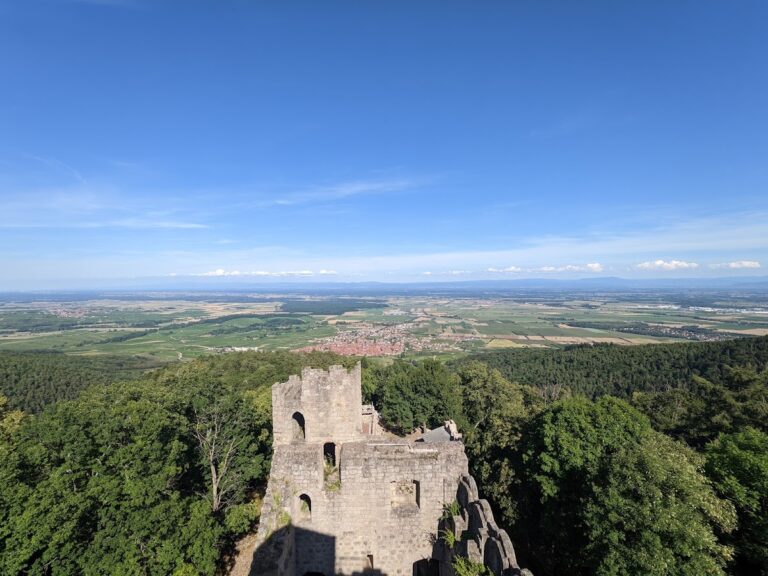
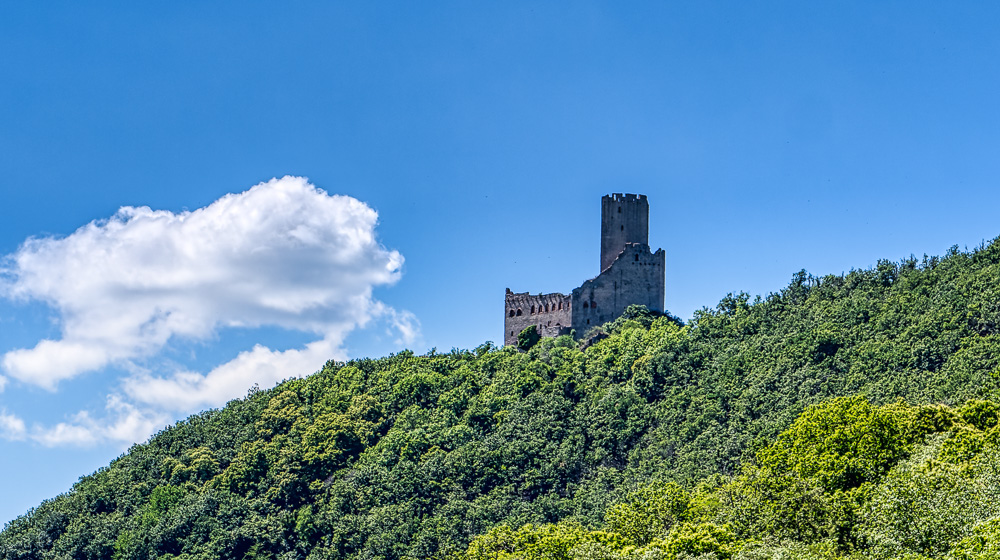
Ortenbourg Castle, also known as Château de l’Ortenbourg, is a medieval hilltop fortress in France above Scherwiller, overlooking the entrance to the Villé Valley. Its surviving form largely reflects the early Gothic rebuilding carried out by Rudolf of Habsburg in the thirteenth century and completed around 1265. The castle occupied a strategic position above routes leading toward the Upper Rhine Plain and remained involved in regional conflicts, changing ownership, and military occupations for centuries.
Origins and the Habsburg rebuilding
The beginnings of the first castle are uncertain. Excavations in 1970 uncovered materials that predate Rudolf of Habsburg’s reconstruction, while an imperial diploma issued by Otto III in 1000 mentions Count Werner of Ortenberg. The castle’s name derives from the Ortenberg family, which had been established at Scherwiller since the tenth century.
Werner of Ortenberg and Hymeldrud had two children, Berlinde and Valmar. Valmar inherited the lordship and married Heilicha. Their daughter Adelaide married Count Lutold of Achalm, who died without children in 1098. Adelaide died in 1120, bringing the Ortenberg line to an end, after which the lordship passed to the Count of Hohenberg.
Around the middle of the thirteenth century, the Count of Hohenberg granted the lordship to Rudolf of Habsburg, who had married his sister. Rudolf enlarged the rocky platform, raised the ground level, and almost entirely rebuilt the castle. Work was interrupted in 1261 during the conflict between Bishop Walter of Geroldseck and Strasbourg, but the fortress was completed around 1265 and was habitable by then. Rudolf, a thirteenth-century Habsburg ruler who became King of the Romans in 1273, thereby created the early Gothic military complex that forms the core of the surviving ruins.
Conflict and changing lordship
After Rudolf’s death in 1291, the Alsatian landvogt Otto von Ochsenstein opposed the election of Albert of Habsburg and supported Adolf of Nassau. A landvogt was a high territorial official who exercised administrative and judicial authority for a ruler. In 1293, Albert entrusted Ortenbourg Castle to Bishop Conrad of Lichtenberg, while Otto besieged it from the neighboring castle of Ramstein on Adolf’s behalf.
The Austrian defenders capitulated after three weeks. Later negotiations awarded the lordship to Albert II of Hohenberg rather than to either the bishop or Albert of Habsburg, although the castle eventually returned to Habsburg control. In 1314, after Habsburg financial difficulties following the war with the Swiss, the castle and the village of Scherwiller were sold to the Müllenheim family for 3,000 marks.
Lorraine troops damaged the castle in 1374 during Jean I of Lorraine’s conflict with the Müllenheim family and his efforts to protect himself from mercenary companies. During the fifteenth century, several co-owners disputed control of the site. The castle later deteriorated into a base for robbers who held travelers for ransom.
The Burgundian seizure and later recovery
In 1470, Peter of Hagenbach, the Alsatian landvogt of Charles the Bold of Burgundy, seized the castle from the Müllenheim family. The defenders surrendered without resistance because the reinforcements they expected had not arrived. An investigation in 1471 concluded that ten or twelve adequately supplied men could defend the site, and that the upper castle and donjon could continue to resist even if the lower bailey fell.
The bishop and the city of Strasbourg later recovered the fortress, with the retaking dated to 1474. The lordship was subsequently renovated and modernized. Dissatisfied inhabitants, together with the bishop and Strasbourg, then took back the castle and restored it to its former owners. Nicolas of Bollwiller acquired the property in 1551, and a castellan serving him was living there in 1562.
Destruction, restoration, and protection
During the Thirty Years’ War, a seventeenth-century conflict that brought Swedish forces into Upper Alsace, the castle was burned and partly destroyed in 1633. The House of Choiseul owned it from 1710 until the French Revolution.
Baron Philippe-Gaétan Mathieu de Faviers bought the castle in 1806 and undertook major restoration work. Ownership later passed to the town of Scherwiller, which continued maintenance from 1966 with help from various associations. The ruins were classified as a French monument historique, a protected historic monument, in 1924. The neighboring castle of Ramstein received the same protection.
Remains
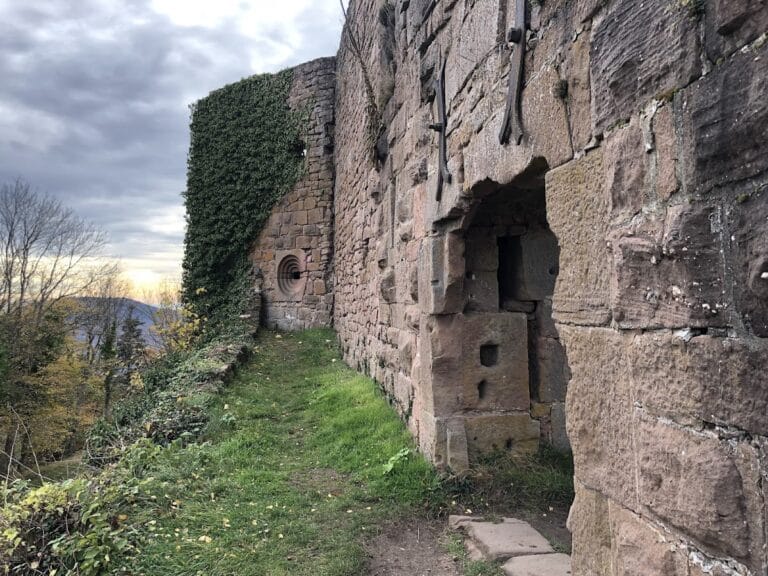
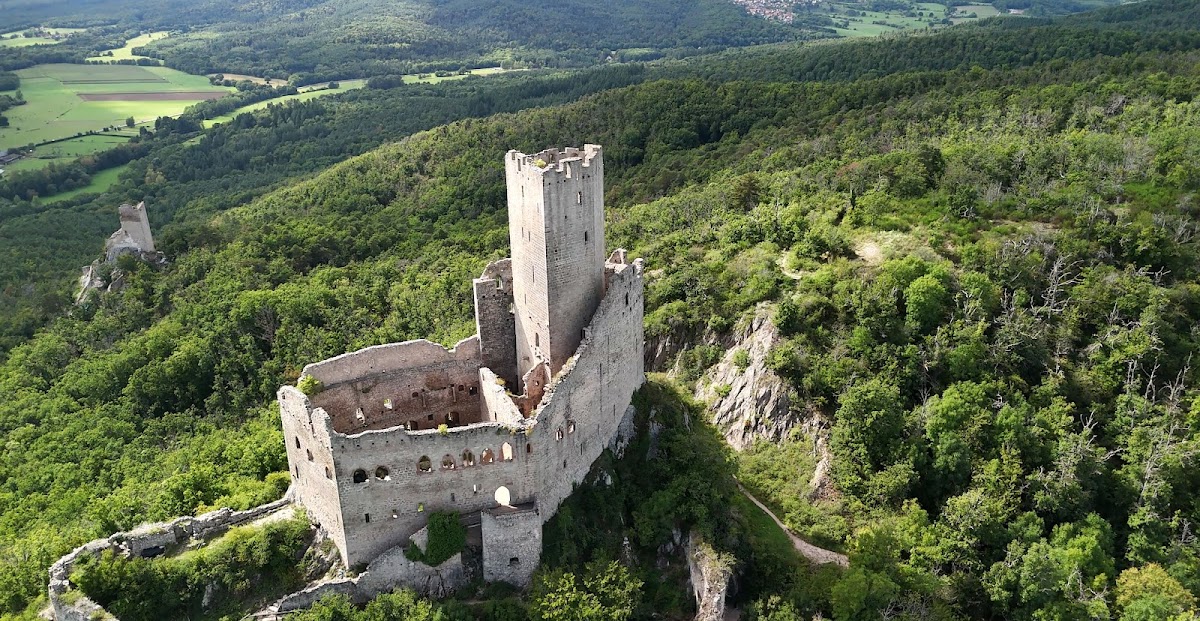
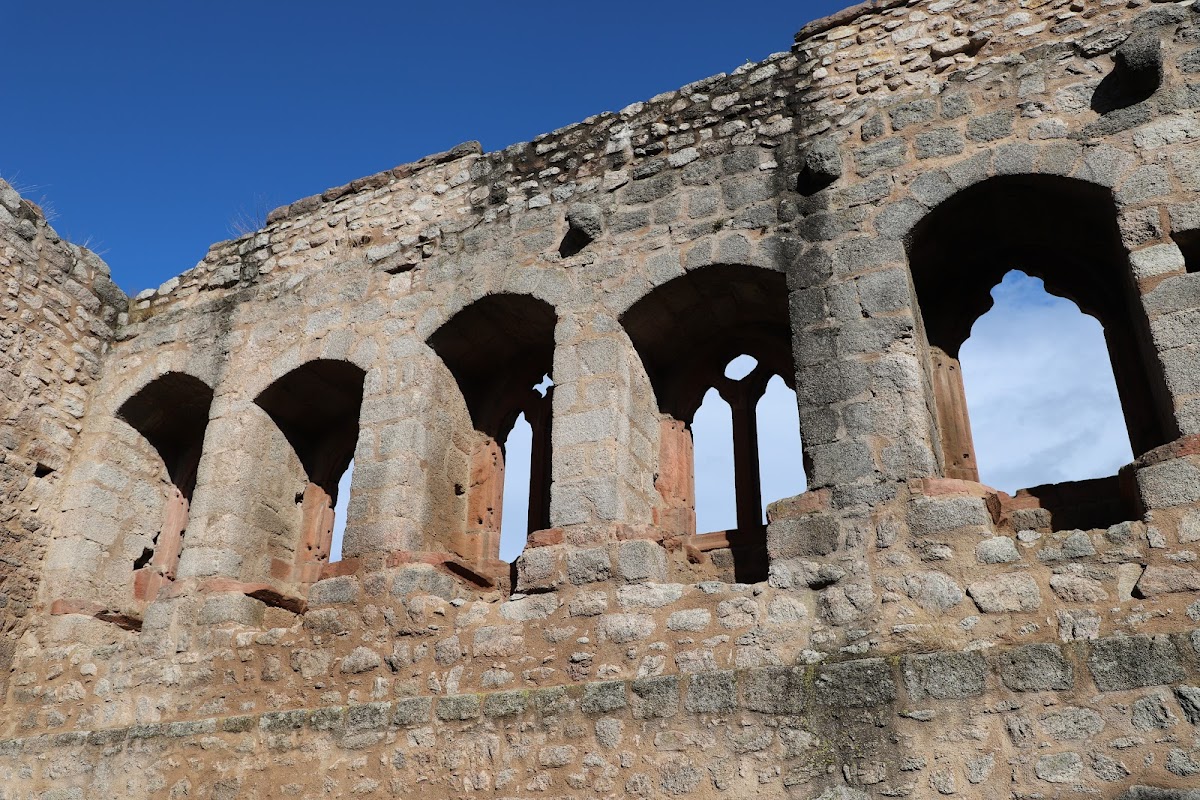
The fortress stands at approximately 437 to 440 metres above sea level on a granite outcrop at the eastern edge of the Vosges. It occupies a rocky spur separated from the main mountain mass by a deep neck ditch, while another large ditch divides the castle from the rest of the mountain. The surviving buildings are mainly constructed from smooth, pale granite, with red sandstone around the windows. The position overlooks Scherwiller and the entrance to the Villé Valley, while also controlling the exits of the Weiler and Lebert valleys toward the Upper Rhine Plain.
Upper fortress
Donjon
The exposed pentagonal donjon, the castle’s principal fortified tower, was built around 1265. It rises approximately 30 to 32 metres immediately behind the defensive curtain wall and above the ditch. Its position forms part of the castle’s most strongly defended upper works.
Mantle wall
The mantle wall, a high defensive wall protecting the main castle, follows a multi-angled plan and rises approximately 17 to 18 metres. It contains five defensive levels. Tall arrow slits pierce the first three levels, while the fourth carried a hoarding, a projecting wooden gallery from which defenders could attack people below. The upper level was crenellated.
Seigneurial residence and cistern
Behind the main defensive works stands a two-storey residential and representational building, the seigneurial residence. Its partly broken early Gothic tracery windows open toward the plain, and Gothic windows survive in views from both outside and inside the structure. A large cistern between the residence and the donjon supplied water for the castle’s inhabitants.
Outer works and military equipment
Outer bailey and entrance
The eastern and southern outer bailey retains sections of its enclosing wall and its outer gate. The entrance to the castle also survives, together with access stairs leading to the second level. These elements connect the outer defenses with the elevated core of the fortress.
Stores and domestic installations
An inventory from 1471 gives a picture of provisions held at the castle. It lists a recently slaughtered cow, two salted pigs, a barrel of herrings, two half-foudres of flour, and substantial quantities of wine. Poultry houses probably formed part of the domestic complex.
Artillery
The castle’s later medieval armament included eight crossbows and twelve artillery pieces. A subsequent record mentions two culverins, early gunpowder weapons, together with the gunpowder needed to operate them. A fragment of a fifteenth-century culverin bearing the arms of Strasbourg was found at the site.
Natural setting
The surrounding stunted oak forests contain rare plants adapted to warm, dry conditions, including gold asters and large stonecrops. The forested setting is protected as a natural area alongside the historic remains.