Humanist Library of Sélestat: A Library of Renaissance Books and Archives
Site at a Glance
- Popularity
- Medium
- Country
- France
- Primary era
- Modern
- Eras represented
- Modern
- Civilizations
- French, German
- Site type
- Civic
- Remains
- Library
On this page12 sections
History
The Humanist Library of Sélestat is a library in France, housed in a nineteenth-century former grain market designed in the neo-Romanesque style. Its collections preserve a long tradition of learning in the town, including the personal library of Renaissance humanist Beatus Rhenanus, which survived almost intact.
The school and parish library
Sélestat’s Latin school was established in 1441, when the city appointed Ludwig Dringenberg, a schoolmaster from Westphalia, to lead it. A Latin school centered on the study of Latin, and Dringenberg also introduced humanist teaching, an approach shaped by the Renaissance study of classical texts and languages. Later heads included Kraft Hofman from 1477 to 1501, Hieronymus Gebwiler from 1501 to 1509, and Hans Sapidus from 1510 to 1525.
The library’s history began in 1452, when Johannes von Westhuss, rector of Sélestat’s parish church, gave books to the collection. Gifts from former pupils helped it grow, and Dringenberg also donated books to the school shortly before his death. Other donors included humanist educator Jacques Wimpfeling and Martin Ergersheim, parish priest from 1503 to 1518. The books supported both church services and teaching.
Beatus Rhenanus’s bequest
Beatus Rhenanus, born in Sélestat in 1485, studied at the Latin school before pursuing a career as a scholar, proofreader, and editor. He assembled his personal library during his studies and literary life in places including Sélestat, Strasbourg, Basel, and Paris. Some books were bought with money inherited from his father. When Rhenanus died in July 1547, he left his library to his hometown.
Rhenanus’s books were first kept alongside the municipal archives in the city chancery, then transferred to the customs house. In September 1757, they were moved to Saint-Georges church and joined the parish collection.
From church collections to public library
In 1840, the parish and Rhenanus collections moved to the second floor of the town hall, where they formed a public reading library. As the space became inadequate, the city decided in 1888 to add a storey to the former grain market. The library moved into the building in May 1889.
The municipal museum and archives joined the library in 1909, while the market continued to operate on the ground floor. Display cases were installed in the main hall in 1958 to present notable books. Purchases and gifts continued to enlarge the collections during the nineteenth and twentieth centuries.
A modern collections centre
When an intercommunal media library opened in 1997, Sélestat’s public-reading service moved there. The Humanist Library could then concentrate on preserving and presenting its collections. It also holds part of the town’s municipal archives, and the city owns the Beatus Rhenanus collection.
On 26 May 2011, Rhenanus’s collection was inscribed on UNESCO’s Memory of the World Register, which recognizes documentary heritage considered important to world history and culture. The inscription recognized the collection’s exceptional and irreplaceable character, including the near-complete survival of a major humanist’s personal library.
The city decided in 2014 to undertake a major redevelopment to improve collection preservation and public facilities. During the work, eight old timber-framed houses were demolished in 2016. The Society for the Conservation of Historic Monuments in Alsace criticized the demolitions as inconsistent with a project focused on heritage.
Remains
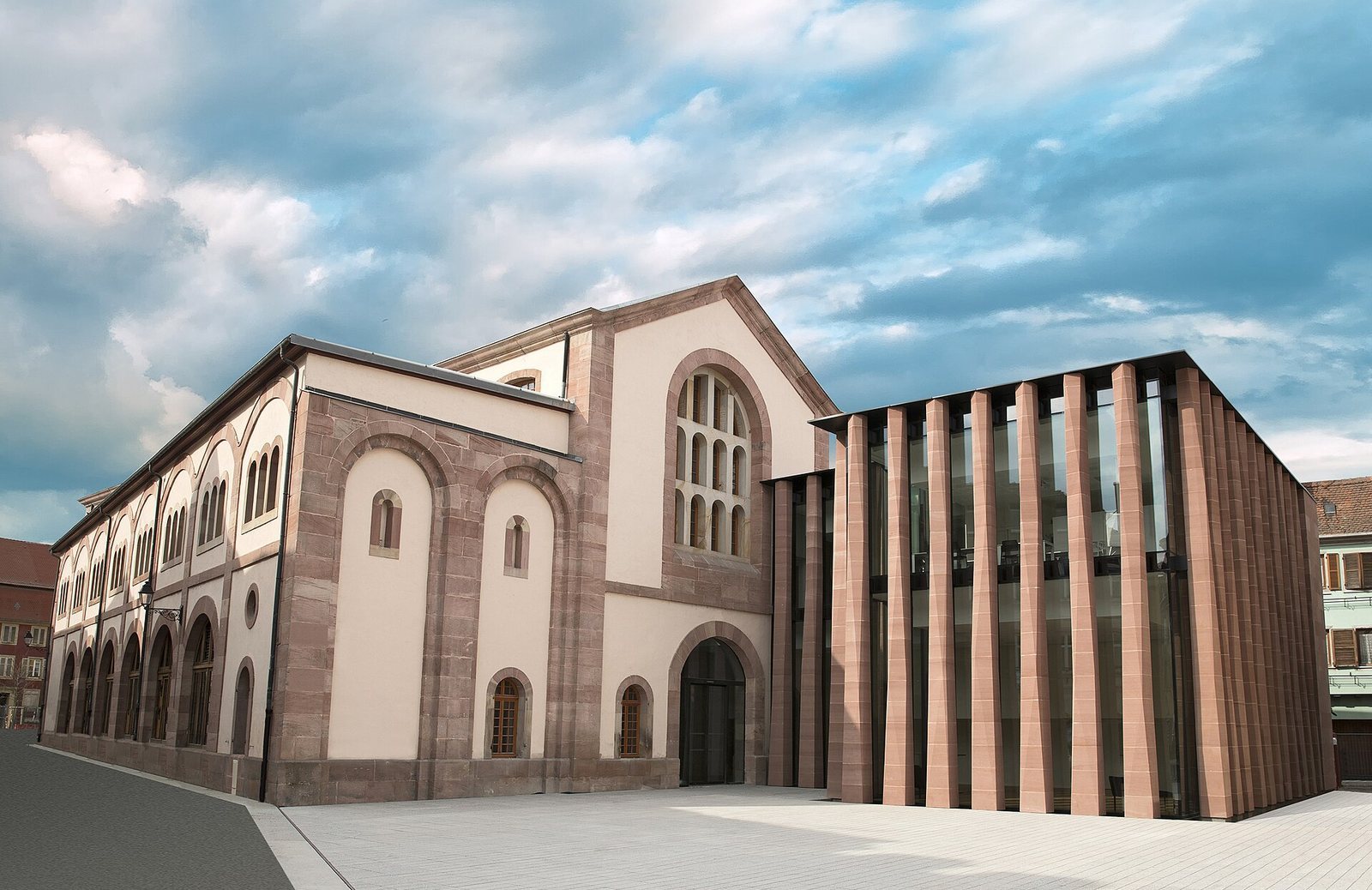
The library occupies a former covered grain market in Sélestat’s historic centre, near the Gothic church of Saint-Georges and the Romanesque church of Sainte-Foy. The site covers about 2,500 square metres. Its original market building and a later extension together accommodate exhibition spaces and the collections.
Market building and extension
The former grain market
Architect Gustave Klotz built the covered market between 1843 and 1845 on the site of the former customs house. Its design adapts forms associated with Romanesque buildings and evokes a church nave. A mosaic by César Winterhalter has decorated the west façade above the entrance since 1907. Its central inscription, ‘STADTBIBLIOTHEK MUSEUM,’ is flanked by Sélestat’s heraldic lion on the right and the German imperial eagle on the left.
The 2018 extension
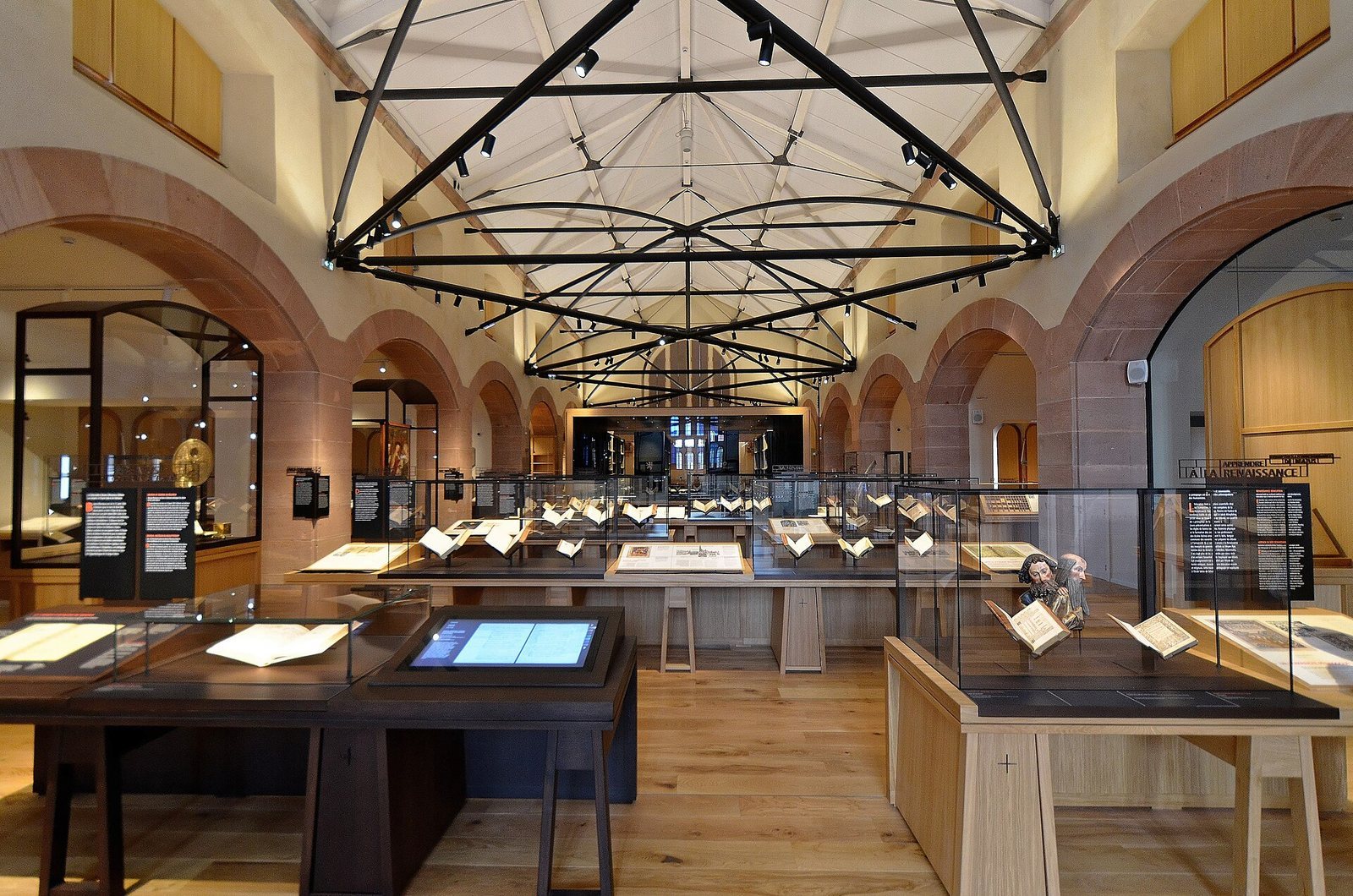
The redevelopment added an extension framed by 25 pillars of Vosges sandstone, intended to suggest the form of a book, and fitted out the basement. The added space doubled the site’s floor area. A vault-shaped metal frame reinforces the building while leaving its original structure visible, and the new entrance hall opens views into the earlier interior arrangement. The work retained the market’s neo-Romanesque appearance.
A permanent exhibition occupies the first floor and is arranged for both general audiences and specialists. Interactive digital displays, including a digital table, offer ways to explore the collections.
Books, manuscripts, and collections
The Beatus Rhenanus collection
Rhenanus’s personal library consisted of hundreds of leather-bound volumes. It includes 423 volumes containing 1,287 works, 41 manuscripts in various compilations, 33 further old manuscripts, and 255 autograph letters. The bequest comprised 1,686 documents overall. Its contents include Rhenanus’s school notebooks, lecture notes, exercises, and annotated books, as well as carefully made bindings.
The collection contains Latin and Greek works, some Hebrew texts, and books in German, Italian, and French. It includes Paris editions from the first quarter of the sixteenth century, works printed by Aldus Manutius and Johann Froben, and books and manuscripts inherited from Rhenanus’s teacher Jean Cuno.
Other holdings
The library holds about 70,000 books and other documents, as well as art collections. Among its holdings are 460 manuscripts and 550 incunabula, books printed in Europe before 1501. Printed works include 2,200 sixteenth-century items, 1,600 from the seventeenth century, and 2,600 from the eighteenth century. Many works have been digitized, and the broader collections include maps, prints, coins, and medals.
Notable items include Rhenanus’s fifteenth-century school notebook, a book of miracles associated with Sainte-Foy, a seventh-century Merovingian lectionary, a book containing readings for religious services, and a twelfth-century prayer book. The Merovingian lectionary is described as the oldest surviving book in Alsace. The library also holds a bust of printer Johannes Mentelin and works by Sélestat-associated humanists including Jacques Wimpfeling, Martin Butzer, Jakob Spiegel, Hieronymus Gebwiler, Hans Sapidus, and Jakob Taurellus.