St Benet’s Abbey: A Medieval Benedictine Monastery in Norfolk
Site at a Glance
- Rating
- 4.6
- Popularity
- Low
- Country
- United Kingdom
- Primary era
- Medieval
- External website
- Open
- Eras represented
- Medieval, Early Modern
- Civilizations
- Anglo-Saxon, British, English
- Site type
- Religious
- Remains
- Monastery
On this page12 sections
History
St Benet’s Abbey is a medieval Benedictine monastery at Ludham in the United Kingdom, on Cow Holm beside the River Bure in the Norfolk Broads. Its foundation is uncertain, but tradition connects the site with a ninth-century monastery where the hermit Suneman was martyred by the Danes. Another tradition holds that this earlier community was destroyed by Viking incursions around 870. The monastery was rebuilt near the earlier site by the monk Wulfric toward the end of the tenth century.
Foundation and early development
During the reign of King Canute in the early eleventh century, the monastery was raised to abbey status or substantially endowed. By about 1022, Canute had granted it the manors of Horning, Ludham, and Neatishead. The first abbot, Elsinus, began replacing the original wooden church with a stone building, despite the lack of suitable building stone nearby. His successor, Thurstan, completed the work. Thurstan was reportedly buried before the altar in the chapel of St Michael after his death in 1064.
St Benet’s early benefactors included Earl Ralf II of East Anglia and Edith Swannesha, together with other leading aristocratic donors. In the early eleventh century, some members of the community were transferred under the authority of the Bishop of Elmham to help establish the Benedictine monastery that later became Bury St Edmunds Abbey. They took half of St Benet’s furniture, books, sacred vestments, and other worship items. Their prior, Ufi, became Bury’s first abbot, while another former St Benet monk, Leofstan, succeeded him from 1044 to 1065.
By 1065, St Benet’s had established a cell, a smaller dependent religious house governed by a larger monastery, which later became Rumburgh Priory in Suffolk. By the late thirteenth century, the abbey held property in 76 parishes and was regarded as one of the wealthiest monasteries in East Anglia.
Norman rule and royal connections
During the Norman Conquest, Abbot Aelfwold supported King Harold Godwinson. After the Norman victory, he was temporarily outlawed and exiled to Denmark. The abbey’s estates were harassed and encroached upon by neighbouring landowners and tenants of Roger Bigod. Aelfwold later returned and resumed the abbacy, dying at St Benet’s on 14 November 1089. Ralph succeeded him, followed by Richard in 1101.
Under Abbot Richard, the church’s western tower was completed and two large bells were installed. During the reign of Henry II, tenants dismantled and removed the abbey’s timber church at Ranworth. A royal command required them to return it. The abbey also had military responsibilities. Under King Harold, its abbot was placed in charge of defending the East Anglian coast, and the monastery organized a shipsoke, an administrative grouping of local hundreds responsible for supplying a fighting ship and related military service. The abbey may have supplied Harold’s ship.
St Benet’s maintained close connections with the royal court during the twelfth century. Conrad, formerly prior of Christ Church Cathedral Priory in Canterbury and confessor to Henry I, became abbot in 1126. He brought two chasubles and a book said to have belonged to St Dunstan, together with a chalice made by Dunstan. These objects were preserved at St Benet’s as relics.
From 1146 to 1150, Hugh, a relative of King Stephen and of other French and English aristocrats, served as abbot through royal influence, with papal confirmation in 1147. His appointment involved the deposition of the previous abbot, Daniel, who later returned to office after Hugh’s removal. In 1183, Pope Lucius III granted St Benet’s exemption from certain consequences of interdicts and feudal charges. In 1253, Henry III granted the abbey the revenues of two fairs held in nearby settlements.
Floods, conflict, and local influence
The abbey’s position beside the waterways exposed it to storms and flooding. During the thirteenth and fourteenth centuries, breaches in the coastal dunes allowed the sea to reach the site. In the flood of 1287, horses had to be moved from the stables to the higher ground of the church nave. A royal licence in 1327 authorized the enclosure of the abbey by a battlemented wall.
The abbey’s tenants paid some rents in goods or services. These included cocks, beer, honey, pepper, cumin, and incense. Churches at Stalham and Norwich also supplied annual incense. St Benet’s promoted local religious cults, including veneration of the hermit Wulfric, or Wulfey, who was believed to have lived at the site before the monastery’s foundation. During the twelfth and thirteenth centuries, the abbey also tried to establish a cult of St Margaret of Holm, a girl traditionally said to have been killed near Hoveton St John on 22 May 1170, but this cult made little progress.
The monastery was drawn into several late medieval conflicts. During the Peasants’ Revolt of 1381, rebels attacked St Benet’s because they believed that the Bishop of Norwich had taken refuge there. Abbot William of Methelwold calmed them and later did not testify against rebels from Norwich. A further plan to seize the abbey as a stronghold was discovered before it could take place in 1382. In 1442, a dispute with Norwich over the collection of the city’s taxes escalated into armed fighting. Forces from the abbey defeated those of Norwich and destroyed several mills around the city, although legal disputes continued for decades.
Sir John Fastolf, the historical figure associated with Shakespeare’s Falstaff, was a major benefactor of St Benet’s. He was buried beside his wife, Millicent, in December 1459, in a new aisle that he had built on the south side of the abbey church.
Reformation and later history
During the early sixteenth century, the abbey came into conflict with the Bishop of Norwich over the conduct of the monks. In 1536, the last abbot, William Rugg, was appointed Bishop of Norwich. During the Reformation, the abbey was united with the newly founded Church of England, and its possessions were assigned to the Diocese of Norwich. An Act of Parliament allowed a prior and twelve monks to remain. St Benet’s is consequently described as the only English abbey to have escaped formal dissolution and as arguably the oldest Anglican Order of St Benedict in England.
The community had collapsed by 1545, when the monks abandoned the site. The lands were then leased to local farmers to pay the monastery’s debts, and most of the abbey buildings were demolished. The ruins remained in the ownership of the Diocese of Norwich, while the authority associated with the abbacy declined and successive bishops saw little reason to use the title.
Since 1939, the Bishops of Norwich have again used the title Abbot of St Benet’s. The bishop appoints a local vicar as prior, and the prior appoints twelve lay monks. On the first Sunday of August, the bishop arrives by wherry, a traditional shallow-draft sailing vessel of the Norfolk Broads, meets pilgrims, and conducts an Anglican service following an interpretation of the Rule of Saint Benedict among the ruins. An oak cross made from timber from the royal estate at Sandringham was erected at the former high altar in 1987, and the annual service is held at the altar beneath it.
St Benet’s became one of Britain’s first scheduled ancient monuments in 1925. A scheduled ancient monument is a legally protected archaeological or historical site designated for its national importance. The main part of the site was acquired by the Crown Estate in 1993 and sold to the Norfolk Archaeological Trust in 2002. The Trust acquired the gatehouse and mill from the Diocese of Norwich in 2004, while the church ruins remained diocesan property and were leased to the Trust for 199 years. Conservation repairs, scientific studies, graffiti recording, wildlife and molehill surveys, maintenance, and the creation of access paths have helped preserve and interpret the surviving remains.
Remains
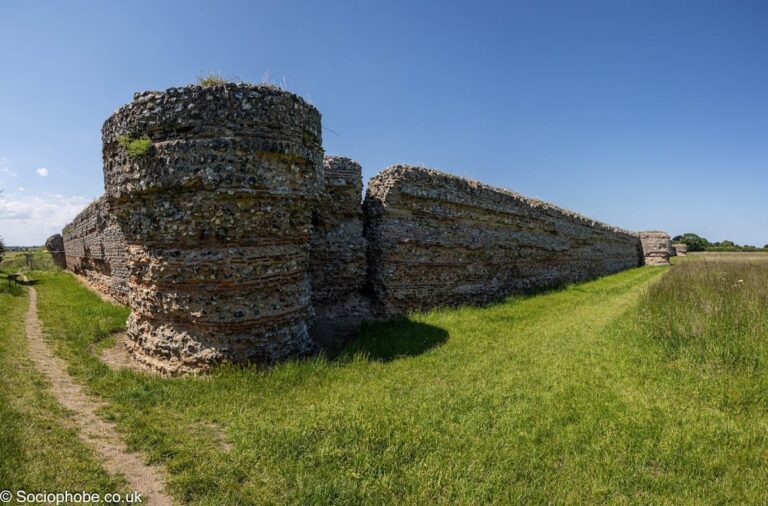
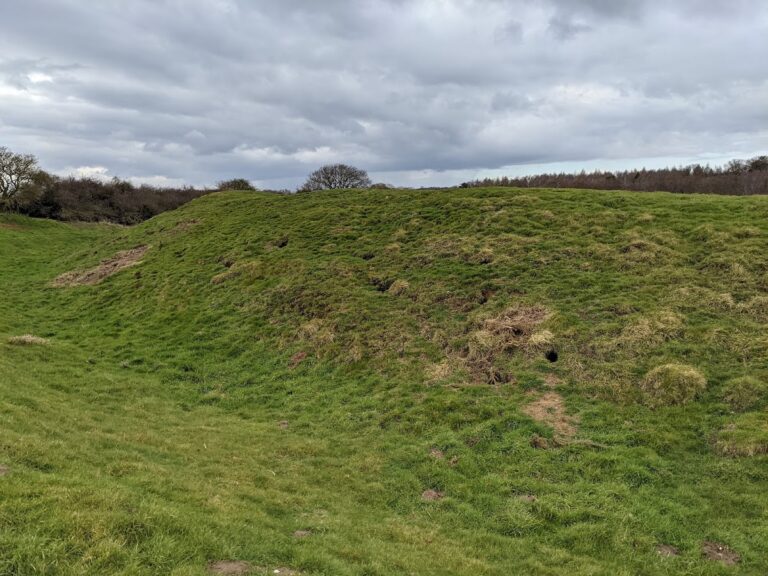
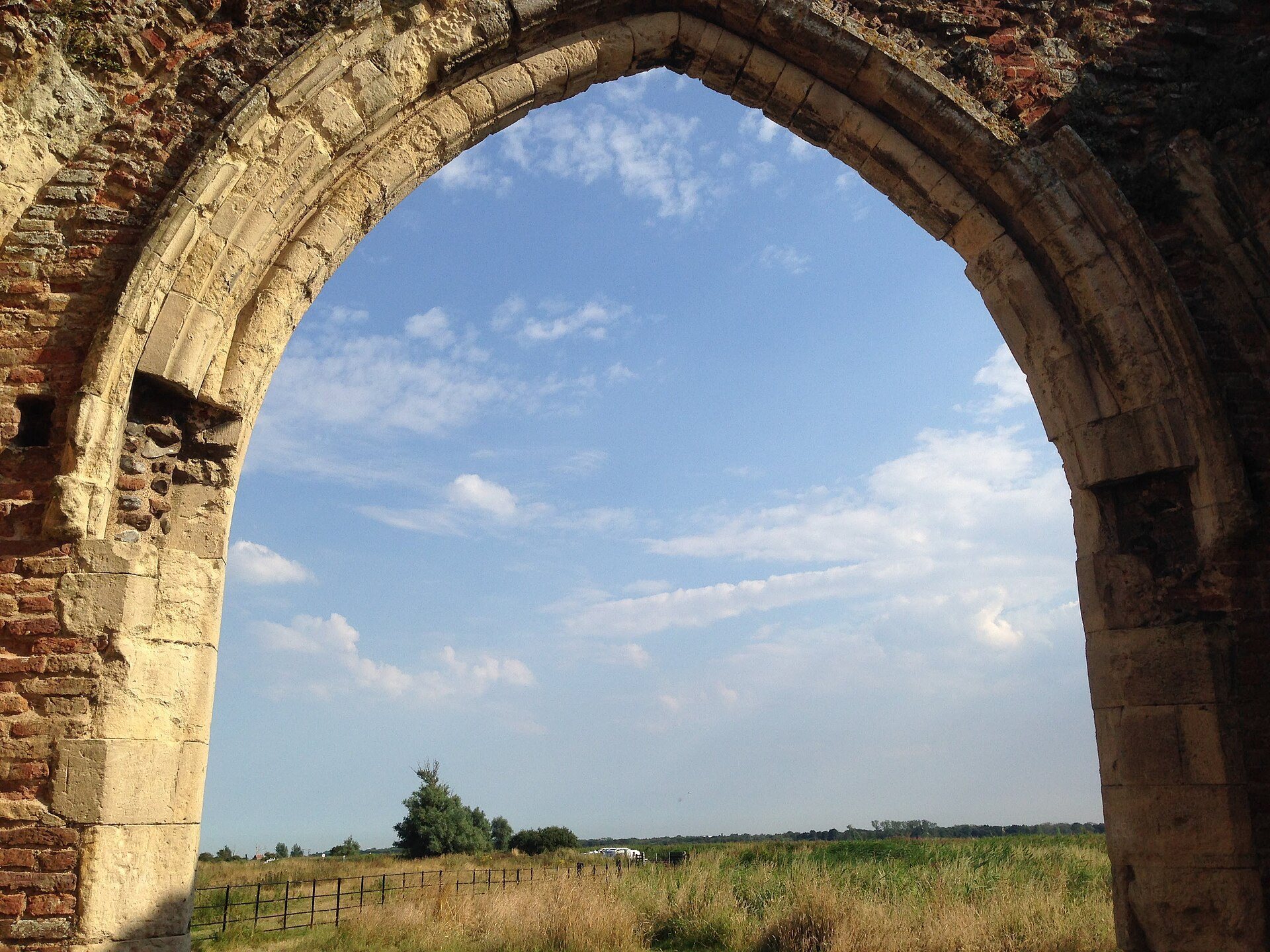
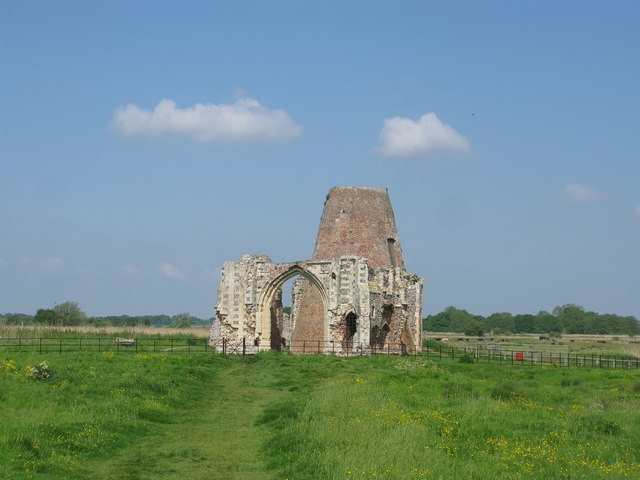
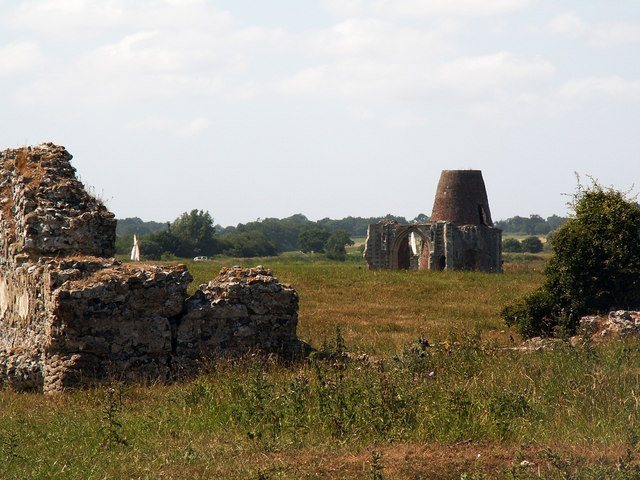
The surviving site occupies agricultural land on Cow Holm beside the River Bure. Its principal remains are the medieval gatehouse, the lower walls of the church sanctuary and other church ruins, the remains of the former enclosing wall, and surrounding earthworks. The gatehouse and mill preserve evidence of a later transformation in which a monastic entrance building was adapted for agricultural drainage.
Church and enclosure
Abbey church
The abbey church began as a wooden structure and was replaced in stone under Abbots Elsinus and Thurstan. The surviving remains include the lower walls of the sanctuary and other fragments of the church. The building included a chapel dedicated to St Michael, where Thurstan was reportedly buried before the altar. Abbot Richard later completed the western tower and installed two large bells. Sir John Fastolf’s south aisle contained his burial place beside that of Millicent, his wife. The position of the former high altar is marked by the oak cross erected in 1987, and the altar area remains the setting for the annual Anglican service.
Enclosing wall
The abbey was enclosed by a battlemented defensive wall authorized under royal licence in 1327. Only isolated traces of this boundary survive among the earthworks. These remains form part of the wider archaeological layout around the church and gatehouse.
Gatehouse and drainage mill
Medieval gatehouse
The gatehouse is a surviving medieval building and a Grade I listed building. Most of the other monastic structures were demolished after the Reformation, leaving the gatehouse as one of the principal standing remains of the abbey complex.
Wind-powered drainage mill
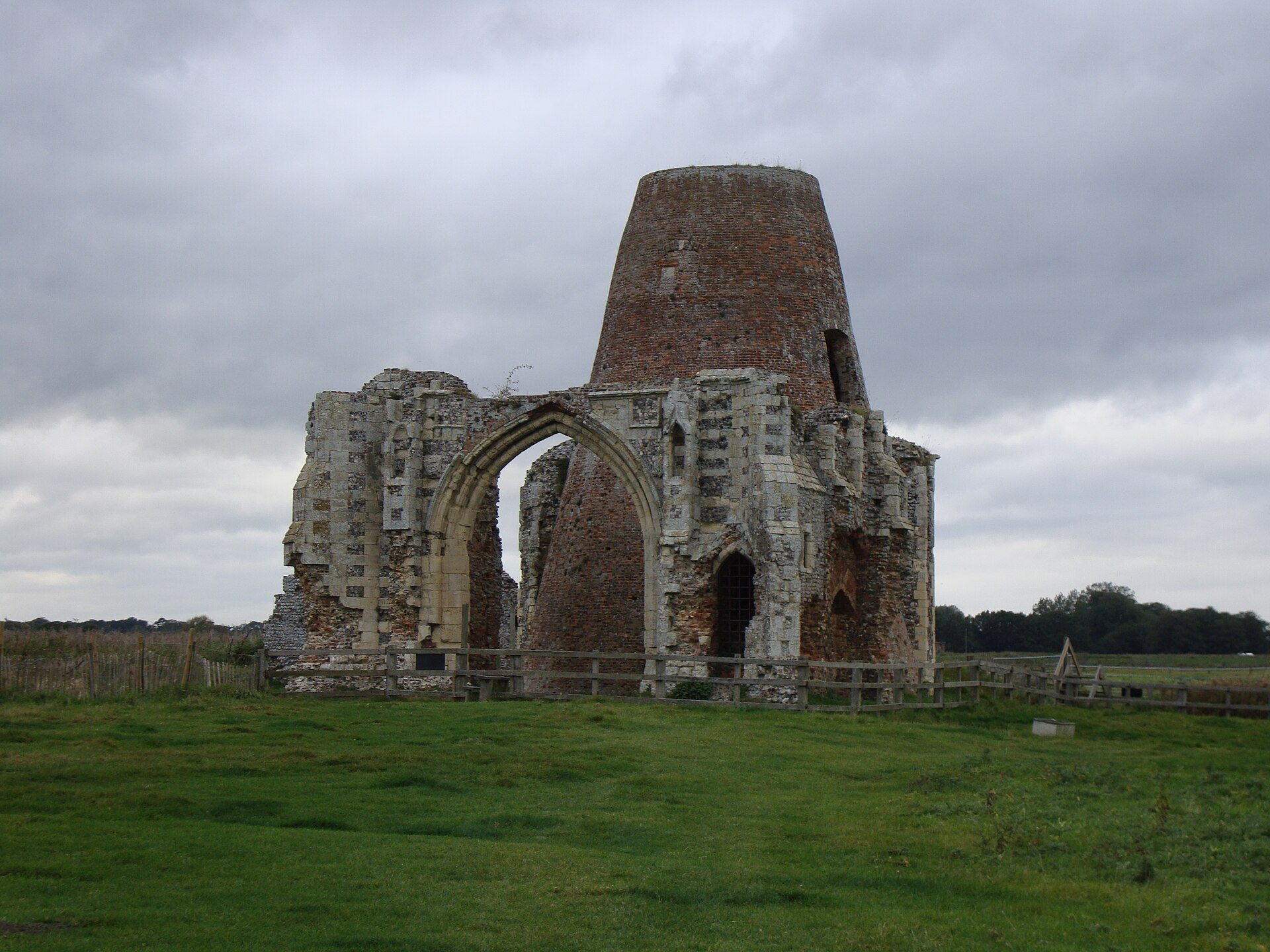
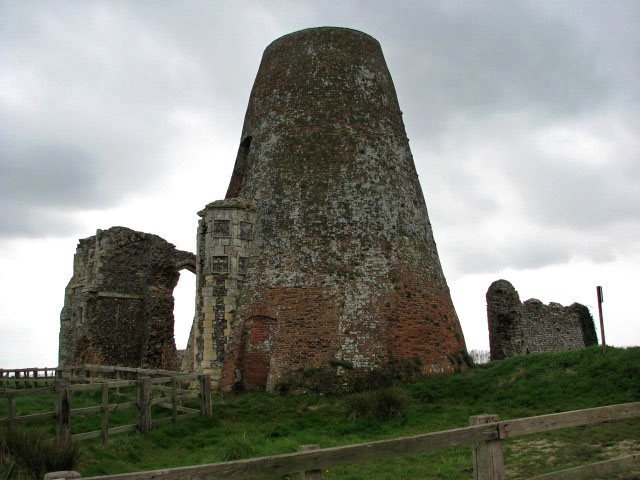
In the eighteenth century, a farmer installed a windmill inside the gatehouse and later converted it into a wind-powered drainage mill. The work required removal of the gatehouse’s second floor, and by 1813 the upper floor had been removed to allow the sails to turn. The sails survived until at least 1854 but had been destroyed by 1863.
The former drainage mechanism is now ruined and is a Grade II* listed building. Its surviving fabric includes a brick-built mill body incorporated into the gatehouse ruins. The remains preserve the later agricultural reuse of the medieval building, while the surrounding church ruins and earthworks retain the layout of the former monastery.