Ramsey Abbey: A Benedictine Monastery and Medieval Centre of Learning
Site at a Glance
- Rating
- 4.3
- Popularity
- Low
- Country
- United Kingdom
- Primary era
- Medieval
- External website
- Open
- Eras represented
- Medieval, Modern
- Civilizations
- British, English
- Site type
- Religious
- Remains
- Monastery
On this page16 sections
History
Ramsey Abbey is a former Benedictine abbey in Ramsey, United Kingdom, founded in 969 during the mid-tenth-century English Benedictine reform. This movement sought to restore stricter monastic discipline and reorganise monasteries according to the Rule of Saint Benedict. The foundation formed part of a wider revival that also included the refoundation of Ely and Peterborough.
Foundation and early community
Oswald, Bishop of Worcester, founded the abbey on land given by Æthelwine, an Anglo-Saxon ealdorman, or senior royal official and regional governor, of East Anglia. Before the foundation, Æthelwine had established a wooden chapel for three monks. He endowed the new monastery with several properties, including an estate at Bodsey and Houghton Mill.
The first community comprised a prior and twelve monks sent from Westbury-on-Trym. Eadnoth became the first abbot. The monastery stood on a marsh island or peninsula, and a wooden causeway linked it with the surrounding dry land. The first stone church replaced the earlier chapel and was built over approximately five years from 969. It was consecrated in 974, but a tower later collapsed, requiring the church to be rebuilt. Oswald consecrated the reconstructed building in 991.
Ramsey also became an important centre of education in its early years. Abbo of Fleury, a Frankish Benedictine scholar and later abbot of Fleury, stayed at the abbey from 985 to 987 at Oswald’s invitation. He established the abbey school and wrote Passio S. Eadmundi and Quaestiones grammaticales for his pupils there.
Relics, lands, and medieval influence
Relics of Saint Ivo were brought to Ramsey in 1001. Saint Ivo was traditionally identified as a Persian bishop who came to England as a hermit. About twenty-five years later, during the reign of Canute the Great, the relics of Saint Felix of Burgundy were transferred to the abbey. His remains were publicly displayed as relics, helping to make Ramsey a pilgrimage centre.
The abbey acquired extensive estates, traditionally reckoned at 387 hides, including 200 hides in Huntingdonshire. It also paid Peterborough Abbey 4,000 eels each year for access to the limestone quarries at Barnack. In 1110, Henry I granted Ramsey the privilege of holding an annual trading fair. The abbey’s economic resources supported its religious, educational, and building activities.
During the later Middle Ages, Ramsey became an international centre of Hebrew scholarship. Its abbots ranked third in parliamentary precedence after the abbots of Glastonbury and St Albans. The abbot held a seat in the House of Lords as Baron of Broughton.
Rebuilding and civil war
Abbot Reginald began rebuilding the monastery in 1116. A larger Romanesque abbey church was consecrated in 1123. Romanesque architecture used massive masonry, rounded arches, and relatively small openings, and the new church represented a major expansion of the early foundation.
Ramsey was drawn into the civil war of 1135 to 1154, a conflict over the English succession during the reign of King Stephen. Geoffrey de Mandeville, first Earl of Essex, expelled the monks and occupied the abbey as a fortress. In 1143 he caused extensive damage and destruction. The community later rebuilt the abbey, beginning another period of prosperity.
The monastery maintained a dispute lasting three centuries with the bishops of Ely over the manors of Chatteris and Somersham. Its period of prosperity ended with the plague epidemic of 1349. During the fifteenth century, brick production became the abbey’s principal economic basis.
Dissolution and post-monastic transformation
Henry VIII’s Dissolution of the Monasteries, the Tudor government’s suppression and confiscation of England’s monastic institutions during the 1530s, brought Ramsey’s monastic life to an end. The community numbered 34 monks when the abbey was suppressed. Its last abbot, John Wardeboys, accepted the dissolution and received a royal pension.
The Crown sold the abbey lands in 1540 to Sir Richard Williams, also known as Richard Cromwell. The sale began the dismantling of the complex, with its building stone reused or sold. Stone from Ramsey was used at Gonville and Caius College, King’s College, and Trinity College in Cambridge, at the tower of St Mary the Virgin in Godmanchester, and later at the tower of Ramsey’s parish church of St Thomas à Becket.
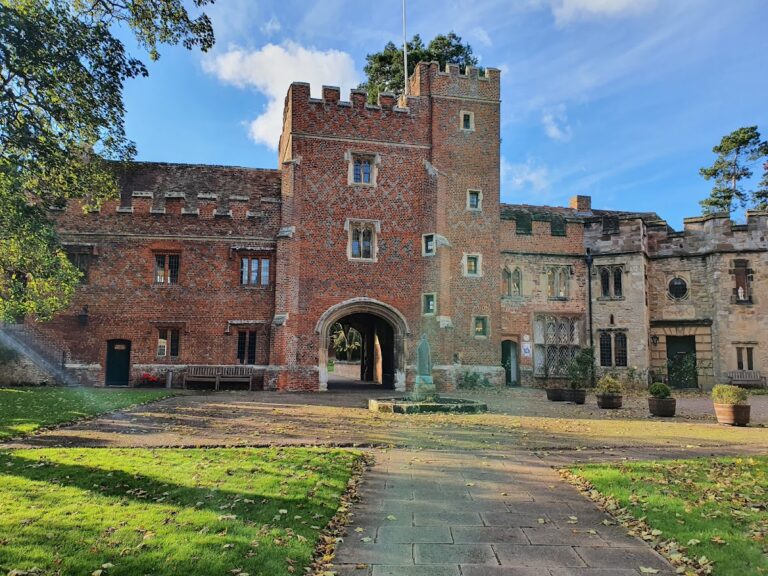
Sir Henry Williams, Sir Richard’s son and heir, removed part of the abbey’s outer gatehouse and re-erected it as the principal gateway of Hinchingbrooke House, his winter residence. Around 1600, he built a house on the site of the abbey church, while surviving conventual buildings were adapted into a residence for the Cromwell family. Oliver Cromwell lived there from 1627.
The house passed to Coulson Fellowes in 1737 and remained with the Fellowes family. William Henry Fellowes enlarged it in 1804 to 1806 to designs by Sir John Soane, an English neoclassical architect. Edward Fellowes became the first Baron de Ramsey in 1889. In 1931, the family moved its principal seat to Abbots Ripton Hall.
The former abbey house was leased to Ramsey Abbey School for 99 years in 1937. In 1952, Major the Hon. Henry Rogers Broughton gave the gatehouse to the National Trust in memory of his wife, Diana Broughton. The abbey site is a scheduled monument, and its surviving buildings include Grade I and Grade II* listed structures. The gatehouse is in the care of the National Trust, while the former abbey house is associated with Abbey College, Ramsey.
Remains
Ramsey Abbey was established on Bodsey Island, a gravel island or peninsula traditionally associated with the name “Ram’s island.” Marshland or impassable fen surrounded it on three sides near the mouth of the Great Ouse. The surviving remains represent several stages of the former complex, including the abbey house, two gatehouse elements with different histories, the parish church of St Thomas à Becket, part of the medieval precinct wall, Bodsey House, and associated almshouses.
Abbey buildings and precinct
Abbey church and early foundations
The first stone church replaced Æthelwine’s wooden chapel. It had two roof towers: a smaller western tower that could be seen from a distance and a larger central tower carried on four columns and stabilised by connecting arches. After the central tower collapsed, the church was rebuilt and consecrated again in 991. This building remained in use until construction of the larger twelfth-century Romanesque church.
The later church formed part of a much larger Romanesque rebuilding consecrated in 1123. The church and most of the adjoining conventual buildings were dismantled after the Dissolution, and their stone was reused in buildings at Ramsey, Godmanchester, and Cambridge.
Ramsey Abbey House
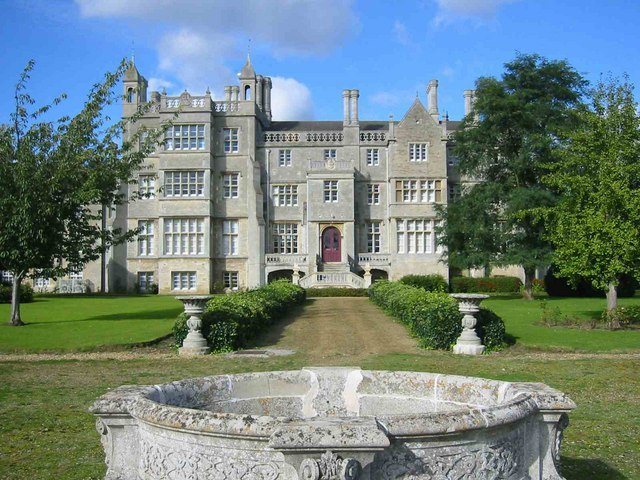
Ramsey Abbey House incorporates the basement of the abbey’s thirteenth-century Lady Chapel, a chapel dedicated to the Virgin Mary. Six bays of the chapel survive within the later building. The house also preserves the history of the post-monastic residence, first associated with Sir Henry Cromwell’s seventeenth-century home and later with the Fellowes family. William Henry Fellowes enlarged it between 1804 and 1806 to designs by Sir John Soane. It is now used by Abbey College, Ramsey.
Gatehouses and precinct wall
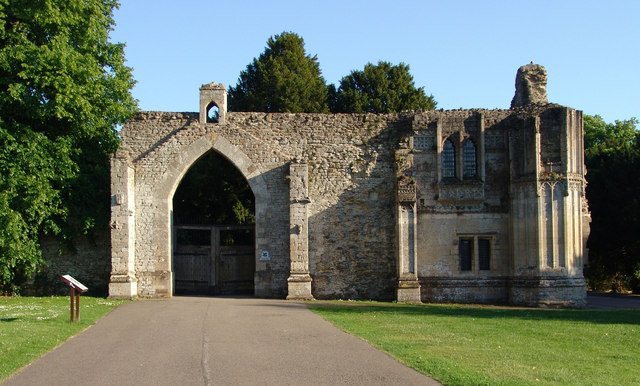
The surviving gatehouse is believed to have been an inner gatehouse. It includes an oriel window, a projecting window supported by brackets or corbels rather than rising directly from the ground, and now forms part of Abbey College.
The principal outer gatehouse followed a different history. Sir Henry Williams removed part of it and re-erected the structure at Hinchingbrooke House. A section of the medieval precinct wall also survives, preserving part of the boundary of the former monastic complex.
Parish and estate buildings
St Thomas à Becket
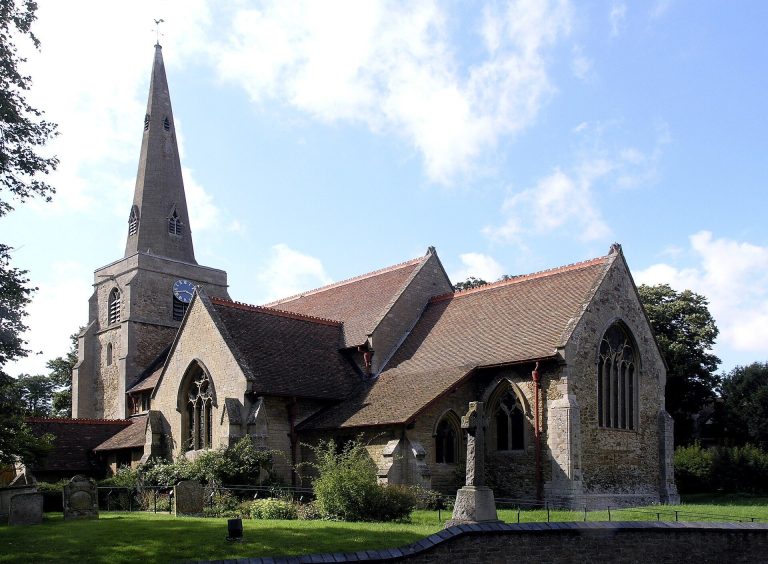
St Thomas à Becket was built around 1180 to 1190 as either the abbey’s hospitium, a monastic guesthouse or lodging building, or its infirmary, the part of a monastery intended for caring for the sick. The original structure consisted of an aisled hall with an eastern chapel, a northern vestry or vestibule, and southern lodgings for the warden. The vestry or vestibule and the warden’s lodgings were later demolished.
Around 1222, the former hospitium or infirmary was converted into a parish church for the growing settlement. The building survives as a Grade I listed church and preserves the form of one of the abbey’s buildings adapted to a wider community role.
Bodsey House and almshouses
The former Bodsey monastic grange survives as Bodsey House. A monastic grange was an agricultural estate operated by a monastery. Bodsey House is a Grade I listed building, and almshouses associated with the former abbey complex also survive.
Objects and manuscripts
Silver liturgical vessels
When Whittlesey Mere was drained, a thurible and an incense boat were recovered from the bed of the mere. A thurible is a vessel for burning incense during religious ceremonies, while an incense boat carries the incense used with it. Both objects are silver and are believed to have come from Ramsey Abbey, since one bears a ram’s-head motif. They are now held by the Victoria and Albert Museum.
Blocks of quarried stone were also found in the bed of Whittlesey Mere. They are conjectured to have fallen from a barge carrying stone to the abbey.
The Ramsey Psalter
The Ramsey Psalter, also called the Psalter of Oswald, is an illuminated Anglo-Saxon psalter dating from the last quarter of the tenth century. Its liturgical features suggest that it may have been intended for use at Ramsey Abbey or for Oswald’s personal use. The manuscript is now held by the British Library as Harley MS 2904.
This manuscript is distinct from another work called the Ramsey Psalter, produced between 1286 and 1316 and now held by the Pierpont Morgan Library in New York as MS M. 302.