Château de Kerampuil: A Historic Estate and Civic Complex in France

Site at a Glance
- Rating
- 4.8
- Popularity
- Very Low
- Country
- France
- Primary era
- Early Modern
- Eras represented
- Early Modern, Modern
- Civilizations
- French
- Site type
- Domestic
- Remains
- Elite Residence
On this page8 sections
History
Château de Kerampuil is an eighteenth-century château in Carhaix-Plouguer, France, built around 1760 for Charles-Robert de Saisy, Count and lord of Kerampuil and a counsellor of the Parliament of Brittany, the highest court in the region under the pre-Revolutionary French monarchy.
The de Saisy estate
The château remained with the de Saisy de Kerampuil family until the French Revolution, when it was sold as national property. This term described property confiscated by the revolutionary state and sold or administered by the government. During the Restoration, the period when the French monarchy was restored after Napoleon’s fall, the estate was returned to the family.
One later member of the family, Emmanuel Joseph de Saisy de Kerampuil, organized a local agricultural festival in 1833 to encourage farming. Known as the “Festival of the Five Hundred Ploughs,” this event provides a historical connection with the Vieilles Charrues festival now held at the Kerampuil site.
Municipal ownership and restoration
In 1938, the château was transferred to the municipality on the condition that it serve as a hospice. The conversion caused the loss of its interiors, including a large wooden double-revolution staircase with balusters, arranged as two flights rising around a central void, as well as several doors.
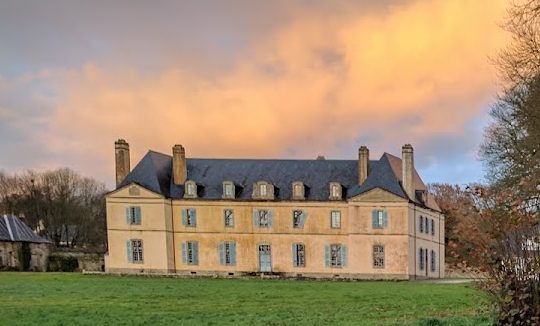
The château and its park became the property of Carhaix-Plouguer in 1999. The Brittany regional government purchased them in 2010 and launched a restoration operation in February 2020 under the direction of SemBreizh. Work on the château was completed in June 2021. The restored building now accommodates offices, including those used by regional officials and the Public Office of the Breton Language, together with a conference room seating 50 people.
The façades and roofs have been protected as historic monuments by inscription since 12 July 1965. The name has appeared in several forms over time, including Kerampuil in 1426, 1632, 1815, 1836, and 1850, and Querampuil in 1678 and 1683. Kerampuilh is said to derive from the Breton phrase ker an puilh, meaning “village of abundance.”
Remains
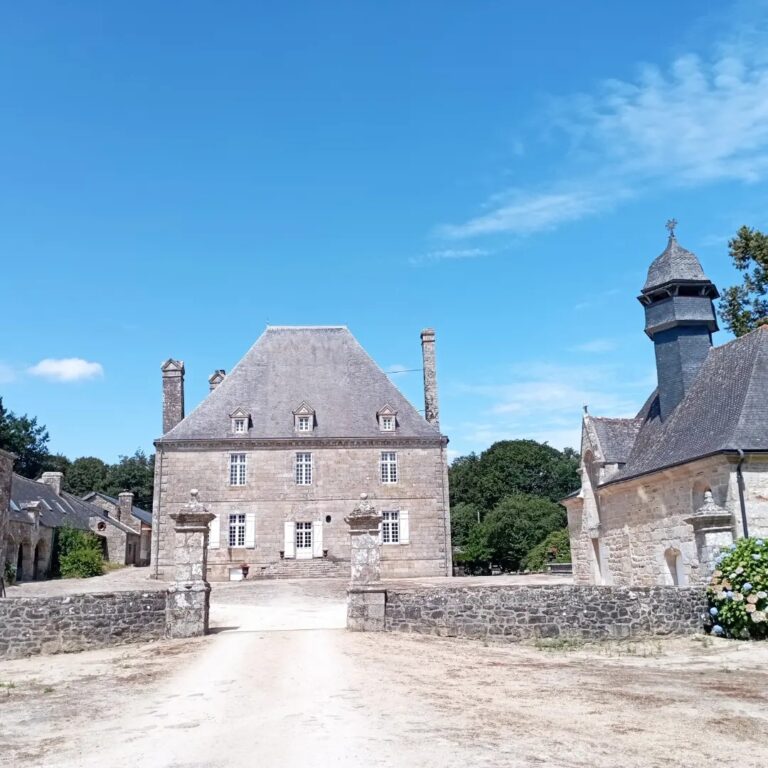
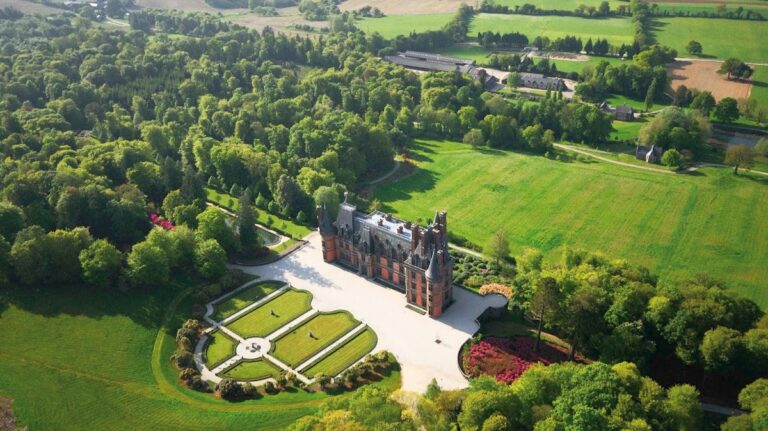
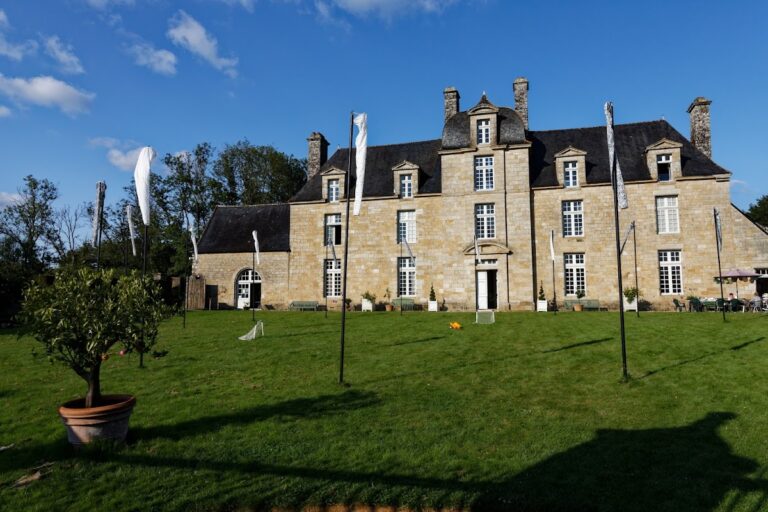
The estate follows a regular plan centered on a residential château with two projecting wings. Its associated buildings form a wider complex that includes a chapel, stable, concierge’s house, henhouse used for storage, and a building occupied by a mobile technical-assistance team of the Brittany regional government. Additional buildings have been added to the château and its dependencies for present occupants.
Principal buildings
Château
The main building consists of a central residential block flanked by two projecting wings, giving the château its regular overall arrangement. Its restored façades and roofs form the principal surviving architectural elements of the eighteenth-century residence. The building now contains administrative offices and a 50-seat conference room.
Chapel
A chapel built in 1840 for the Viscount de Saisy is dedicated to Charles Borromeo, the sixteenth-century Catholic cardinal and archbishop of Milan associated with Catholic reform after the Council of Trent. The chapel contains statues of Saint Agatha and Charles Borromeo. Its high altar is surmounted by a baldachin, a canopy placed above an altar, transferred from the Ursuline chapel in Carhaix. The Ursulines were a Catholic religious order particularly associated with the education of girls.
Dependencies and accommodation buildings
The château’s wider estate includes the stable, concierge’s house, storage henhouse, and the building used by the regional government’s mobile technical-assistance team. A separate accommodation center consists of five buildings. During the week, these serve the Diwan secondary school, a Breton-language education network, including its boarding facilities, school-life services, and catering.
Nearby sites