Kutscherfeldov palác: A Rococo Palace in Bratislava
Site at a Glance
- Rating
- 4.4
- Popularity
- Very Low
- Country
- Slovakia
- Primary era
- Early Modern
- Eras represented
- Medieval, Early Modern
- Civilizations
- Habsburg, Hungarian
- Site type
- Domestic
- Remains
- Elite Residence
On this page11 sections
History
Medieval houses and eighteenth-century ownership
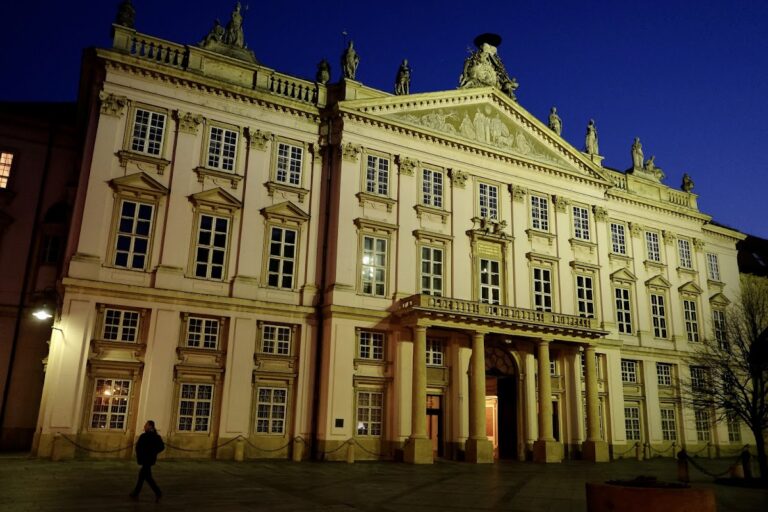
Kutscherfeldov palác is a Rococo palace in Bratislava, Slovakia, built in 1762 as a private residence on the site of three older medieval houses. The project was commissioned by the Kutscherfeld-Podevin family and carried out by Leopold von Kutscherfeld, an administrator of the imperial estates of Mosonmagyaróvár.
The three earlier houses had been joined around 1600. Their ownership was divided among several proprietors during the late seventeenth and first half of the eighteenth centuries. In 1679, Ján Wulpinusz and his wife, Rosina Radingerová, sold their shares to Jozef Segner and his wife, Anna Ernyeyová, for 2,000 florins. By 1700, Segner held most of the property.
The pharmacist Ján Juraj Peltz gradually assembled the remaining shares. He acquired Gottman’s share in 1711 for 900 florins, bought another share from Zuzana Puschová in 1716 for 1,000 florins, and purchased Jozef Segner’s share in 1719 for 4,000 florins. By 1722, Peltz owned the entire house.
Peltz sold the property to the pharmacist Ján Tomáš Stelling in 1746 for 10,000 florins. Leopold von Kutscherfeld later acquired it from Stelling and transformed the town house into a Rococo palace in 1762. Rococo was an eighteenth-century European style known for delicate ornament, asymmetry, light colors, and elaborate decoration.
The Kutscherfeld and Esterházy families
Leopold von Kutscherfeld was a member of the Hungarian Chamber and became director of the treasury of Mosonmagyaróvár in 1760. In 1763, Maria Theresa, the Habsburg ruler of the period, granted him a noble title and coat of arms. The palace remained with the Kutscherfeld-Podevin family until around the turn of the nineteenth century.
Count Imrich Esterházy bought the palace in 1813. The Esterházy family retained ownership until the end of the nineteenth century, and the building is sometimes also called Esterházy Palace. Imrich Esterházy belonged to the Hungarian Esterházy noble family, an important aristocratic house of the Habsburg lands.
Residents and modern institutional use
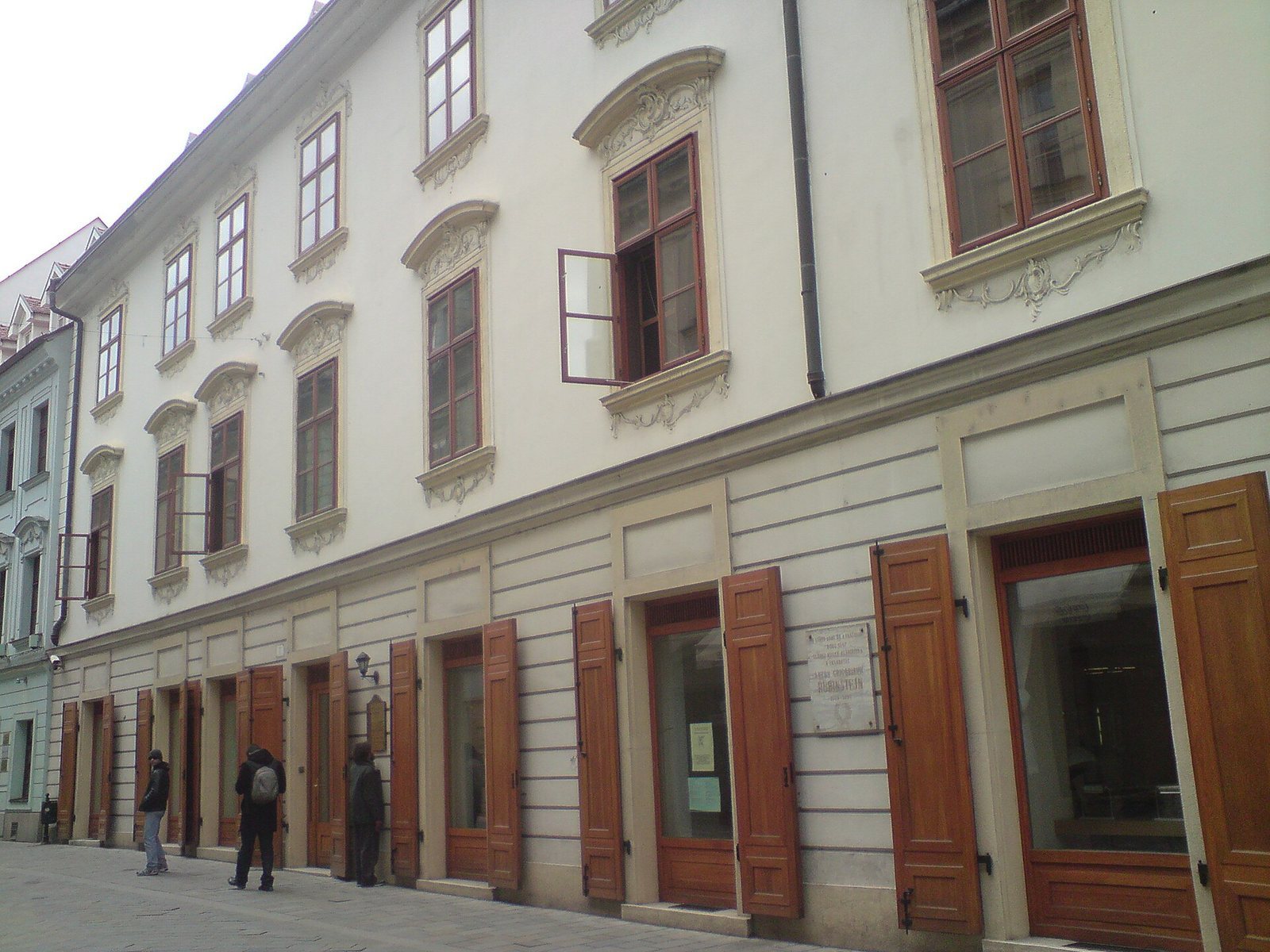
The Russian composer and pianist Anton Rubinstein lived in the palace in 1847. A commemorative plaque installed in 1959 records his residence, and he may have composed the well-known Melody in F there. Count József Antal Vince Hubert Esterházy de Galántha was born in the palace on 22 January 1911.
On 14 September 1990, French President François Mitterrand received the symbolic keys to the palace. The French Institute of Slovakia moved into the building the following year, followed by the Embassy of France in Slovakia in December 1994. Both institutions remain housed there. The palace is also a nationally protected monument listed in Slovakia’s register of national cultural monuments.
Remains
Building fabric and decoration
Courtyard plan and medieval fabric
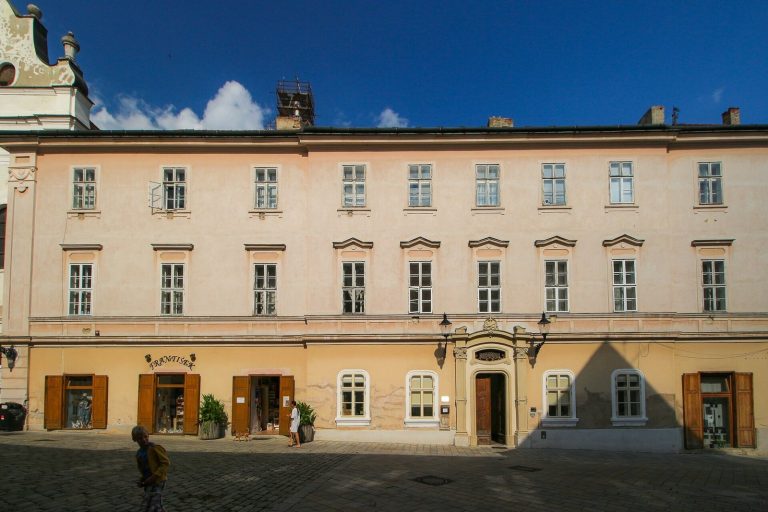
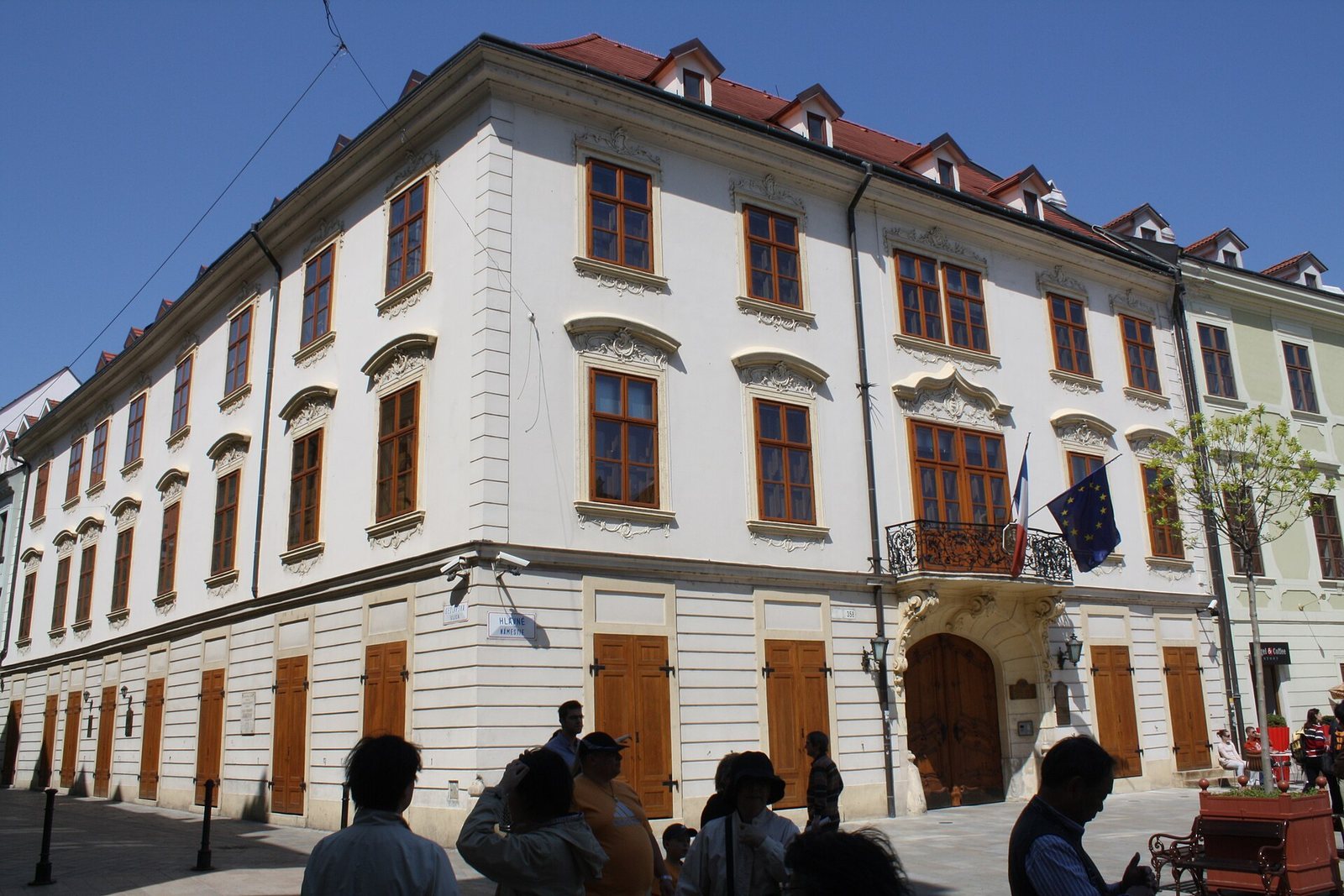
The palace stands at the corner of Sedlárska Street and Hlavné námestie in Bratislava’s historic center. It is a three-storey building arranged in four wings around a central courtyard. The 1762 palace incorporates masonry from the earlier houses, linking its present Rococo form with the older urban fabric of the site.
Basement and surviving construction
Part of the basement belonging to the medieval buildings is vaulted over a central column. This surviving construction element preserves evidence of the structures that occupied the property before its conversion into the palace.
Architectural and commemorative features
Rococo interiors and ceremonial staircase
The building contains architectural and artistic decorative details added when the town house was converted into a palace. Its ceremonial staircase has decorative wrought-iron railings, forming one of the palace’s notable interior features.
Rubinstein memorials
A commemorative plaque for Anton Rubinstein is affixed to one side of the palace. An embassy salon inside the building also bears his name, preserving the connection between the palace and the composer’s residence there in 1847.