Spindeltalkirche: A Revived Marian Pilgrimage Church in Germany


Site at a Glance
- Rating
- 4.7
- Popularity
- Low
- Country
- Germany
- Primary era
- Medieval
- Eras represented
- Medieval, Early Modern, Modern
- Civilizations
- Holy Roman Empire
- Site type
- Religious
- Remains
- Church
On this page9 sections
History
Spindeltalkirche is a revived medieval Marian pilgrimage church in Germany, standing in the Spindeltal near Wellheim in the Eichstätt district of Upper Bavaria. Built in the Gothic period in 1477–1478, it became a place where believers travelled to venerate the Virgin Mary, especially through a revered devotional image associated with miraculous intercession. The site lies at the ecclesiastical boundary between the dioceses of Eichstätt and Augsburg and is connected today with the Wellheim–Rennertshofen parish district of the Diocese of Augsburg.
Gothic foundation and pilgrimage
In 1458, Count Conrad von Helfenstein, the Landvogt, or territorial administrator, of Monheim, acquired Wellheim Castle and the market town from the Margrave of Ansbach as a hereditary fief, an estate granted in return for loyalty and service. His son Jörg von Helfenstein replaced a dilapidated Marian chapel in the Spindeltal with a Gothic church in 1477–1478. The new building soon attracted pilgrims from the surrounding area.
Secularization and destruction
The local Helfenstein line died out in 1517. In 1542, Ottheinrich, Count Palatine of Neuburg, converted to Protestantism, a change that affected religious institutions under his authority. Around 1550 he had the chapel secularized. Its furnishings were removed and the roof was dismantled, bringing the pilgrimage to an end.
The devotional tradition revived in 1727 after Franz Ferdinand von Schwab, lord of Trippach and a Palatine-Neuburg revenue official at Graisbach, fell from his horse near the ruins but escaped injury. In gratitude, he placed a Marian painting among the remains. Pilgrimages from nearby villages soon resumed.
A priest from Rögling rebuilt the church on its Gothic remains in 1729 and enlarged it in 1747. The rebuilding led to a prolonged dispute over the offerings made by pilgrims. The Rögling priest, whose parish then belonged to the Diocese of Eichstätt, contested them with the priest of Wellheim in the Diocese of Augsburg, while the priest of neighboring Ensfeld also claimed them.
After Wellheim again took possession of the offerings, the Eichstätt ordinariate, the administrative office of the diocese, asked the Augsburg ordinariate to have the church demolished on 26 April 1781. The two offices agreed instead to close the building and allow it to decay naturally, but pilgrimages continued. In 1783, an order from the Neuburg government led the Monheim district judge to destroy the church. The land was sold privately, while the associated pilgrims’ inn survived until 1811.
Relocation of the furnishings
The Rögling priest added a chapel to the parish church in 1775 for the Spindeltal miraculous image. The image was transferred there together with a Rococo altar from 1750. The altar included an Anna Selbdritt representation, showing Saint Anne with Mary and the child Jesus, as well as sculptures of Willibald and Walburga, early medieval missionaries and saints associated with the Diocese of Eichstätt.
A Gothic Madonna carved from Ellingen variegated sandstone was found buried in the ruins in 1931. It was taken to the nearby parish church of Ensfeld, where it remained after a later dispute over ownership. The transfer of the original image and altar left the surviving ruins with a history divided between the former pilgrimage church and neighboring parish churches.
Consolidation and revival
During the 1960s, Andreas Bauch, a professor at the Eichstätt Philosophical-Theological College and rector of the Eichstätt seminary, had the ruins’ rubble-stone masonry consolidated to prevent their complete collapse. A wooden cross was erected through private initiative in 1984, and a Madonna image was installed soon afterward. From 1985, the site again became a regular destination for worshippers.
After 1985, parts of the ruins were rebuilt despite heritage-conservation concerns. A protective roof was added in connection with Johann Grad, and the building received windows, doors, and benches. In October 1996, Eichstätt Bishop Walter Mixa blessed the ruin church under the name “Our Lady in the Spindeltal.” The Diocese of Augsburg regards it as belonging to Wellheim parish and forming part of the Gammersfeld filial church, a church dependent on a principal parish. The building itself is held under lease by the registered association Friends of the Spindeltalkirche rather than being church property.
Regular Masses had ceased by 2001 at the latest because of staffing conditions in the pastoral unit. A Catholic Rural Youth Movement motorcycle gathering held there in 2005 was followed by the establishment of an annual motorcycle service. In 2006, a copy of the Spindeltal Madonna was installed in the church. The ruin church continues to serve for occasional religious ceremonies.
Remains
Setting and surviving fabric
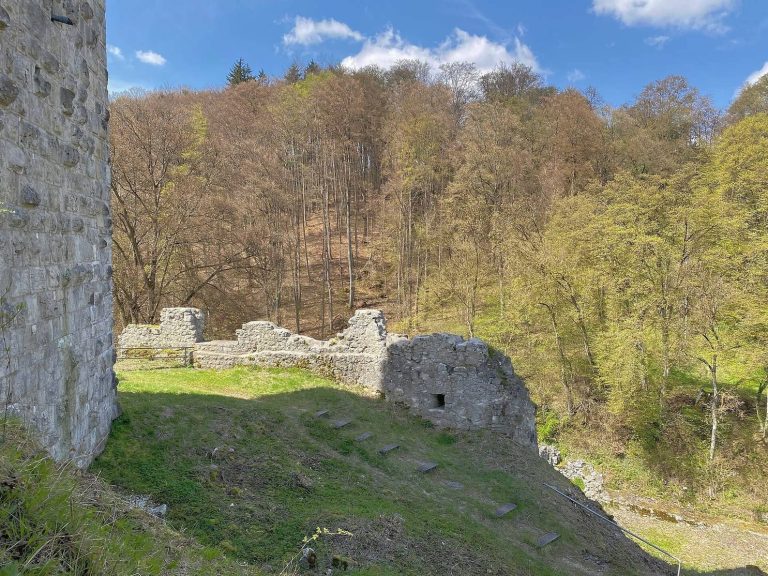
Spindeltalkirche stands on the southern edge of the Spindeltal, a side valley of the Wellheim dry valley in the Southern Franconian Alb, about two kilometres west of Konstein. The valley’s name is said to derive from spindle trees. The present ruin church combines surviving portions of the Gothic building from 1477–1478 with the later structure erected on those remains in 1729 and enlarged in 1747.
The surviving walls are built of rubble stone. Sections of the ruin were rebuilt after 1985 and enclosed beneath a protective roof, with windows and doors inserted into the structure. Benches were also installed, allowing the remains to function as a place of worship while retaining their character as a partially reconstructed ruin.
Images and altar furnishings
The Gothic Madonna recovered from the ruins in 1931 is carved from Ellingen variegated sandstone and is preserved in the parish church of Ensfeld. The 1750 Rococo altar, with its Anna Selbdritt scene and sculptures of Willibald and Walburga, was transferred to Rögling along with the Spindeltal miraculous image in 1775.
Modern furnishings
The wooden cross erected in 1984 and the Madonna image installed soon afterward form part of the modern furnishing of the ruins. The Madonna copy placed in the church in 2006 continues the connection between the present ruin church and the devotional image that shaped the site’s earlier pilgrimage tradition.