Burg Mörnsheim: A Medieval Hilltop Castle in Germany


Site at a Glance
- Rating
- 3.6
- Popularity
- Very Low
- Country
- Germany
- Primary era
- Medieval
- Eras represented
- Medieval, Early Modern
- Civilizations
- Holy Roman Empire
- Site type
- Military
- Remains
- Castle
On this page6 sections
History
Burg Mörnsheim, also known as Staffelburg, is a medieval hilltop castle in Germany, associated with the Lords of Mörnsheim and later with the bishops of Eichstätt. Its origins may reach back to the tenth century, while its first recorded mention dates from 1225. Between 1225 and 1228, Bishop Heinrich I of Zipplingen commissioned a massive central strongpoint at the highest point of the site, built in a masonry style using carefully cut stone blocks with projecting, rough outer faces. The fortress was intended to be exceptionally difficult to capture.
The medieval stronghold
In 1281, the castle was explicitly called castrum Mornsheim, or Mörnsheim Castle. Bishop Konrad II of Pfeffenhausen then enclosed the complex with defensive walls. Under Bishop Friedrich IV, Count of Oettingen, the buildings and fortifications were strengthened, the perimeter was repaired, and an enclosed defensive area between the main wall and an outer wall, known as a zwinger, was added. The outer bailey, or secondary fortified enclosure, was probably established during this phase.
During the tenure of Bishop Albrecht II of Hohenrechberg, the castle gained a broad, deep ditch across the southeastern approach. This neck ditch, cut through the narrow connection between the summit and the surrounding high ground, helped isolate the fortified area. A ring wall with towers and wall walks was built together with a substantial outer rampart, creating a stronger defensive perimeter.
Residential expansion and decline
Johann III of Eych, a later bishop of Eichstätt, commissioned a large residential building in the southern corner of the main castle. The project reflects the continuing development of Burg Mörnsheim beyond its role as a defensive strongpoint, although the complex remained organized around its fortified summit.
After 1634, the castle began to fall into disrepair. Part of the complex was demolished in 1760, leaving the surviving structures as a ruin. Safeguarding work has been carried out since 1980. Burg Mörnsheim is protected as an architectural monument of Mörnsheim and is also registered as an archaeological monument because medieval and early-modern settlement remains survive underground within the former castle.
The castle’s wider historical setting has also been interpreted through the nearby Krugsburg, first mentioned in 1024. Castle researcher Helmut Rischert regarded Krugsburg as an outpost within sight of Burg Mörnsheim, linking the two fortified sites in the medieval landscape.
Remains
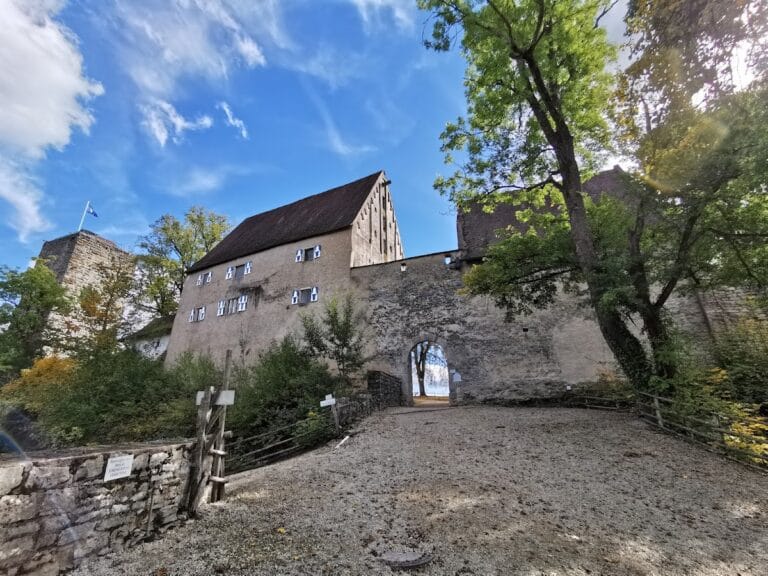
The ruin occupies the summit of the Schloßberg at approximately 510 metres above sea level, above the Gailach Valley in Mörnsheim, Bavaria. Its elevated position shaped the arrangement of the complex, which consisted of a main castle, a probable outer bailey, a zwinger, and defensive works concentrated around the summit. The surviving layout is defined by sections of the ring wall and zwinger wall, while the southeastern side retains the defensive setting formed by the neck ditch and outer rampart.
Defensive walls and summit structures
The central keep stood at the highest point of the castle and was erected between 1225 and 1228 from bossed ashlar blocks. These carefully shaped stones have projecting outer faces that give the masonry a strongly textured appearance. The wider defenses included towers, wall walks, and the ring wall, whose surviving sections preserve parts of the castle’s medieval enclosure. Associated remains on the Schloßberg include the Zwinger Burgberg and structures identified with Burgberg 5 and Burgberg 7.
Chapel and residential buildings
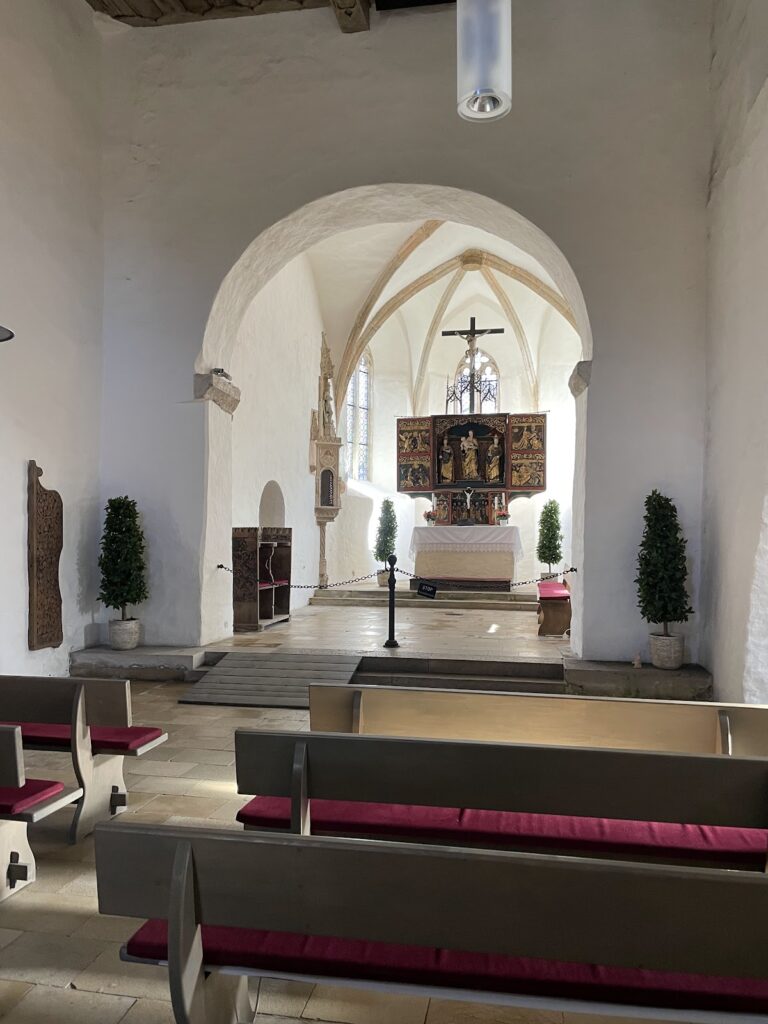
A barrel-vaulted room survives from the castle chapel of St. Afra. The main castle also contained the large residential building commissioned by Johann III of Eych in the southern corner. Views from the south identify the Amalienturm, or Amalia Tower, as a named tower associated with the castle complex. Together, these remains represent the defensive, religious, and residential elements of Burg Mörnsheim’s fortified summit.