Burg Dollnstein: A Medieval Hilltop Castle in Germany


Site at a Glance
- Rating
- 4.3
- Popularity
- Very Low
- Country
- Germany
- Primary era
- Medieval
- Eras represented
- Medieval
- Civilizations
- Carolingian, Holy Roman Empire
- Site type
- Military
- Remains
- Castle
On this page9 sections
History
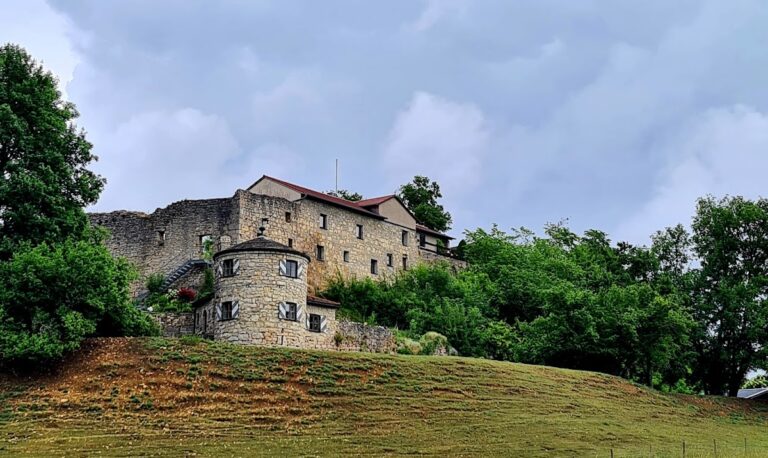
Burg Dollnstein is a historic hilltop castle in Dollnstein, Germany, whose origins reach back to the Carolingian period. Built on a prominent rock ledge above the north bank of the Altmühl, it developed from an early medieval settlement into a fortified residence, administrative center, and agricultural estate.
Early Medieval Origins
The site was occupied by an unfortified settlement from about 700. Archaeological evidence indicates that a defensive installation was established in the ninth or tenth century, during the Carolingian era, a period associated with the dynasty that ruled much of western and central Europe from the eighth to the tenth century. The earliest fortification used timber and earth rather than a stone wall.
By 1147 at the latest, Dollnstein belonged to the Counts of Grögling. This family later took the names Counts of Dollnstein and, eventually, Counts of Hirschberg. During the eleventh century, the settlement gained its first stone enclosure and a stone residential building, establishing the core of what became the lower castle.
Changes of Lordship
In 1305, the Counts of Öttingen took possession of Dollnstein and its castle. The Lords of Heideck purchased the town and castle in 1360. In 1440, Bishop Albrecht II of Hohenrechberg acquired Dollnstein’s castle and market for the Bishopric of Eichstätt, an ecclesiastical principality in which the bishop exercised both religious authority and territorial power. Eichstätt retained the property until 1802.
The castle also supported a substantial agricultural estate. A manorial farm northwest of the castle managed extensive farmland. After the complex ceased to function as a noble residence and became primarily an administrative seat, the farmyard was divided into eight field fiefs in 1459. Dollnstein also had at least one weapons forge until the sixteenth century.
Secularization and Later Transformation
In 1802, secularization transferred the castle and other church possessions to Bavaria. Secularization was the transfer of ecclesiastical property and political authority to secular rulers. In 1803, the complex passed to Grand Duke Ferdinand III of Tuscany. The castle was auctioned to Dollnstein citizens in 1804, after which the upper castle was demolished. The outer-castle buildings were adapted as homes, while parts of the upper castle survived until about 1850.
Parts of the lower castle have been extensively renovated since 2006, and the Altmühlzentrum opened there in 2015. Burg Dollnstein is protected as both a listed architectural monument and an archaeological monument. The protected archaeological area includes a Bronze Age settlement, an early medieval settlement, and the high- and late-medieval castle.
Remains
Burg Dollnstein occupies a rock ledge at roughly 400 metres above sea level on the Altmühl’s north bank. The hilltop fortress was arranged around this elevated position, with a main castle covering approximately 0.56 hectares. The upper castle survives as a ruin, while the lower castle retains substantial buildings and wall sections. The surviving masonry combines regularly cut ashlar blocks with more irregular rubble stone.
Fortifications and Early Castle Core
The first defensive work was a timber-and-earth installation from the ninth or tenth century. In the eleventh century, it was replaced or developed into a stone ring wall, a defensive enclosure surrounding the castle or settlement. A stone residential building was constructed at the same time and formed the nucleus of the lower castle. Above-ground sections of the main enclosure preserve masonry dating back to this period.
Parts of the ring wall were rebuilt during the twelfth century. On the southern side, a chamber gate was added during this phase and remains preserved. In the fourteenth century, another building campaign equipped portions of the enclosure with a crenellated parapet, a battlement made of alternating raised sections and openings.
Lower Castle
The lower castle is the best-preserved part of the complex. Its castle gate and late-medieval economic buildings remain arranged in a semicircle against the enclosing wall. The buildings served the practical needs of the castle estate and were constructed in an early Altmühl-Jura tradition. Their surviving arrangement, materials, and fabric give the lower castle architectural and historical value.
In 1445, service buildings and stables were attached to the ring wall. These additions expanded the working area of the lower castle and form part of the late-medieval building group that survives there. The lower-castle buildings were later adapted for residential use after the complex passed into private ownership.
Upper Castle
The upper castle is now a ruin, and its architectural development is less clearly understood. Some visible wall sections are unequivocally Romanesque, the medieval style associated with heavy masonry, rounded arches, and massive forms. These remains probably date from the twelfth century. The upper castle was demolished after the 1804 auction, although fragments remained until about 1850.
Archaeological Finds
Excavations in November 2007 revealed a ceramic vessel containing silver coins and other objects made of precious metal. The material dates to around 1370. The circumstances that led to the objects being placed together are unknown, but the find adds evidence for activity at the castle during the later medieval period.