Sønder Aarslev Church: A Medieval Church in Brabrand, Denmark
Site at a Glance
- Popularity
- Very Low
- Country
- Denmark
- Primary era
- Medieval
- Eras represented
- Medieval, Early Modern, Modern
- Civilizations
- Danish
- Site type
- Religious
- Remains
- Church
On this page13 sections
History
Sønder Aarslev Church is a medieval church in Brabrand, Denmark. Its oldest parts probably date to the late 12th century, when a stone church replaced an earlier wooden building. The surviving medieval masonry is Romanesque, a style associated with substantial stonework and rounded forms.
Medieval expansion and church affiliations
The church was enlarged in the late Middle Ages. It originally belonged to the Aarhus Cathedral Chapter, a body of clergy responsible for cathedral administration. Its early congregation was Catholic. After the Reformation, the 16th-century religious transformation that ended Catholic ecclesiastical control in Denmark, the church passed to the Danish Crown. It is now part of the Church of Denmark.
Ownership and clergy
In 1686, King Christian V transferred the church to Otto Bielke of Kærbygård. Bielke sold it in 1691 to Christen Wegerslev, a provisions officer in Aarhus. Following several further changes of ownership, Count Christian Frijs of Frijsenborg bought the church at auction in 1758.
Anders Knudsen Toustrup began a three-generation family succession of priests at the church. He also owned both Sønder Aarslev Church and Tilst Church. Thomas Lillelund served from 1758 to 1781 and was known as a skilled preacher. In 1773, he wrote a history of the church that covered Catholic bishops up to the Reformation and bishops in Denmark and Norway thereafter.
Pastoral changes and later history
Until 12 May 1873, Tilst Church was subordinate to Sønder Aarslev. On that date, Sønder Aarslev became an annex church to Brabrand Church, while Tilst became the principal church in a pastorate, a group of churches under shared pastoral administration, with Kasted Church as an annex.
A major renovation took place in 1870, and the church’s current tower was built in 1883. A fire damaged the altar in 1874. Miller Andreas Severin Weis provided a replacement altarpiece, painted by A. Dorph in 1875.
The church became independently owned in 1912 in connection with the commutation of tithes, the settling and ending of traditional church payments. In 1994, Nanna Christiansen of Årslev donated a figure of Christ by Valdemar Foersom Hegndal, and an altar cross by the same maker was installed. The church belongs to Sønder Aarslev Parish, the Brabrand–Sønder Aarslev pastorate, Aarhus West Deanery, and the Diocese of Aarhus.
Remains
The church combines a medieval stone structure with later changes to its interior and exterior. Its surviving fabric and furnishings reflect successive periods of building and use.
Building fabric
Medieval church and tower
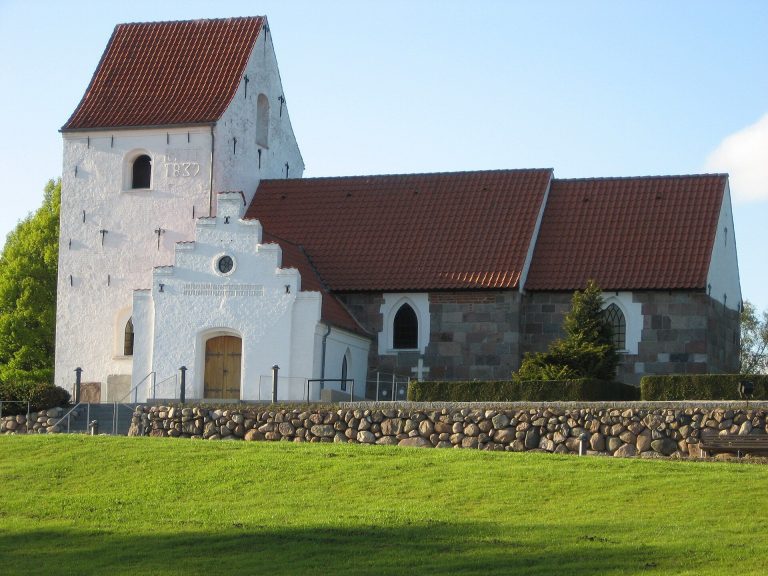
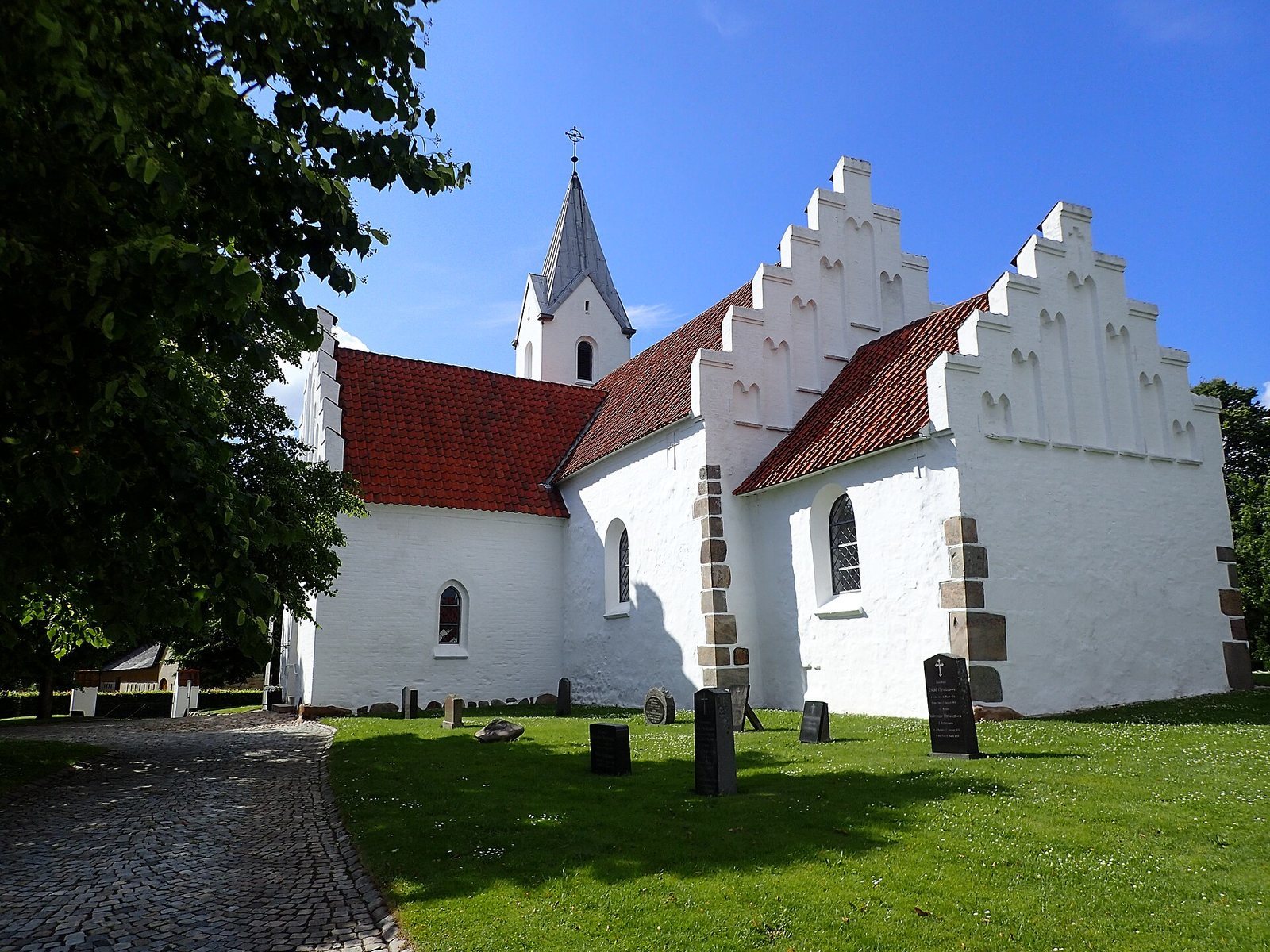
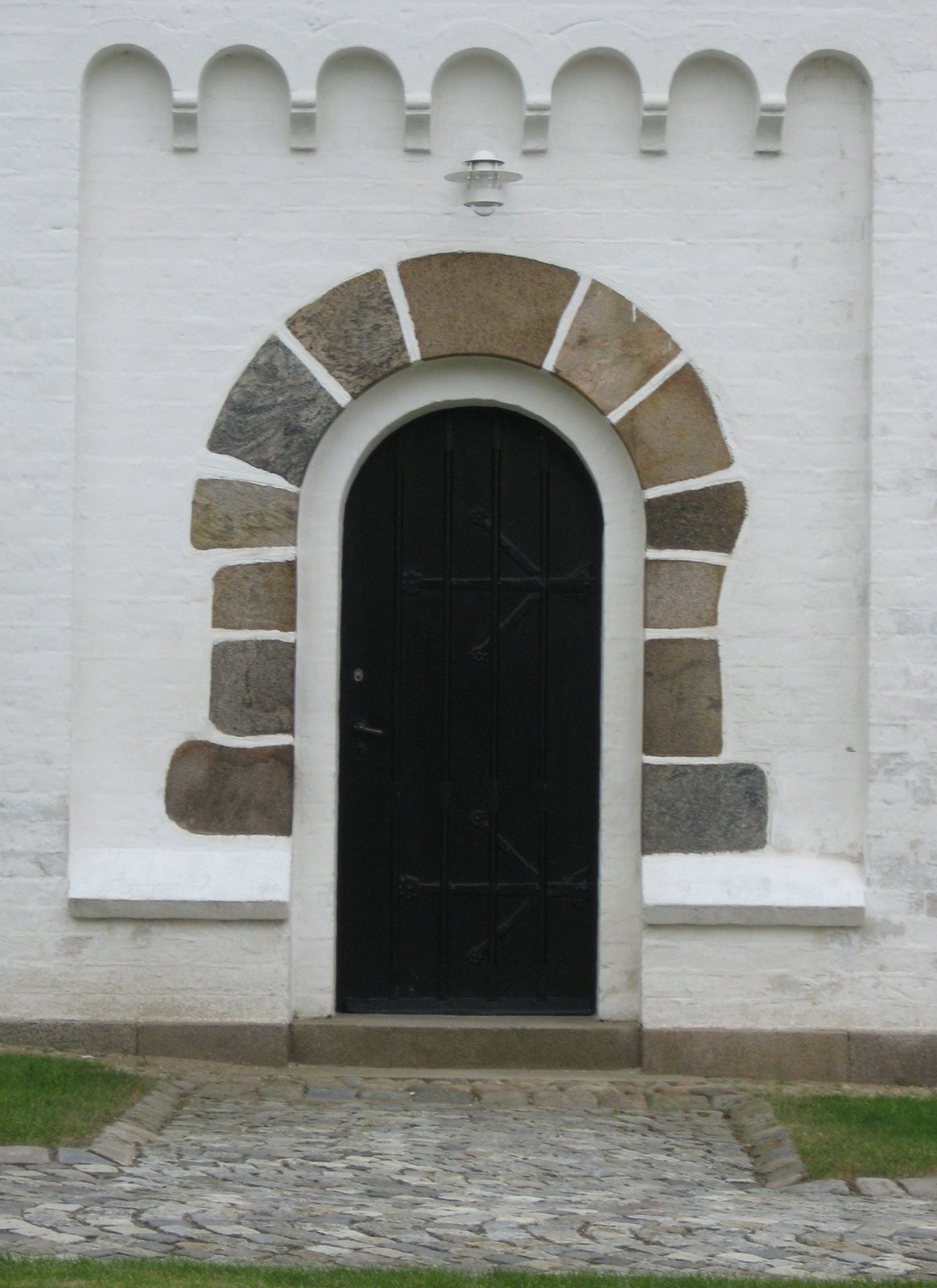
Romanesque stonework forms the oldest surviving part of the church. In the late Middle Ages, the building was enlarged and its original flat wooden ceiling was replaced with rib vaults, ceilings formed by intersecting structural ribs. The first tower was a stilt tower, raised above the roof on supporting posts or piers, and probably dates to this period. The present tower is a later structure, built in 1883.
Nineteenth-century exterior
The 1870 renovation added tall blind recesses, shallow features set into the wall without openings, and crow-stepped gables, whose roof edges rise in steps. The north doorway is now blocked.
Interior furnishings
Altar and baptismal furnishings
The altar frontal, a decorated panel covering the front of the altar, is a Renaissance work from about 1600. Morten Snedker is considered its likely maker and is also thought to have made the pulpit, dated to about the same time. He produced other pulpits in the region. The church has a Romanesque granite baptismal font, probably among its original furnishings, and a brass baptismal basin dating to about 1550.
Altarpiece and later objects
The altarpiece painting depicts Jesus and the penitent woman. It now hangs on the north wall beside the organ. A figure of Christ stands behind the altar, and the altar cross is mounted above the baptismal font.
Organ and memorials
Built in 1967 by Th. Frobenius & Sønner, the organ has 10 stops, controls that select different sounds, and follows the Hørve type, a Danish organ design category. Memorial stones commemorate priests. One, set into the north wall of the chancel, honours the Toustrup family; another, dedicated to Thomas Lillelund, is on the porch wall.
Bell and cemetery
The church bell was hung in 1774 and recast in 1910, with its original inscription retained. The inscription says that the household of the counts of Frijsenborg paid for it. The adjoining cemetery is the burial place of painter Jens Hansen-Aarslev (1847–1928).