Borum Eshøj: A Bronze Age Burial Complex in Denmark
Site at a Glance
- Popularity
- Medium
- Country
- Denmark
- Primary era
- Bronze Age
- Eras represented
- Stone Age, Bronze Age, Modern
- Civilizations
- Danish
- Site type
- Burial
- Remains
- Necropolis
On this page19 sections
History
Borum Eshøj is a Bronze Age burial complex near Borum and Sabro, west of Aarhus in Denmark. Bronze Age communities built its main mound, Eshøj I, around 1500–1300 BC, during the Scandinavian Early Bronze Age. One of the largest Bronze Age burial mounds in northern Europe, it received burials over several later phases.
Bronze Age burials
Eshøj I contained eight graves: three burials of uncremated bodies in oak coffins, two cremations in stone cists (graves enclosed by stone slabs), and three other cremations. The oak-coffin burials belong to Period II, an early division in the Scandinavian Bronze Age dating system, and date to around 1350 BC. Cremation burials reflect later Bronze Age activity at the mound.
Other mounds in the Eshøj group also held Bronze Age burials. The graves and deposits at Eshøj II–IV reveal several kinds of burial and activity across the area, including a later cremation burial at Eshøj II.
Discovery and protection
In 1850, the owner of Højballegaard farm dug into Eshøj I’s eastern slope and uncovered a burial. Three years later, he presented a sword from his find to King Frederik VII and asked for the mound to be protected. It became the first protected burial mound in Denmark. That protection lapsed when the farm was sold in 1856, and the farmer also reported that other people had dug into the mound.
The mound collapsed during the winter of 1859–60, exposing another burial. In 1871, earth was removed from the eastern side to improve farmland, revealing an oak-coffin burial. The discovery prompted a fuller investigation. In 1875 the National Museum commissioned Danish archaeologist C. Engelhardt to excavate the mound and prepare a plan; two more oak-coffin burials came to light. Road construction, agricultural earth removal, and excavations greatly reduced the mound. Its surviving portion received protection in 1937.
Later investigations and local traditions
In 1959, a schoolboy began digging into Eshøj II while searching for treasure. A director of a nearby museum stopped the work, and the finds were recorded before the mound was covered again and the objects taken to a local museum. Later excavations investigated Eshøj II in 1988–91, Eshøj III in 1989–92, and Eshøj IV in 1990–92.
Local tales connected the great mound with Prince Buris, who was said to have flirted with Liden Kirsten, sister of the twelfth-century Danish king Valdemar the Great, and to have been blinded as punishment. Another story placed a cruel troll in the mound. In that tale, the giant Sven Fælding was persuaded by the troll of Jelshøj to kill it, after a magical drink from a horn gave him extraordinary strength. The horn associated with the story is a late-medieval object, not a Bronze Age find; it is now at Kulturen in Lund.
Remains
The burial mounds occupy a plateau on Eshøj, a moraine hill formed from material deposited by a retreating glacier. The hill is about 100 m high, and its plateau covers roughly 4 km². Estimates based on older photographs suggest that around 25–30 burial mounds once stood there. The investigated mounds lie within 300 m of one another, while earth removal and ploughing reshaped other mounds in the area.
Eshøj I
Mound construction and stone boundaries
A survey in 1875 measured Eshøj I at 37.66 m across and 7.21 m high. By 1948, the surviving mound measured 19 m across and 6 m high. Builders formed it by stacking turf slabs cut from the ground and carried to the site. Differences in colour between the layers reveal the courses of turf. Construction is estimated to have used about 630,000 slabs, taken from roughly 66 hectares of pasture. Variations in the deposits also indicate that the work was divided into sectors.
A stone circle and kerb, a stone edging around a mound, were laid out at the base. At the centre, builders hollowed an oak trunk to make a coffin; wood shavings from the work survived beneath it. As the mound grew, its edge covered the first stone circle, and a second circle and kerb were made beside it. The 1875 plan also shows square stone settings, interpreted as small enclosures or structures where the dead could be honoured, along with stone pavements and a carefully stepped stone boundary.
Older man’s oak coffin
The central grave held a man aged about 50–60 who was approximately 170 cm tall. His coffin was made from a split oak trunk hollowed to hold the body, with the other half serving as a lid. Tree-ring dating, which compares annual growth rings, places the oak at around 1350 BC. The man lay on a cowhide, dressed in wool and covered by a wool mantle. His clothing included a skirt, a cordlike belt, a cap, and foot coverings. The wool is thought to have come from southern or central Europe.
Muscle and other soft tissue remained attached to the skeleton, preserving details of his appearance and care. His nails had been carefully kept, and he had been freshly shaved. A fastener was associated with his clothing. The coffin and finds are held by the National Museum of Denmark in Copenhagen.
Young man’s oak coffin
A younger man, around 20–22 years old and 166 cm tall, was buried in another oak coffin. His hair was abundant and curly, cut in a pageboy style. He lay on a cowhide wearing woollen clothes, including a mantle and skirt, with cloth shoes tied at the ankles and a leather belt. Tree rings date the coffin to around 1345 BC. His grave goods included a short bronze dagger in a long wooden scabbard, a bark box, a horn comb, a bone clothing pin, and a double wooden button. His burial is part of the National Museum of Denmark’s collection.
Woman’s burial
An oak-coffin burial at the mound’s eastern edge was found in 1871; the coffin was destroyed during handling. The woman was about 157 cm tall and is estimated to have been 40–50 years old. She lay on her back on a cowhide. Her blond hair, about 70 cm long, was braided and gathered beneath a cap that could be tied under the chin. She wore a short woollen shirt with half-length sleeves. A longer textile garment has been interpreted either as a skirt or as a shroud. The quality of her woollen clothes suggests that their wool came from southern or central Europe.
Her grave goods included a bronze neck ring with a thick clasp, open arm rings, spiral finger rings, a cast bronze dagger, a horn comb, and a small ceramic vessel. Her clothing was decorated with tutuli, round bronze ornaments often attached to garments. The ornaments were more than 4 cm across, with central spikes about 2 cm long. A circular bronze belt plate measured 17.8 cm across. Its raised central boss ended in a projecting point, and its decoration included paired ring patterns and spirals.
Stone coffins and cremation burials
The stone coffin found in 1850 lay east–west and measured 2.5 m long, 1.9 m wide, and 0.94 m high. The burial exposed after the mound’s collapse also lay east–west, measuring 1.6 m long and 1.3 m wide. It contained cremated human bones, a long bronze pin, and three short bronze swords. One sword had gold wire decoration at the hilt; it was given to Aarhus Museum.
One later cremation burial near the mound’s top used a small wooden box as an urn. It contained burnt bones and miniature objects: a sword, razor, tweezers, and a buckle with a long point. The objects had a gilded surface.
Eshøj II
Mound and Bronze Age graves
Eshøj II lies about 100 m east of Eshøj I. A survey measured it at 27.5 m across and 1.90 m high, with gently sloping sides. Stone remains indicate an original mound diameter of about 19–20 m. Finds from the digging in 1959 included fragments of a bronze sword, a wooden scabbard, a spiral-decorated belt fitting associated with Period II, and a flanged axe, whose raised side ridges helped secure it to a handle, associated with Period I.
Excavation revealed a central east–west grave at the original ground level. Its stone setting measured 3.6 by 2 m and had supported a probable oak coffin. A hollow within it measured 2.0 by 0.6 m. The coffin and body had decayed, leaving a small wood fragment and a piece of tooth enamel. Sword fragments and a clothing pin of a type found in men’s graves support the interpretation that the deceased was male. The grave disturbed in 1959 lay beside the central setting’s northwest corner; the older style of its flanged axe complicates the burial sequence.
About 5 m north of the central grave, another east–west stone setting lay roughly 1 m above the original ground level, indicating a burial within an already completed mound. It may have held an oak coffin. A Period II arm ring of a type worn by women supports the interpretation that the buried person was female.
Urn burial and ground marks
A later burial at Eshøj II contained the cremated remains of a person in a ceramic urn from Period IV or V, later divisions of the Scandinavian Bronze Age chronology. Long furrows crossed at right angles beneath the mound. They have been interpreted either as marks made by an ard plough, an early plough that cut shallow furrows, when the ground was prepared for burial, or as traces from the Late Neolithic.
Eshøj III
Eshøj III lies about 150 m northeast of Eshøj I. When measured in 1918, it was 18.25 m across and 1.20 m high. Excavation found crossed ard-plough marks at its base and a circular stone ring around the centre. Built in three courses, the ring had an inner diameter of 20–22 m and four short gaps. Two further stone rings lay outside it, each about 1.5 m beyond the preceding ring. Two stone settings at the centre stood side by side, with space between them for an oak coffin. The coffin and body had decayed, leaving traces of wood.
Eshøj IV
Mound and graves
Eshøj IV lies between Eshøj II and III, about 125 m northeast of Eshøj I. Its 1918 measurements were 23.5 m across and 2.20 m high. A stone ring around the centre measured 20–21 m across, with broad stone pavements inside and outside it. Several other stone settings lay beyond the mound, and ard-plough marks crossed the ground beneath it. Burnt bone fragments in disturbed central fill may come from a cremation affected by earlier digging.
Just north of the centre, an oak-coffin burial was supported by a few stones. The coffin had decayed apart from a few centimetres of wood. Wooden carrying poles found there were probably used to transport turf blocks.
Earlier longhouse
Partly beneath Eshøj IV lay a two-aisled longhouse, a long building supported by two rows of interior posts. The Late Neolithic, the final phase of the Stone Age, house dates to around 2000 BC. Its postholes indicate a length of 19.4 m and a width of 6.5 m, and several buried stone pit hearths were associated with it. Identified as the oldest known house of its type in eastern Jutland, it was marked with oak timber in 2001.
Reconstructed features
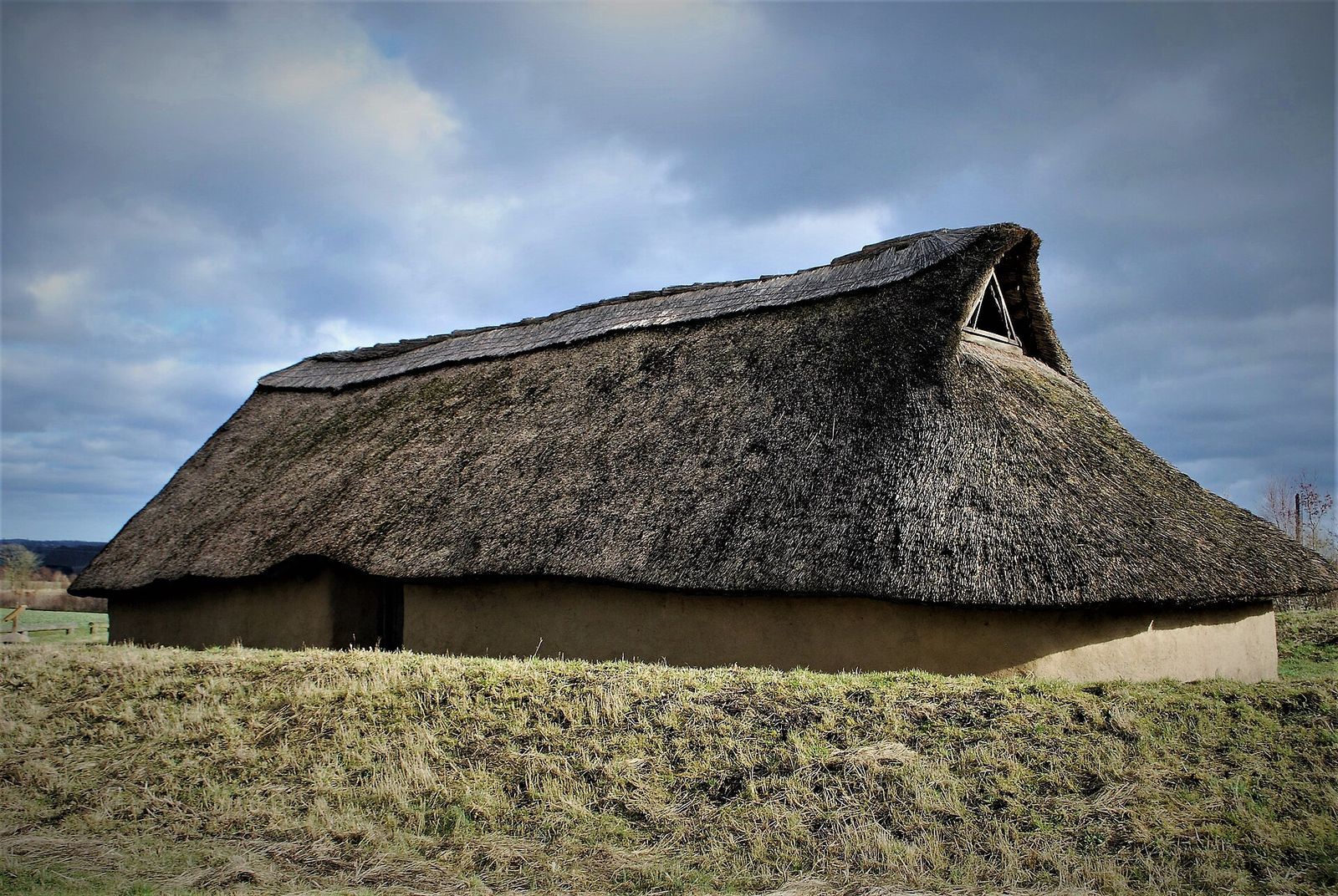
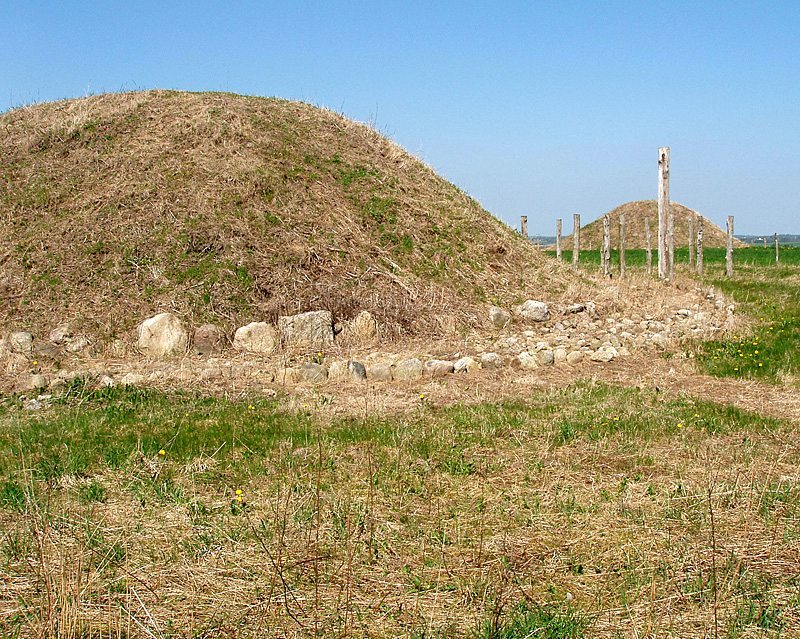
Three burial mounds at Eshøj were reconstructed in the early twenty-first century as part of a recreated ancient landscape. A separate replica Bronze Age house was built in 1993–95 through a work camp involving young people from several countries and a group of long-term unemployed young people. Local volunteers later maintained the structure.