Solliden Palace: The Swedish Royal Family’s Summer Residence


Site at a Glance
- Rating
- 4.3
- Popularity
- Medium
- Country
- Sweden
- Primary era
- Modern
- External website
- Open
- Eras represented
- Modern
- Civilizations
- Swedish
- Site type
- Domestic
- Remains
- Palace
On this page8 sections
History
Solliden Palace is a summer residence of the Swedish royal family on the island of Öland near Borgholm, Sweden. Queen Victoria of Sweden commissioned the palace, which was built between 1903 and 1906 in a private country-residence tradition rather than as a ceremonial palace. Its location beside the ruins of Borgholm Castle connects the modern royal residence with an older fortified landscape.
Queen Victoria’s summer residence
Architect Torben Grut designed Solliden for Queen Victoria, who wanted an intimate home in which to spend the summer. Her poor health and Öland’s mild climate influenced the choice of location. Victoria drew inspiration from Villa San Michele on Capri, the residence of her close friend Axel Munthe, a Swedish physician and writer. Solliden was completed in 1906.
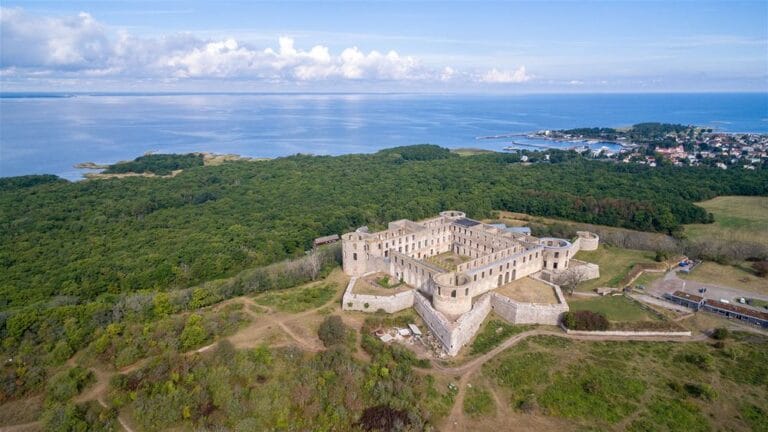
The palace grounds occupy land associated with Borgholm Castle, which burned in 1806. The neighboring fortress had developed from a Renaissance stronghold, shaped by European military and architectural traditions from the fifteenth century onward, and was transformed into a Baroque castle during the seventeenth century. After a nineteenth-century fire, it fell into ruin.
Royal ownership and continuing use
After Queen Victoria’s death, her husband, King Gustav V, assumed responsibility for Solliden and opened the park to visitors. Carl XVI Gustaf inherited the property at the age of four after Gustav V died in 1950. Solliden has continued to serve as a summer residence occupied by the Swedish royal family.
The estate also remains associated with the annual celebration of Crown Princess Victoria’s birthday on 14 July. Known as Victoriadagen, the event is traditionally held at Solliden, whose gardens open to visitors during the summer season.
Development of the gardens
A major addition to the grounds came in 1922, when Queen Wilhelmina of the Netherlands gave the Dutch Garden to her friend Queen Victoria as a gift for Victoria’s sixtieth birthday. The garden became part of the estate’s varied landscape and its continuing royal associations.
Remains
Solliden combines a compact palace with an extensive park arranged in several distinct garden areas. The estate lies at the boundary between Öland’s dry, relatively poor soils around the island ridge and eastern coast and the milder, more fertile conditions of the west. The gardens form a richly planted green area below the surrounding Öland steppe, while the main entrance approaches from the steppe toward the park and its water features.
The palace and entrance buildings
The palace is formed from staggered sections that create an approximately quadrilateral, cuboid structure beneath a low, flat copper roof. Its exterior decoration is restrained. Double and triple windows framed by small columns provide the principal ornament. A loggia, meaning a covered gallery open along one or more sides, projects from the west side, while a covered exterior staircase rises on the east.
The entrance house belongs to the palace’s construction period and contains exhibitions about Solliden and its residents. Opposite the palace in the Italian Garden stands the Playhouse, a small building covered in plants that was formerly used by the gardener and his family.
The palace gardens
The Italian Garden lies directly beside the villa. Its planting includes isolated boxwood and boxwood hedges shaped through topiary, the practice of training shrubs into formal geometric or ornamental forms. A path leads from this area to the English Garden, where large trees and lawns create a different garden character.
Below the lawn in front of the palace is a modern cascade presented to the king as a birthday gift from the Swedish Parliament. The Dutch Garden contains marble sculptures and various rose varieties, while dozens of rose varieties are cultivated throughout the wider park.
Borgholm Castle ruins
Directly beside Solliden stand the imposing ruins of Borgholm Castle. The surviving remains belong to the fortress’s Renaissance and Baroque phases, and their masonry forms a strong physical contrast with the palace’s green gardens. Together, the ruined castle and the residence occupy the same historic setting, linking the royal estate to the earlier fortified complex.
Nearby sites