Räpplinge Church: A Medieval Parish Church and Stronghold in Sweden
Site at a Glance
- Country
- Sweden
- Primary era
- Modern
- Eras represented
- Medieval, Early Modern, Modern
- Civilizations
- Swedish
- Site type
- Religious
- Remains
- Church
On this page12 sections
History
Räpplinge Church is the parish church of Räpplinge-Högsrums parish in Borgholm, Sweden. Consecrated in the twelfth century, it belongs to the Church of Sweden, a Lutheran church, within the Diocese of Växjö, a church administrative district.
Medieval origins and defensive development
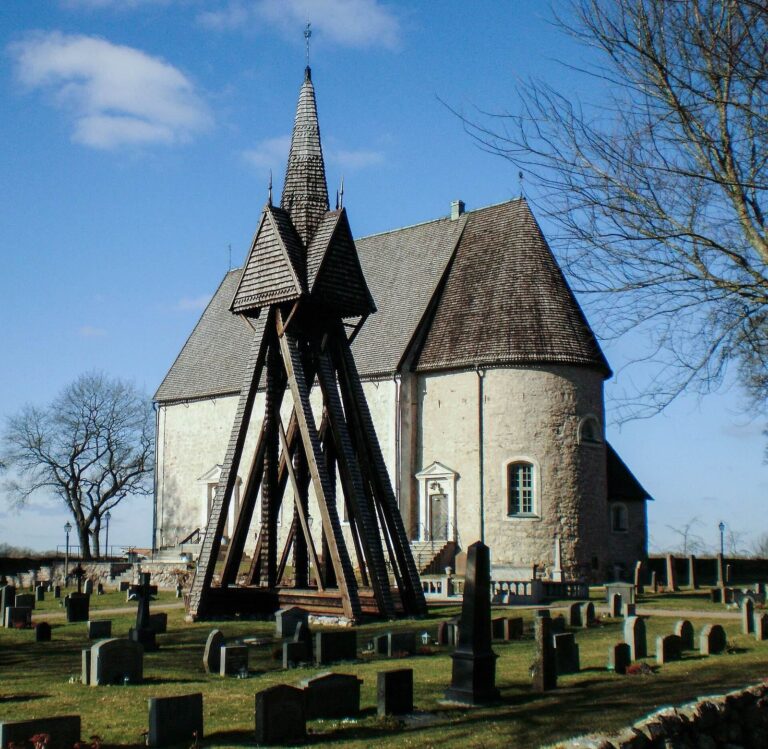
A timber church probably stood here around the middle of the eleventh century before a stone church replaced it. Over subsequent medieval phases, additions changed the building from a place of worship into a parish stronghold as well. Unsettled political conditions around the Baltic from the late twelfth century into the early thirteenth prompted this defensive role.
Drawings made in 1634 by antiquarian draughtsman J. H. Rhezelius show that the church had expanded in stages. Its development reflects successive alterations rather than a single building campaign.
War damage and rebuilding
During conflicts in the sixteenth and seventeenth centuries, the church suffered severe damage more than once. Its closeness to Borgholm Castle exposed it to harm, and the repeated repairs placed a heavy burden on the parish. After the building was judged dilapidated in the eighteenth century, major rebuilding began in 1802 under master mason Henrik Wermelin. The medieval west tower was completely rebuilt in 1820.
Later gifts added to the church’s furnishings. In 1937, Princess Sibylla and court jeweller Gunnar Svensson donated royal armchairs for the chancel. In 1951, Princess Sibylla gave the church two crucifixes under the terms of Queen Victoria’s will; the crucifixes had previously been kept at Solliden Palace.
Remains
The present church combines surviving sections of its medieval stone building with a hall-like interior from the later rebuilding. Its features include two-ended medieval tower remains, a former chapel, and furnishings from several centuries.
Medieval fabric
Stone church and towers
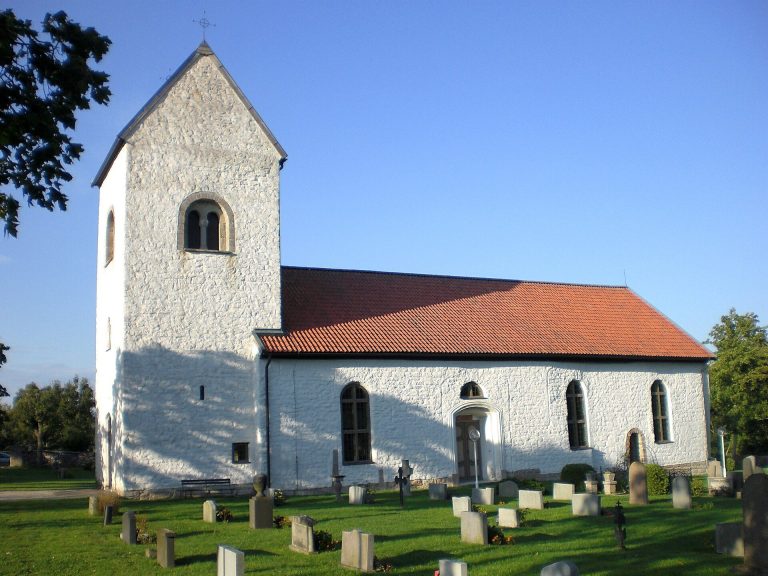
The first stone church, built in the first half of the twelfth century, had a nave, the main body of the church, and a chancel, the area around the altar, ending in a rounded apse to the east. Its south nave wall and west gable survive within the present building. A west tower was added in the second half of the twelfth century and an east tower followed near the century’s end, placing a tower at each end. The nave walls were raised to make a defensive upper storey, with narrow openings for observation or firing.
North chapel
A chapel added on the north side of the nave in 1240 retains part of its west side, including an arched opening and a small window. A medieval stone altar stands there, with a cross marked on its slab.
Later building and furnishings
Interior and west tower
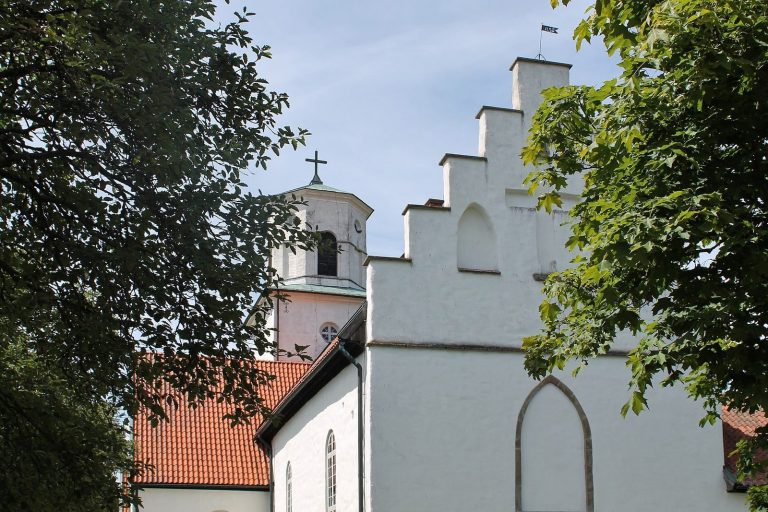
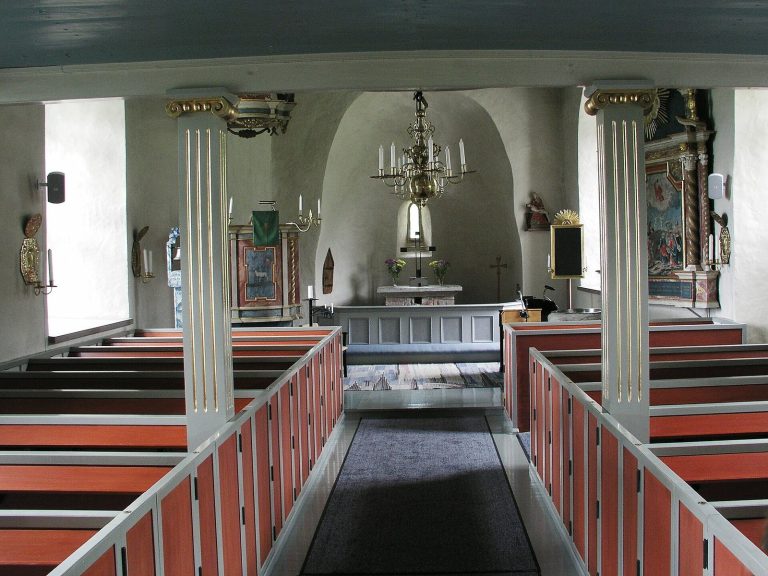
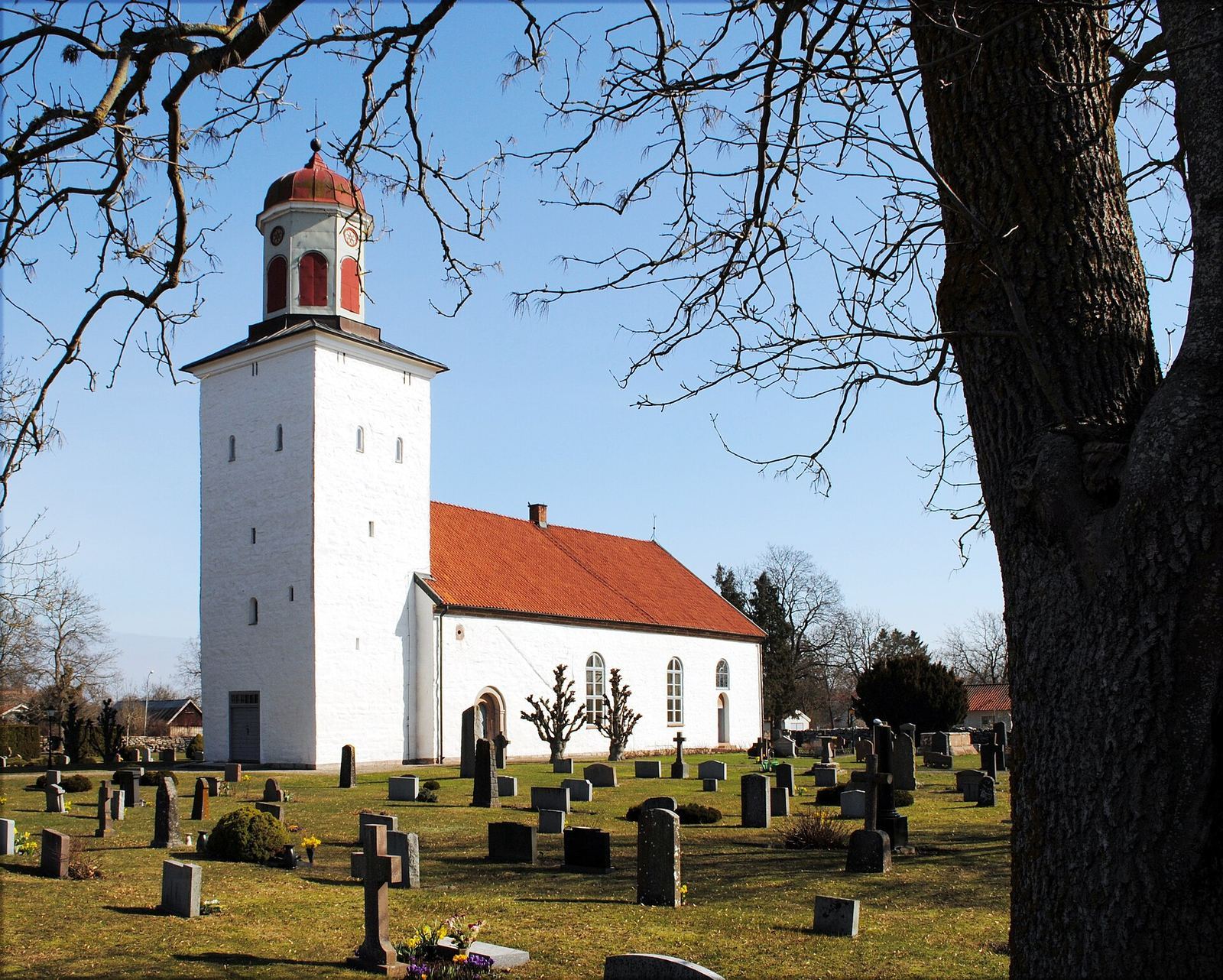
The rebuilt church has a broad, hall-like interior, large round-arched windows, and a barrel vault, a continuous tunnel-shaped ceiling. Its west tower carries an octagonal lantern, a raised structure on a tower, with a helmet-shaped roof topped by a cross. Two bells hang in the lantern. The larger was cast in 1684 by Hans Jackob Bierman; the smaller was made in Stockholm in 1750 by Johan Fahlsten. Both bells had earlier hung in a separate bell tower.
Chancel furnishings
The chancel’s rustic Rococo altarpiece, an ornate eighteenth-century style, was sculpted by Jonas Berggren in 1755, alongside a contemporary altar. Its central scene depicts the Raising of the Cross. Above it, an angel carries a cross and the Holy Spirit appears as a dove among rays and clouds; figures flanking the frame represent Law and Gospel. Berggren also made the pulpit, which Anders Georg Wadsten painted and gilded. Its main scene shows Jesus speaking with the Samaritan woman.
The chancel also contains gilded royal armchairs bearing the monograms of Gustaf V and Victoria. Woodcarver Theodor Karlsson of Virserum made them. Portraits of Gustaf V and Queen Victoria, painted by Olof Segerfeldt in Stockholm in 1941, hang there, and Gustaf V embroidered an altar frontal. Two crucifixes are among the church’s furnishings.
Gallery, windows, and other furnishings
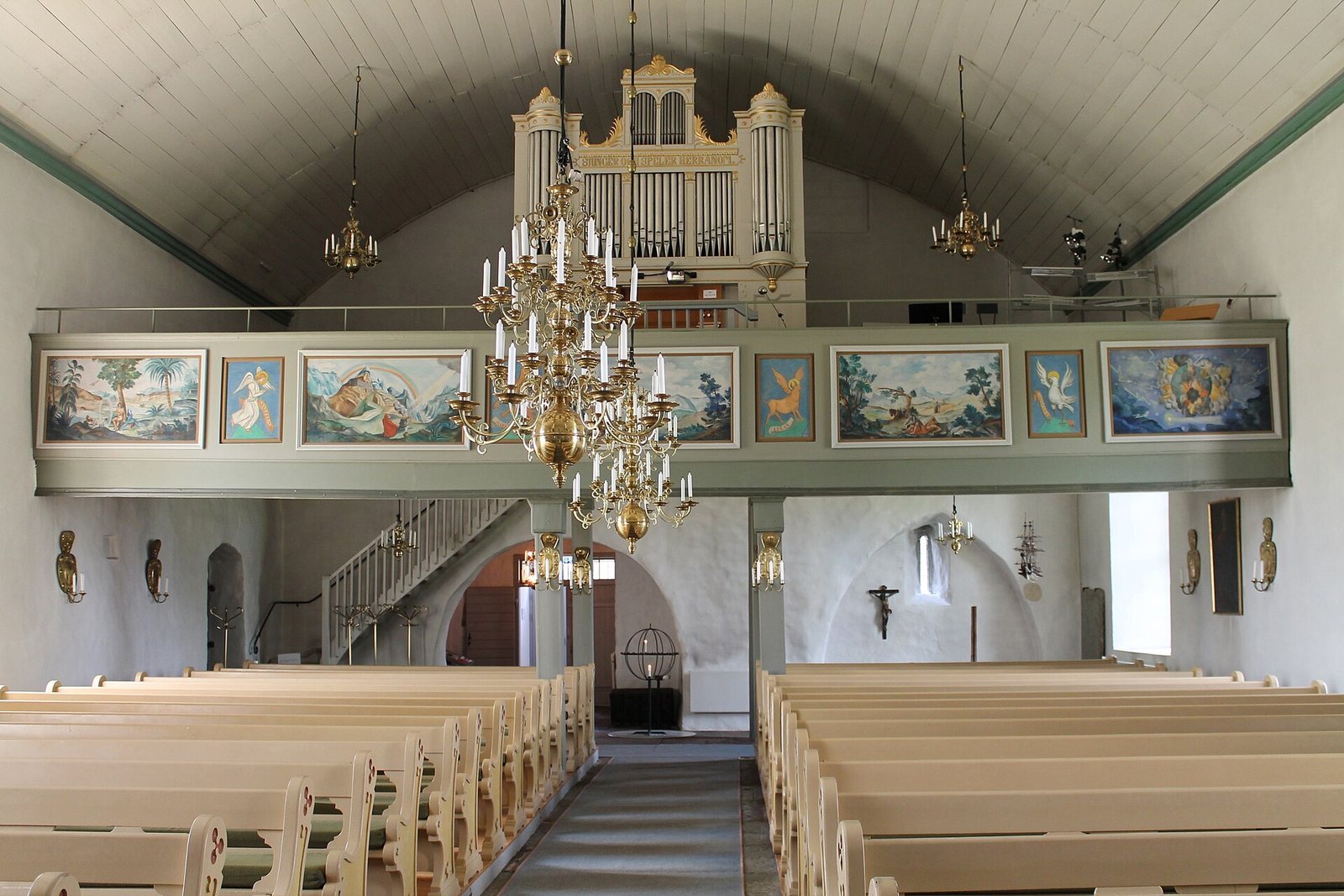
The gallery dates from the rebuilding period and carries paintings by Erik Jerken from 1929 and 1943. Their subjects include Adam in Paradise, Noah’s Ark, the Nativity, the Good Samaritan, and the end of the world. Jerken also designed the colorful chancel windows in 1929, showing the Sermon on the Mount and the Transfiguration of Christ. The south chancel window depicts God’s All-Seeing Eye.
A red-limestone baptismal font dates to 1642, the pews to 1905, and a votive ship, a model offered to a church, to 1690. The ship represents a Dutch warship and has elaborate sculptural decoration.
Organ
Nils Petter Petersson of Visby built a six-stop organ melodeon in 1854, with stops controlling groups of pipes with different tones. Ludvig Hawerman designed its façade. Emil Wirell of Virestad rebuilt the instrument in 1899, renewing its mechanism and adding a separate console. Olof Hammarberg of Gothenburg supplied an eleven-stop pneumatic organ in 1920, operated by air pressure. In 1965, A. Mårtenssons Orgelfabrik of Lund installed a mechanical organ, operated by physical linkages, behind Hawerman’s façade. Its specification has since been changed.