Zvolen Castle: A Medieval Hunting Residence in Slovakia


Site at a Glance
- Rating
- 4.3
- Popularity
- Medium
- Country
- Slovakia
- Primary era
- Medieval
- External website
- Open
- Eras represented
- Medieval, Early Modern
- Civilizations
- Habsburg, Hungarian
- Site type
- Military
- Remains
- Castle
On this page8 sections
History
Zvolen Castle is a medieval hunting residence in Zvolen, Slovakia, built for Louis I of Hungary in the second half of the fourteenth century and completed in 1382. Inspired by Italian castles of the period, it replaced an earlier regional seat above the meeting of the Slatina and Hron rivers. That older twelfth-century stronghold, now called Pustý hrad or “Deserted Castle,” stood on a steep cliff and was difficult to reach, encouraging the relocation of the seat to the new castle near the town.
Royal Residence and Dynastic Events
The castle was closely connected with the Hungarian monarchy from its foundation. In 1382, Louis I’s daughter Mary became betrothed there to Sigismund of Luxembourg, who later became king of Hungary and Holy Roman Emperor. Their wedding was celebrated at Zvolen Castle in 1385, giving the residence a role in an important dynastic alliance.
During the fifteenth century, John Jiskra of Brandýs held Zvolen Castle as one of his manors from 1440 to 1462. Matthias Corvinus, the Hungarian king known for his military power and patronage of the arts, visited the castle frequently. His wife, Beatrice of Aragon, used it as a manor from 1490.
Rebuilding and Early Modern Fortification
At the beginning of the sixteenth century, Jan Thurzo financed a late-Gothic rebuilding. Thurzo was a wealthy mining entrepreneur and councillor of Kraków, and Queen Anne had pledged estates in central Slovakia to him in exchange for loans. The castle was rebuilt again as the Ottoman threat grew. Ferdinand I commissioned Italian specialists in fortification, while Italian craftsmen contributed to reconstruction dated to 1548.
Further work took place during the sixteenth, seventeenth, and eighteenth centuries. A major reconstruction in 1784 included the rebuilding of the chapel in the Baroque style. The Esterházy family, who then owned the castle, sold it to the state in 1805.
Modern Preservation and Museum Use
Zvolen Castle was later reconstructed and revitalized. Its status as a national cultural monument of the Slovak Republic was declared in 1961. The castle now houses a regional branch of the Slovak National Gallery, whose exhibitions of old European masters include works by Peter Paul Rubens, Paolo Veronese, and William Hogarth.
Remains
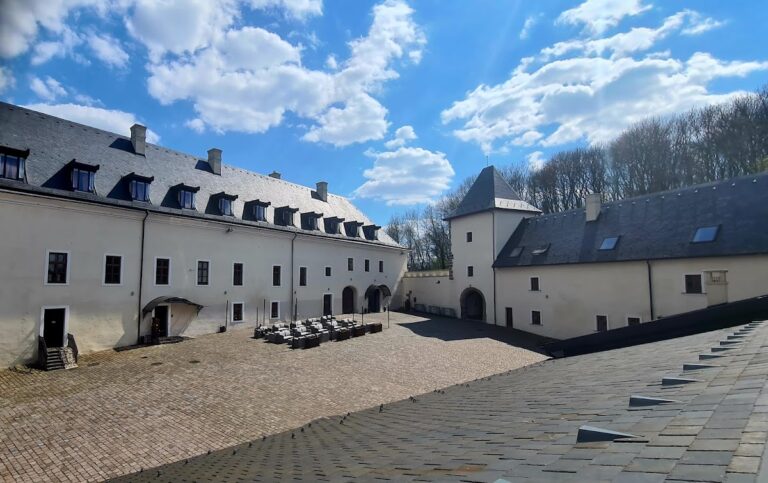
The castle forms a medieval complex on a hill near the center of Zvolen. Its Gothic core is enclosed by Renaissance fortifications, while later alterations gave parts of the residence a Baroque character. The overall complex preserves evidence of successive changes from a royal residence inspired by Italian models to a fortified early modern palace.
Gothic Palace
The late-fourteenth-century palace retains elements of its original Gothic mass, including frames for three-part windows and red-and-white rustication. Its interiors contain wall paintings and richly ornamented stone portals, particularly in the ground-floor rooms. These features belong to the residential character established when the castle was built for Louis I.
Renaissance Defenses
A defensive circuit added around 1500 surrounds the earlier castle. It includes four round bastions and a square entrance gate tower, while the southern side incorporates a building known as the Captain’s House. In the mid-sixteenth century, an additional storey with embrasures, openings used for weapons, and corner oriel towers, projecting upper-storey towers, was added. An artillery bastion followed around 1590.
Chapel and Baroque Interiors
A chapel occupies the western part of the courtyard. It was rebuilt in the Baroque style in 1784 during the castle’s major eighteenth-century reconstruction. The complex also contains an eighteenth-century Baroque hall with a coffered ceiling, adding a later ceremonial interior to the medieval and Renaissance fabric.
Nearby sites