Gärdslösa Church: A Medieval Lutheran Parish Church on Öland


Site at a Glance
- Rating
- 4.2
- Popularity
- Very Low
- Country
- Sweden
- Primary era
- Medieval
- External website
- Open
- Eras represented
- Medieval, Early Modern, Modern
- Civilizations
- Swedish
- Site type
- Religious
- Remains
- Fortified Church
On this page15 sections
History
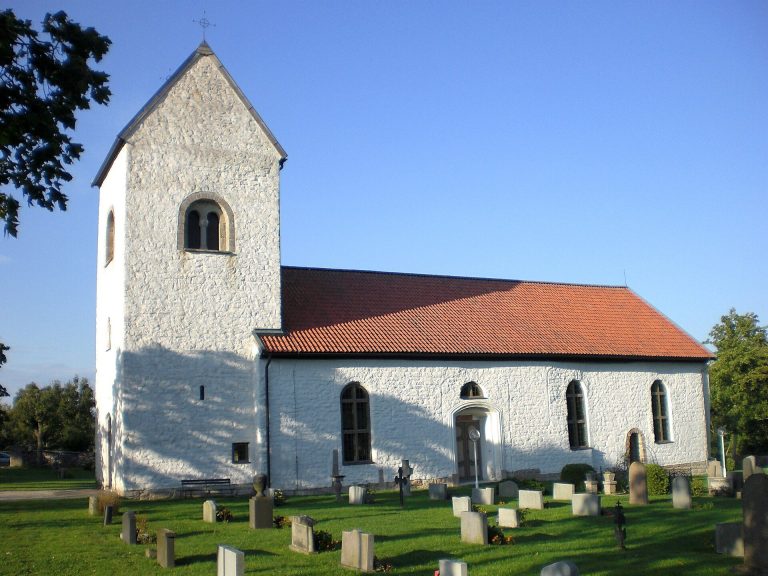
Gärdslösa Church is a Lutheran parish church in Sweden, on the island of Öland, whose present building dates from the twelfth century and retains a largely medieval character. It belongs to the Diocese of Växjö, the administrative district of the Church of Sweden governed by a bishop, and served for a long period as a religious centre for Öland.
Early church and medieval expansion
A Christian runestone in the porch indicates that a wooden church may have occupied the site as early as the eleventh century, although this possibility has not been proven. The present church belongs to the twelfth century, and tradition places its inauguration in 1138. Its oldest surviving fabric is the western part of the nave, followed shortly afterward by the foundation of the tower.
The building was enlarged through several medieval campaigns. Around 1200, the tower was raised and given a defensive storey when the church was adapted as a fortified church against pagan seaborne raiders. The north and south transepts, which project at right angles from the nave, were added in the middle of the thirteenth century. Their construction is associated with Håkan Tanna, while the master stonemason Ronensis from Gotland is linked with a later rebuilding of the choir.
At about 1270, the original apsidal choir was demolished and replaced by a straight-ended one. The choir was then rebuilt in stages. During the first half of the fourteenth century, the nave was widened and joined to a new choir, producing the principal medieval arrangement that survives today.
Later changes and continuing associations
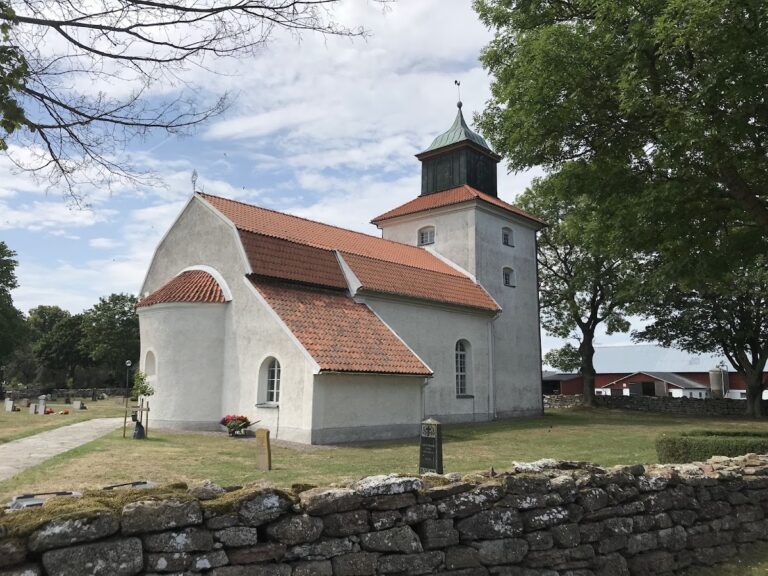
A sacristy, the room used to store liturgical objects and prepare for worship, was added in the eighteenth century, while remains of an earlier sacristy survive on the south side. The church’s windows were enlarged and its spire altered in 1845. These changes modified parts of the exterior, but the building still largely preserves its medieval appearance.
The church was renovated in 1957 and 1958. During the work, medieval and later wall paintings that had been covered over in 1781 were uncovered and conserved in 1958. Gärdslösa Church is sometimes regarded as the best-preserved medieval church on Öland.
The building has also retained associations with notable people and events. On 30 June 1964, Princess Margaretha of Sweden, sister of King Carl XVI Gustaf, married the English businessman John Kenneth Ambler here. The Swedish poet Erik Johan Stagnelius was born in the parsonage in 1793, where his father served as priest for several years and where Stagnelius spent his childhood. A memorial stone with a portrait medallion by the sculptor Arvid Källström was erected near the church in 1924. A burial chapel was added to the churchyard in 1968.
Remains
Medieval building
Nave, tower, and transepts
The church consists of a nave, north and south transepts, a choir nearly as wide as the nave, and a tower at the west end. The westernmost part of the nave is the oldest surviving section, with the tower foundation dating from slightly later. The transepts have vaulted ceilings and separate portals on their north and south sides. Their portals, columns, bases, and capitals carry sculpted decoration.
Choir and vaults
The choir ends in a straight eastern wall crowned by a crow-stepped gable, whose stepped outline rises toward the roof peak. The gable is decorated with blind arches, recessed arches that do not open through the wall, and is described as unique of its type on Öland. An old Romanesque portal, belonging to a medieval tradition of round-headed arches and substantial masonry, provides access to the choir.
The cross vaults date from approximately 1240 and are attributed to the conventionally named Master of Gärdslösa, an otherwise unidentified medieval craftsman. Their consoles are richly decorated with figures. The sculptor is unknown but may have come from Gotland. The exterior walls are whitewashed, with a small area deliberately left exposed to show the stone, while the surviving structure as a whole presents a strongly medieval appearance.
Paintings and furnishings
Wall paintings
Wall paintings and frescoes from several periods cover the walls and arches. A thirteenth-century fresco on the east wall of the north transept depicts Saint Margaret. The nave decoration from 1498 is attributed to Magnus Ingelsson and includes apostles, ornamental foliage, band ornament, and consecration crosses.
A painting on the north wall of the choir, dating from the late sixteenth century, shows a wolf on a coat of arms. Other choir paintings date from 1642. Their Old Testament scenes include Samson killing a lion, Absalom’s flight, Cain murdering his brother, and the sacrifice of Isaac. The south wall shows David and Goliath and Bathsheba bathing, together with long inscriptions in a Gothic style. The artist is unknown and may have worked at Kalmar Castle.
Altar and older objects
The altarpiece was made between 1764 and 1766 by the painter Anders Georg Wadsten and the sculptor Jonas Berggren. It was modelled on the altarpiece in Kalmar Cathedral and includes a painting of Christ in Gethsemane. The oldest furnishing is a small triumphal cross from around 1300 or the early fourteenth century. A Madonna and Child from the late fifteenth century was made in a northern German workshop.
Pulpit and baptismal font
On the south side stands a pulpit made in 1666 by the Scottish artists Peter and Jonas Bundie, who worked in Kalmar. Its eight painted panels portray Christ and seven apostles. A contemporary hourglass was made by Jacobus Hartmann of Leipzig. The baptismal font, donated in 1670, is made of Öland limestone. Outside the south portal, a sundial stands on the foot of an older baptismal font.
Ship model and later furnishings
A votive model, a vessel displayed as a religious gift, hangs in the north-western part of the church. Dated 1682, it represents the royal ship Nyckeln, which sank in 1679. Other eighteenth-century furnishings include chandeliers, a number board, silver communion vessels, a bridal crown, a chasuble, and a chalice veil.
The first organ was installed in 1759. It had been built in 1693 by Magnus Åhrman of Borås. An instrument from the Åkerman & Lund workshop replaced it in 1884, and Hammarbergs Orgelbyggeri supplied another organ in 1958.
Churchyard and nearby monuments
Churchyard features
The churchyard contains two thirteenth-century gable-shaped grave monuments. Its wooden entrance gates date from the eighteenth century, and nearby iron rings were formerly used to tether the horses of churchgoers. Foundations of a former guildhall remain visible in the north-western part of the churchyard. A burial chapel built in 1968 also stands within the grounds.
Memorials and stone cross
About 200 metres east of the church, at Tjusby, stands Minneskors, a memorial cross believed to date from the twelfth century. It is regarded as one of Sweden’s oldest stone crosses. Near the church, the 1924 memorial to Erik Johan Stagnelius bears the portrait medallion made by Arvid Källström.