Sogn Gieri: A Medieval Painted Church near Rhäzüns
Site at a Glance
- Rating
- 4.8
- Popularity
- Very Low
- Country
- Switzerland
- Primary era
- Medieval
- External website
- Open
- Eras represented
- Medieval, Early Modern
- Civilizations
- Holy Roman Empire
- Site type
- Religious
- Remains
- Church
On this page8 sections
History
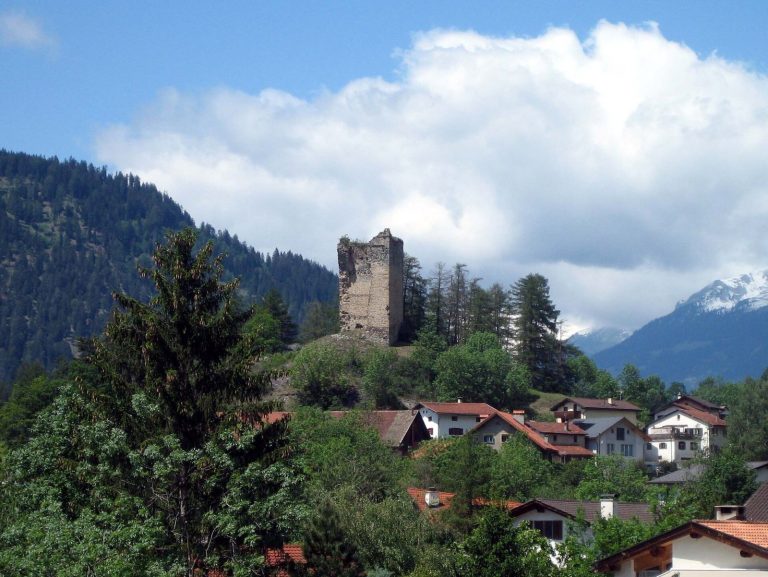
Sogn Gieri is a small Roman Catholic church in Switzerland, located outside Rhäzüns in Graubünden. Its history reaches back to an earlier church built between about 750 and 850, and it preserves an exceptional cycle of medieval paintings in a single nave. The church belongs to the Roman Catholic parishes of Bonaduz and Rhäzüns, and its patronal feast is celebrated on 23 April, the feast day of Saint George.
Early church and medieval expansion
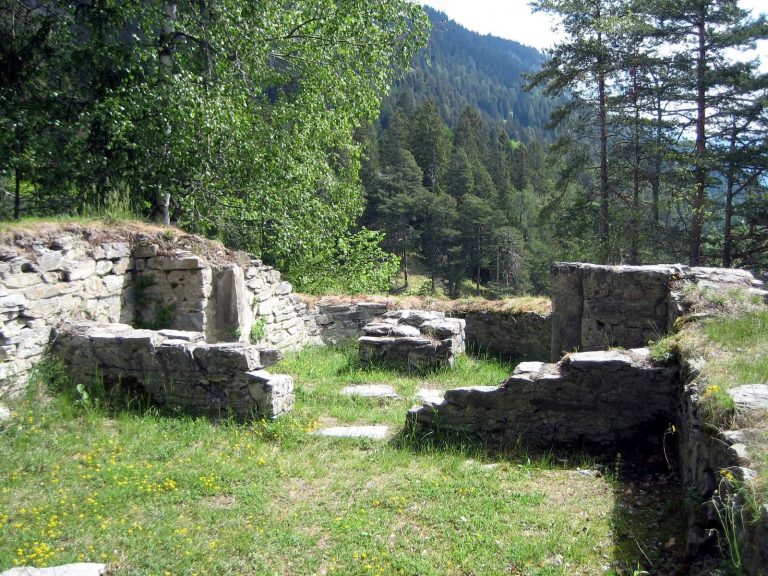
Archaeological excavations carried out in 1961 and 1962 revealed an earlier single-nave church with an apse and a walled forecourt. During the first millennium, the apse was moved farther east, indicating a change to the early building. Sogn Gieri appears in a written record from 960 as a castle church, in an entry that names Bonaduz and Rhäzüns. A later reference from the first half of the twelfth century calls it the Church of Saint George.
The nave was lengthened toward the west during the twelfth and thirteenth centuries. At the beginning of the fourteenth century, a late Gothic choir was inserted. This later medieval architectural tradition is associated with more complex vaulting and pointed forms. A tower was added during the fourteenth or fifteenth century, after the original church had been built.
Legend and later alterations
Sogn Gieri is traditionally linked with Saint George, the Christian martyr and warrior saint associated with the defeat of a dragon. According to local legend, George escaped his adversaries by leaping across the Rhine on horseback. He then had the church built at the site in gratitude for divine assistance. This episode was also represented among the church’s wall paintings.
In the sixteenth century, the church was heightened and its entrance was transferred from the south side to the west. The ceiling was renewed in 1731, the last major structural alteration recorded. The restoration of 1961 and 1962 removed the original star decoration from the blue ceiling, while the same campaign brought the earlier building phases to light through archaeological investigation.
Sogn Gieri is recognized as a Swiss cultural property of national importance. Its interior preserves a complete Biblia Pauperum, or “Bible of the Poor,” a sequence of visual scenes that presents biblical narratives for religious teaching, including to people who could not read. The visual story begins with the Creation and ends with the Last Judgment.
Remains
Setting and exterior
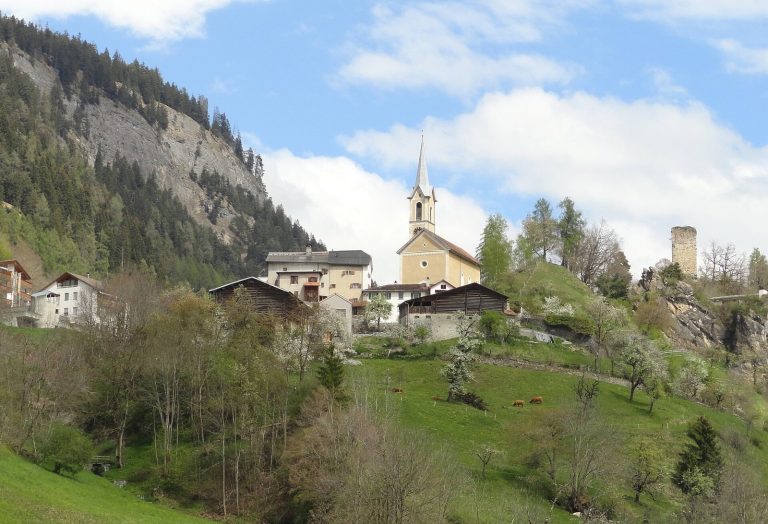
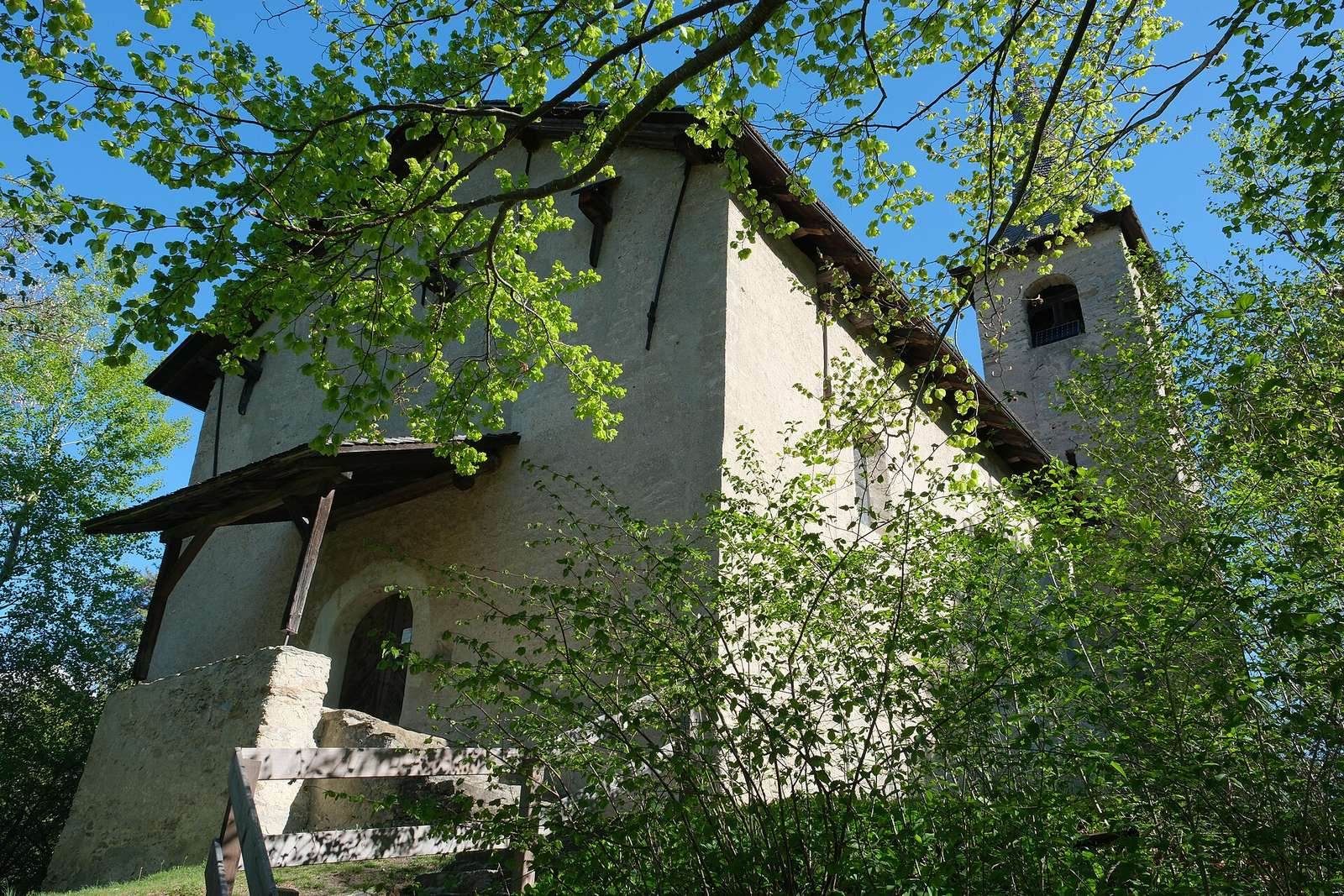
The church stands on a small wooded hill on a high plateau, directly beside the steep bank of the Hinterrhein. Its walls are built of roughly plastered rubble stone, with tuff stone reinforcing the corners. The nave and choir form a unified building beneath a gabled roof. Beneath the eastern gable, a covered double-flight staircase leads to the entrance.
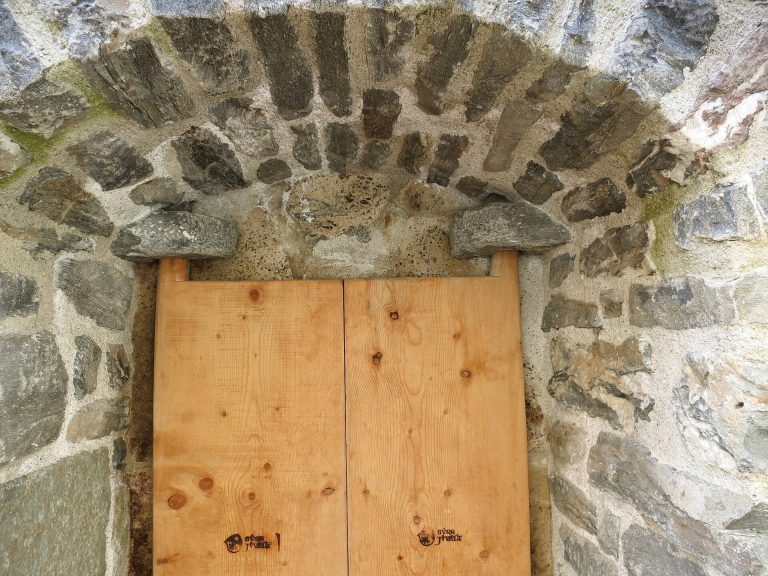
The north wall of the nave contains two Romanesque round-arched windows. Romanesque churches commonly use rounded arches and narrow slit windows, and Sogn Gieri retains this character in its high-set openings. The south wall has three segmental-arched windows and the original main portal, which was later walled up when the entrance was moved.
Interior structure
The interior occupies an irregular rectangle and receives light through high Romanesque slit windows. The northern slit window survives in its original form. The nave has a flat boarded ceiling made by Jakob Moron in 1731. Its central panel shows Saint George fighting the dragon and carries the inscription “M.I.Mor 1731.” Behind the chancel arch, the choir has a cross vault with a disk-shaped keystone.
The almost square tower has a pointed helmet roof. A window visible from inside the church opens into the tower, providing evidence that this structure was added after the original church. Two bells hang in the tower. The larger, of unknown manufacture, has a diameter of 89.5 centimetres, weighs about 440 kilograms, and is tuned to c”. Its inscription is dated 1465 and invokes the King of Glory, followed by the names of the evangelists and a reference to the Word becoming flesh.
The second bell dates from around 1350. It measures 72.5 centimetres in diameter, weighs about 240 kilograms, and is tuned to dis”. Half-length angel figures appear on it beside an inscription naming Luke, Mark, Matthew, John, and George.
Medieval wall paintings
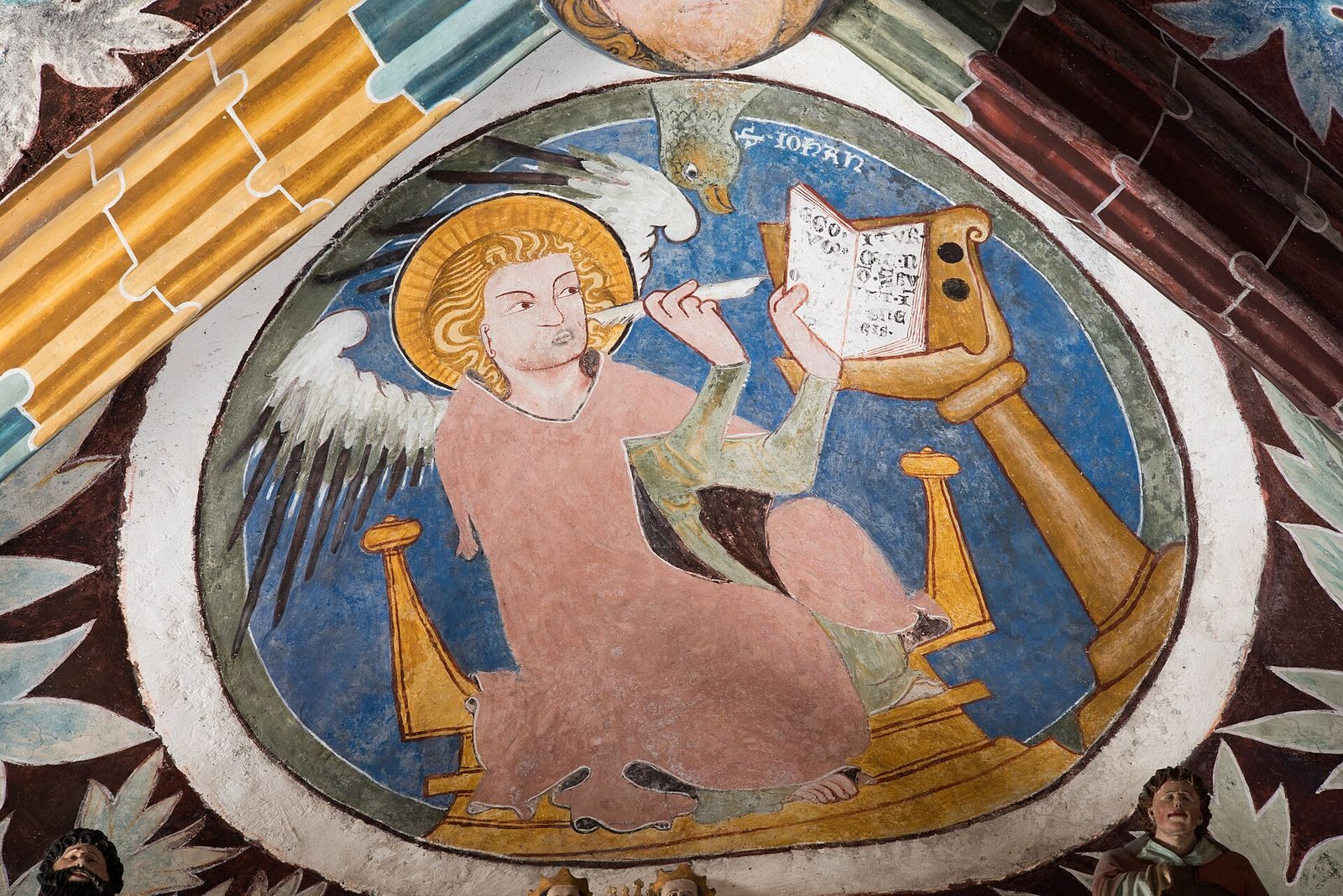
The choir contains well-preserved Gothic frescoes painted in strong colors around 1330 to 1340. They are attributed to the Waltensburg Master, the conventional name for an unidentified Gothic mural painter active in the Alpine region. The paintings are partly concealed by the winged altarpiece. Evangelists represented as angels occupy the principal fields of the choir vault.
A fragment from the first half of the fourteenth century shows Saint George fighting the dragon and is also attributed to the Waltensburg Master. On the north wall, a prominent version of the same subject recalls representations in the Manesse Codex. Beneath it, another painting shows George leaping across the Rhine gorge. The coat of arms of the Lords of Rhäzüns appears below and to the right.
Large remains of a Saint Christopher painting survive on the south wall of the choir and are likewise attributed to the Waltensburg Master. The frescoes combine elegant saints and noble knights with stark scenes of Saint George’s torture, giving the painted cycle both devotional and dramatic subjects.
Paler frescoes on the side walls were made by a different unidentified painter conventionally called the Rhäzüns Master. These scenes come from the Old and New Testaments and form part of the church’s wider visual biblical narrative.
Altarpiece and furnishings
The late Gothic winged altarpiece dates from 1522 and originated in southern Germany. When closed, it shows the Adoration of the Magi. When opened, its painted wings display Saints Catherine and Dorothy on one side and Saints Lawrence and James the Elder on the other. Within the altarpiece, a Madonna is accompanied by Saint John the Baptist and Saint George on her left, and Saints Martin and Felix on her right. The original figure of Felix was replaced by a smaller late Gothic figure.
Around 1550, the shrine canopy above these figures was painted with the coat of arms of the Solèr family of Lugnez, who donated the altarpiece. Painted figures of Saint George and Saint Luzius flank the canopy. The chest-shaped pulpit was made by Heinrich and Georg Moron in 1659, while simple-beam kneeling benches have stood on the lime-mortar floor since 1661.