Śmiełów Palace: A Classical Residence and Adam Mickiewicz Museum in Poland


Site at a Glance
- Rating
- 4.7
- Popularity
- Medium
- Country
- Poland
- Primary era
- Early Modern
- External website
- Open
- Eras represented
- Early Modern
- Civilizations
- Kingdom of Prussia
- Site type
- Domestic
- Remains
- Elite Residence
On this page8 sections
History
Śmiełów Palace is a Classical residence in Poland, built in 1797 for Andrzej Gorzeński to a design by Stanisław Zawadzki, a leading architect of the Classical period. Classicism drew on the forms and principles of ancient Greek and Roman architecture. Zawadzki had been brought from Warsaw after the fall of the Kościuszko Uprising, and the palace became an important estate beside the border dividing the former partitions of Poland.
The Gorzeński Estate
The location gave Śmiełów a political role during the nineteenth century. The partitions of Poland had divided the former Polish-Lithuanian Commonwealth among neighboring powers, leaving Wielkopolska under Prussian rule during the period relevant to the palace. Śmiełów served as a transit point for people and literature connected with independence activities.
Hieronim Gorzeński, Andrzej’s son, served as an aide-de-camp to Marshal Louis Davout during Napoleon’s campaign in Russia. After returning to Śmiełów, he managed the estate, which became known in part for horse breeding. He also took part in several patriotic organizations. The palace’s role as a support point for independence activity grew after the November Uprising, a Polish insurrection against Russian rule that began in 1830 and continued into 1831. Adam Mickiewicz, a major Polish Romantic poet and national literary figure, stayed at Śmiełów for several weeks in August 1831.
The Chełkowski Era
After the Gorzeński family line died out in 1887, the indebted estate was purchased by Franciszek Chełkowski. The Chełkowski family modernized the farm and formed a collection of memorabilia connected with Mickiewicz in the palace. They also developed the residence as an open house for cultural and political figures. Until the outbreak of the Second World War, visitors included Henryk Sienkiewicz, Ignacy Paderewski, Wojciech Kossak, Ludwik Puget, Ludomir Różycki, and Władysław Tatarkiewicz.
Occupation and Museum
After German forces entered Wielkopolska in 1939, Józef and Maria Chełkowski were interned. The occupiers took over the estate, including the palace. After 1945, the building was looted and divided into apartments, and it later housed a school.
The National Museum in Poznań took over Śmiełów Palace in 1970, renovated it, and opened the Adam Mickiewicz Museum in Śmiełów in 1975. The museum is a branch of the National Museum in Poznań. Its collections include paintings, sculptures, printed works, and craft objects connected with Mickiewicz. Dedicated rooms address Pan Tadeusz, Dziady, Mickiewicz and Henryk Sienkiewicz, and Józef and Maria Chełkowski. The palace is entered in the register of immovable monuments of the Wielkopolskie Voivodeship.
Remains
Plan and Exterior
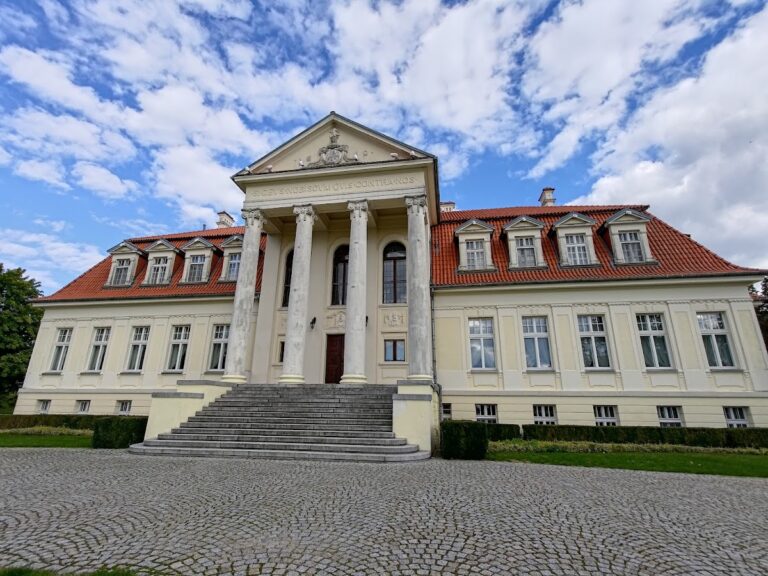
The palace has a two-storey main block joined by semicircular galleries to two service wings, creating a horseshoe-shaped plan with a span of approximately 43 metres. A four-column portico with columns of the giant order stands before the main block. It bears the Nałęcz coat of arms of the Gorzeński family, while a Nałęcz coat of arms associated with Hieronim Gorzeński is also connected with the palace.
The design was inspired by Villa Badoer at Fratta Polesine, created by the sixteenth-century Italian architect Andrea Palladio, whose work strongly influenced later European Classical architecture. The service wings have Kraków roofs, which incorporate raised knee walls. At least some of the farm buildings, including the stable, coach house, and granary, were also designed by Zawadzki.
Interior Arrangement and Decoration
The harmonious Classical exterior contrasts with an irregular and complex interior. Numerous niches, corners, and small rooms shape the arrangement, while the distinction between representative and residential areas is blurred because the ground floor and first floor are almost the same height. The west service wing contained guest rooms, and the east wing, which has a separate garden entrance, contained the kitchen.
An octagonal salon projects from the garden façade without a direct connection to the stairwell. Beneath it is an octagonal basement room with a barrel vault and lunettes, curved sections of vaulting formed where a vault meets an opening or another vault. The room served as a meeting place for a Masonic lodge, a local organization of Freemasonry whose members traditionally gathered for ceremonies and assemblies. A feature known as the Masonic altar in the stairwell is also associated with Masonic symbolism.
Franciszek and Antoni Smuglewicz were commissioned to provide the interior paintings. The oval salon has an iconographic program referring to Homer’s Iliad, while the blue salon contains rustic-themed frescoes imitating Pompeian painting. These painted decorations survive in two ground-floor rooms.
Park and Landscape
Śmiełów Palace stands above a broad valley. The grounds extend across meadows toward a range of hills and the silhouette of the church at Brzostków. A maintained landscape park surrounds the residence and stretches toward the forests along the Warta River. The museum’s historic park also includes Zosia’s Garden and a monument to Adam Mickiewicz.