Palace in Winna Góra: A Historic Residence and Memorial to General Dąbrowski


Site at a Glance
- Rating
- 4.5
- Popularity
- Low
- Country
- Poland
- Primary era
- Modern
- External website
- Open
- Eras represented
- Early Modern, Modern
- Civilizations
- German, Polish–Lithuanian Commonwealth
- Site type
- Domestic
- Remains
- Manor House
On this page10 sections
History
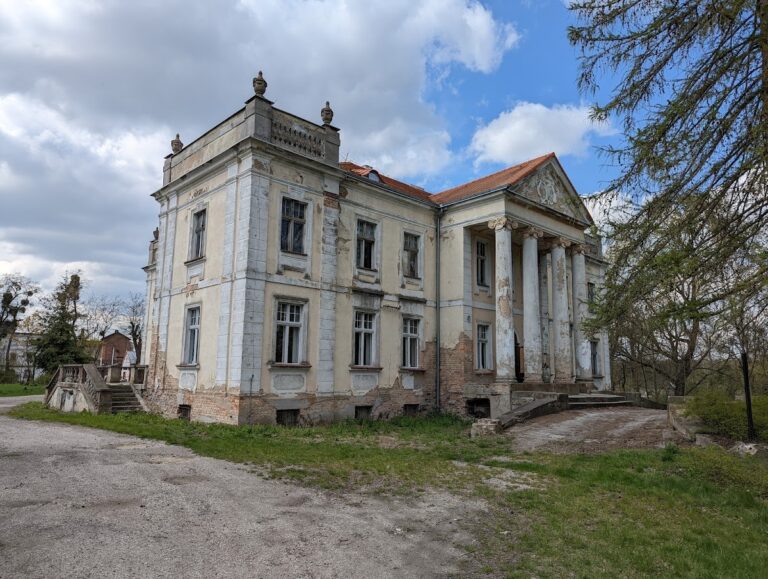
The Palace in Winna Góra is a historic residence in Poland, whose first building was erected as a Baroque palace between 1760 and 1770 on the initiative of Teodor Kazimierz Czartoryski, the Roman Catholic Bishop of Poznań. Set on a plain between forests to the north and vineyards to the south, the estate later became closely associated with General Jan Henryk Dąbrowski, a Polish military leader of the Napoleonic period whose name is also commemorated in the Polish national anthem.
The eighteenth-century residence
The original palace formed the centre of a landscaped estate. Its entrance drive was lined with lime trees, while former moats remained behind the building. A formal French garden, an orchard, and a plantation of mulberry trees surrounded the residence. The palace and its lands were confiscated by Prussian authorities in 1796, changing the ownership of the estate during a period when Polish territories were under Prussian control.
Dąbrowski’s Temple of Victory
On 30 June 1807, Napoleon granted Winna Góra, together with the towns of Środa and Pyzdry, ten manor farms, and a dozen or so villages, to Jan Henryk Dąbrowski. The grant covered more than 2,500 hectares. Napoleon was the French emperor and military ruler who dominated much of Europe in the early nineteenth century, and Dąbrowski had served as a general associated with the Polish Legions during the Napoleonic period.
Dąbrowski transformed the palace into a national memorial known as the Temple of Victory. Its displays brought together documents and memorabilia connected with Polish military struggles. Wall frescoes commemorated battles and the legionnaires who had fallen while fighting alongside Dąbrowski. The arrangement was probably inspired by Izabela Czartoryska’s Temple of the Sibyl at Puławy, another setting devoted to objects associated with Polish national memory.
The Temple of Victory included Jan Gładysz’s painting The Entry of General H. Dąbrowski into Poznań, together with busts of Napoleon, John III Sobieski, and Stefan Czarniecki set on columns. These objects and images gave the residence a commemorative purpose rooted in Polish military history.
A centre of Polish national thought
After Napoleon’s fall, Dąbrowski settled permanently at Winna Góra. The palace then became an important centre of Polish national thought. Visitors included Julian Ursyn Niemcewicz, Władysław Syrokomla, and Henryk Sienkiewicz. The estate continued to carry Dąbrowski’s memorial significance after his death, even as its ownership passed through later family disputes and transfers.
Following the death of Dąbrowski’s son Bronisław and a prolonged dispute with Bronisław’s widow, Weronika née Łącka, Winna Góra was purchased by Napoleon Ksawery Mańkowski, the son of Bogusława. The estate subsequently passed to his son Henryk Mańkowski, who used the Zaręba coat of arms, a Polish heraldic emblem.
The Mańkowski residence and twentieth-century changes
By the beginning of the twentieth century, the old palace was in poor technical condition. Henryk Mańkowski responded by commissioning a new residence nearby. Designed by Stanisław Borecki, it was built in 1910–1911 as a traditional manor house that was nevertheless modern and relatively large for its time.
Winna Góra remained with Henryk Mańkowski and later with his son Andrzej until the outbreak of the Second World War. The owners were then expropriated, and the property was taken over by German authorities. After the war, the estate was nationalized. In 1963, the palace came under the Institute of Plant Protection in Poznań, and efforts began to return General Dąbrowski’s memorabilia to Winna Góra.
A General J. H. Dąbrowski Memorial Room was established in 1987. It operated independently until 1997, when it became a branch of the Museum of the Origins of the Polish State in Gniezno. In 2003, the Institute leased and later sold the palace, park, and most of the estate to Stanisław Hybner, a manufacturer of bathroom ceramics. He carried out a thorough renovation while retaining the memorial room.
After the property was acquired by the Marshal’s Office of the Wielkopolskie Voivodeship, the palace housed a branch of the Museum of the Landed Gentry in Dobrzyca from 2018. In January 2021, the General Dąbrowski Palace in Winna Góra became an independent cultural institution of the Wielkopolskie Voivodeship. It functions as a centre for interpreting the history of Dąbrowski and the pioneers of organic work, a Polish social and economic programme that emphasized education, civic organization, and the strengthening of Polish society and economic life alongside armed struggle. The institution also organizes cultural and civic initiatives with local institutions and organizations. The palace has been protected as a historic building since its entry in the register under number 1438/A on 12 April 1973.
Remains
The earlier Baroque palace and gardens
The first residence was a Baroque building, a style known for monumental forms and rich, dynamic decoration. A lime-tree-lined drive led toward the palace, while former moats survived behind it. The estate’s grounds included a formal French garden, meaning a geometric garden arranged according to a planned design, as well as an orchard and a mulberry-tree plantation. These elements established the relationship between the residence, its approach, and its cultivated surroundings.
The present manor house
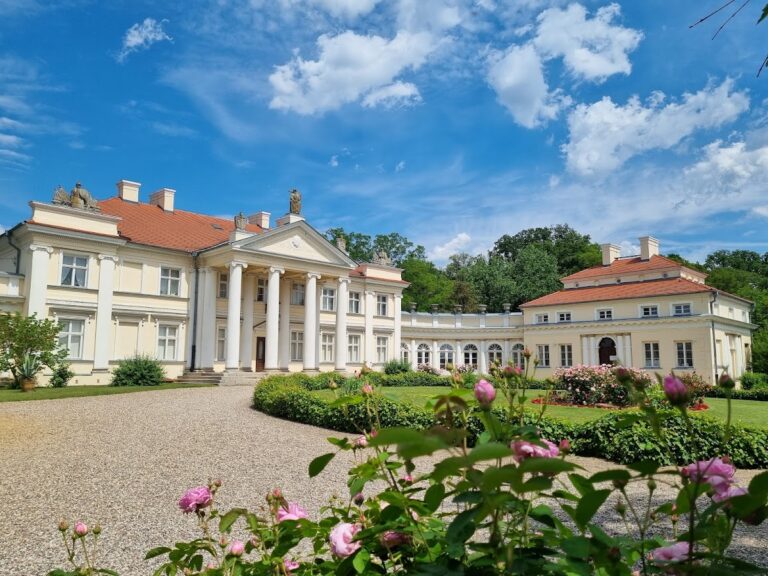
Stanisław Borecki’s palace of 1910–1911 takes the form of a traditional manor house. Its lower storey is a high basement that is only slightly sunk into the ground, with large windows comparable to those of a residential floor. Above it, the upper storey is concealed within a large Polish mansard roof, a distinctive broken roof form containing numerous dormer windows. Dormers are windows that project from a sloping roof.
Stone steps lead to a monumental four-column portico, or columned entrance porch. The columns rise through more than one storey in a giant order and support a triangular tympanum, the field above a classical façade or portico. The tympanum bears the Mańkowski family’s Zaręba coat of arms. The façade also carries the inscription “SI DEUS NOBISCUM QUIS CONTRA NOS,” meaning “If God is with us, who can be against us?”
Interior arrangement and collections
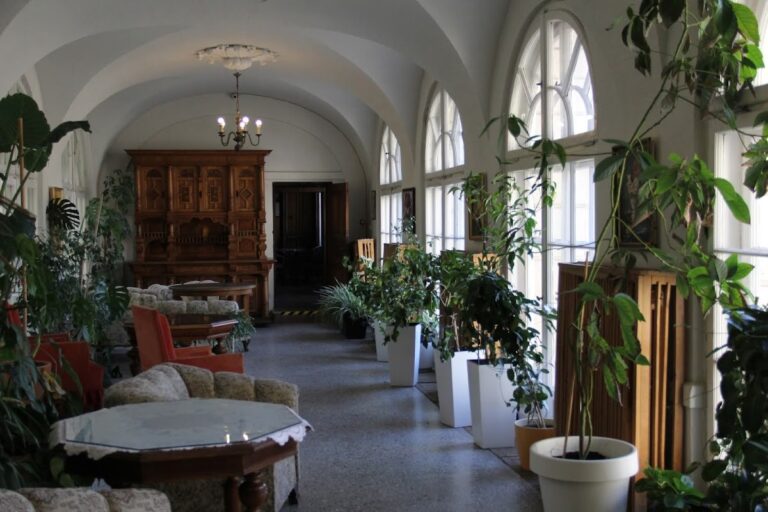
The interior is organized around a tall, two-storey hall arranged in the English style. It contains a fireplace, a two-flight staircase, and a front mezzanine, an intermediate or partial upper level. Central heating and bathrooms were installed from the beginning, reflecting the modern facilities incorporated into the new residence.
The palace held family memorabilia, fine furniture, paintings, Napoleonic memoirs, and noblemen’s Slutsk sashes, elaborately woven ceremonial belts associated with the Polish-Lithuanian nobility. It also contained a collection of more than 10,000 coins assembled by Dąbrowski. The collections were dispersed, and much of this material was lost during the Second World War. The surviving commemorative purpose of the residence is represented by the General J. H. Dąbrowski Memorial Room, retained during the later renovation.
Estate grounds
The present residence was accompanied by a garden complex of approximately eight hectares. The grounds included two ponds and a large manor farm, extending the estate beyond the palace itself and preserving its role as the centre of a substantial landed property.