Palazzo Granafei Nervegna: A Renaissance Palace in Brindisi



Site at a Glance
- Rating
- 4.6
- Popularity
- Medium
- Country
- Italy
- Primary era
- Early Modern
- External website
- Open
- Eras represented
- Early Modern
- Civilizations
- Kingdom of Naples, Spanish
- Site type
- Domestic
- Remains
- Elite Residence
On this page8 sections
History
Granafei origins and the early palace
Palazzo Granafei Nervegna is a Renaissance-style historic palace in Brindisi, Italy, whose original nucleus is documented from 1565. At that time, Nicolò Granafei owned the building, which was recorded during a pastoral visitation by Giovanni Bovio, archbishop of Brindisi. The Renaissance was a cultural and artistic period associated with renewed interest in classical forms, symmetry, humanist learning, and architectural ornament. In southern Italy, it broadly covered the fifteenth and sixteenth centuries.
Tradition held that the Granafei family came from Constantinople and fled to Oria after the city was captured by the Ottoman sultan Mehmed II. The family moved to Brindisi in 1508, encouraged by Ferdinand of Aragon’s efforts to repopulate the Salento city. The palace remained linked to the family even when its members did not live in Brindisi, and it was frequently rented to other occupants.
Descriptions from later centuries show the palace developing as a large residence. In 1699, it included a hall, rooms, storerooms, a garden, and further spaces above and below ground. An arrangement recorded in 1749 listed an upper hall, a north-facing antechamber, three adjoining rooms, a chapel, an alcove room, a women’s room, additional side rooms, a kitchen, and a pantry. The lower level included stables and storerooms.
Transfer to the Nervegna family
The palace passed to the Nervegna family in the eighteenth century, while the Granafei family moved to Mesagne during the early nineteenth century. The Nervegnas originated in Ortona and settled in Brindisi at the beginning of that century. Giuseppe and Luigi Nervegna traded agricultural products through Adriatic ports, including oats, olive oil, grain, and wine. They also acquired farms, olive groves, vineyards, urban properties, and a brickworks in Vico I del Monte.
In 1862, the Granafei family sold the palace to Giuseppe and Luigi Nervegna. Luigi was then living there as a tenant, and the brothers purchased it partly to adapt the building for their shared use. Later interventions enlarged or reorganized the property. By about 1880, it was described as having twenty rooms on the ground floor, twenty on the first floor, twenty on the second floor, and a garden.
Giuseppe Nervegna combined commercial activity with archaeological and civic interests. His numismatic books are preserved in Brindisi’s Archbishopric Public Library A. De Leo. From December 1864, he and Luigi served on the Chamber of Commerce of Terra d’Otranto, a historical administrative region covering parts of present-day Apulia and Basilicata, and Giuseppe was its president from 1869 to 1881.
Giuseppe also served as a municipal and provincial councillor, British vice-consul from the 1860s, Dutch vice-consul, and German consul. He promoted the development of Brindisi, Taranto, and Gallipoli as commercial ports, improvements to railway infrastructure, the modernization of Brindisi’s port, and its connection with the India Mail route. This international postal connection linked Europe with India through Mediterranean and Middle Eastern ports. In 1901, he joined other landowners in establishing Brindisi’s cooperative agricultural consortium.
Sale and municipal use
Giuseppe and Luigi Nervegna died in 1908, and their property passed to Giuseppe’s eldest son, Oscar Maria Nervegna. The family’s entrepreneurial activity then ended, and Oscar Maria sold the palace in 1921 to the Piccolo Credito Cattolico bank, managed by the priest Lorenzo Monaco.
The bank later sold three rooms on Via Giovan Battista Casimiro to a private party and transferred the rest of the palace, together with its garden, to the Municipality of Brindisi in 1930. From 1930 until 1976, the municipal property housed the Tribunal, the Court of Assizes, and the Pretura. The Pretura was a lower-level Italian court for less serious civil and criminal cases.
Remains
Facade and exterior organization
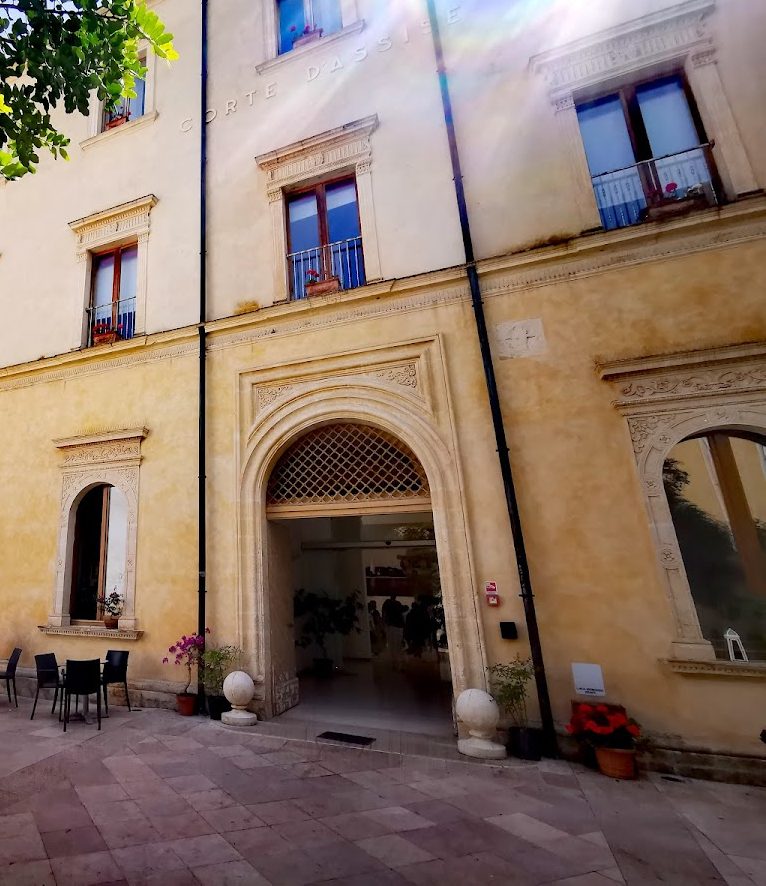
The palace has the ordered elevation of a Renaissance residence, with its facade divided into three levels by cornices. Its windows vary individually, accompanied by decorative elements that give the exterior a differentiated appearance rather than a completely uniform pattern. The principal portal carries the Granafei coat of arms, showing a rampant lion holding an ear of wheat. The wheat refers to the presumed meaning of the family name, interpreted as “grain bearer.”
Interior arrangement and garden
The recorded interior gives the palace the character of an extensive domestic and working complex. The eighteenth-century upper floor brought together representative rooms, private chambers, a chapel, kitchen, and pantry, while the lower spaces included stables and storerooms. An early nineteenth-century property register counted twelve upper rooms and three lower rooms, as well as a garden and five storerooms. Later, the Nervegna period was associated with a much larger arrangement of rooms across three levels and with the garden that passed to the municipality in 1930.
Coat of arms and aphorisms
The family emblem above the main entrance connects the building’s architecture with the Granafei identity and its association with grain. Four Latin aphorisms displayed on the palace offer moral reflections on household responsibility, wisdom, listening, and diligence. They state that a wise woman builds her house while a foolish one destroys it with her own hands; that wealth is useless to a fool who cannot buy wisdom; that answering before listening reveals folly and deserves blame; and that sleep should not be loved lest poverty follow.
Nearby sites