Slatiňany Castle: A Renaissance Aristocratic Residence and Hippological Museum in Czechia


Site at a Glance
- Rating
- 4.8
- Popularity
- Medium
- Country
- Czechia
- Primary era
- Early Modern
- External website
- Open
- Eras represented
- Early Modern, Modern
- Civilizations
- Habsburg, Holy Roman Empire, Kingdom of Bohemia
- Site type
- Domestic
- Remains
- Castle
On this page10 sections
History
Slatiňany Castle is a Renaissance aristocratic residence in Slatiňany, Czechia, whose surviving core was created after 1580 and later adapted as an Auersperg summer residence. The estate developed from a medieval fortress into a hunting center, horse-breeding establishment, and museum complex.
From medieval fortress to Renaissance residence
Slatiňany is first mentioned in 1294, while its fortress is recorded from 1371, when it belonged to the local lord Zbyněk Otháje. Later owners included the Talmberk and Šarová families, as well as the nearby city of Chrudim. In 1547, the Habsburg Crown confiscated the fortress. Bohuslav Mazanec of Frymburk and Mimoň later acquired it and converted the medieval stronghold into a Renaissance residence.
After 1580, the Swiss builder Ulrico Aostalli designed a new four-wing Renaissance castle. The project included lunette cornices, sgraffito, a decorative technique made by scratching through a surface layer to expose contrasting plaster beneath, richly ornamented gables, and a clock tower. The work was not completed, and the eastern and southern wings became the principal surviving parts of the project.
Confiscation, restoration, and Auersperg ownership
Following the Battle of White Mountain in 1620, a conflict that confirmed Habsburg control over the Bohemian lands, the castle was confiscated again. It was later purchased by the Berk of Dubé family. After 1669, Adam Zikmund Puchhart of Voděrad and Hrochov Týnec restored the deteriorated building.
The Schönfeld family bought the castle at auction in 1732. More than a decade later, Johann Adam, Prince of Auersperg, acquired it. Under the Auerspergs, Slatiňany became the center of an extensive hunting territory. The castle was restored in the mid-eighteenth century, remodeled in the Classical style in the early nineteenth century, and altered again in the Neo-Gothic style at the end of the nineteenth century.
The estate gained much of its present character during the final years of the nineteenth century. The Auerspergs constructed the princely stables and the building known as the Cat Castle. They also added a pond, tennis court, gazebos, and chapel to the enclosed park.
State ownership and the museum
After the Auersperg family became extinct in 1942, the castle passed to the Trauttmansdorff family. In 1945, after the Second World War, the state confiscated the property under the Beneš decrees, post-war Czechoslovak presidential decrees that provided the legal basis for confiscating property from certain groups and individuals.
From 1950, the interiors were adapted for a state hippological museum. Hippology concerns horse breeding, care, and related equestrian subjects, so the museum presents the cultural and material history of horses and horse breeding. A reconstruction of the castle and park was completed in 2020, after which the building was presented as an Auersperg summer residence.
The castle complex, park, and stables are protected as a Czech national cultural monument. The National Heritage Institute, the Czech state institution responsible for protecting and managing historic monuments, owns the castle. Since 1992, the stables have formed part of the National Stud at Kladruby nad Labem.
Remains
Castle complex and layout
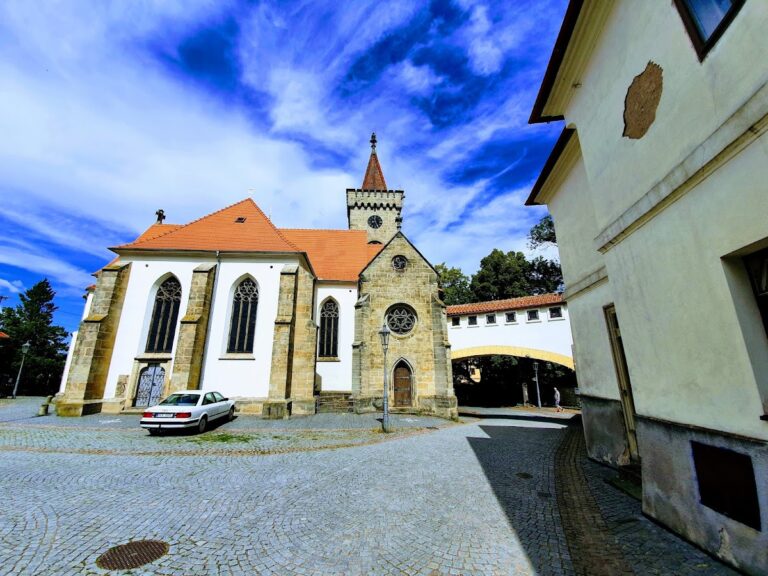
Slatiňany Castle stands in the southeastern part of Slatiňany beside the Gothic Church of Saint Martin. The complex contains the main residence, a covered bridge linking the castle with the church, greenhouses, kitchen gardens, a gardener’s house, the large stable complex, the Cat Castle, a children’s farm, and smaller buildings.
The main castle is an open-plan building of four wings. The eastern, southern, and western wings enclose a courtyard that opens to the north. A stair tower occupies the northwestern corner of the eastern wing, and a decorative cast-iron fence with a gate extends from the tower to close the courtyard. The eastern and southern wings preserve the principal remains of Aostalli’s unfinished Renaissance design, including its planned decorative character.
Park and outdoor features
The Auerspergs laid out the naturalistic landscape park in 1796 and modified it in the mid-nineteenth century. Its later additions included a pond, tennis court, gazebos, chapel, and enclosure. A bronze horse statue by Bohumil Kafka, cast in 1935 and installed at Slatiňany in 1951, stands in the park and was also used for the castle’s horse-breeding exhibition.
Stables and museum collections
Princely stables
The stable complex is the estate’s principal building after the castle. Horse breeding was already practiced at Slatiňany under the Auerspergs. Plans to enlarge and reconstruct the stables were proposed in 1889, and the architectural firm W. & C. Manning of Newmarket in Britain prepared the design. Construction began in 1897, and the main building is dated 1898.
Hippological museum
The hippological museum contains paintings, sculptures, porcelain, and other art and household objects decorated with horse motifs. The collection includes works associated with Josef Mánes, J. Hamilton, Diego Rodríguez de Silva y Velázquez, Adriaen de Vries, and Josef Václav Myslbek, connecting the castle’s interiors with the estate’s long association with horses and breeding.
Nearby sites