Slangenburg Castle: A Classical Water Castle in the Netherlands


Site at a Glance
- Rating
- 4.3
- Popularity
- Low
- Country
- Netherlands
- Primary era
- Early Modern
- External website
- Open
- Eras represented
- Early Modern
- Civilizations
- Dutch
- Site type
- Domestic
- Remains
- Castle
On this page13 sections
History
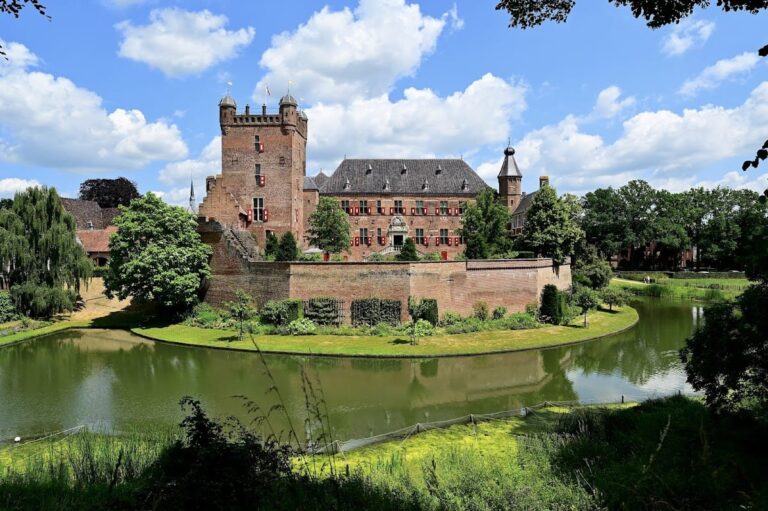
Slangenburg Castle is a brick water castle in the Netherlands, near Doetinchem, rebuilt in 1612 in the Classical style after its destruction during the Eighty Years’ War. A water castle is a fortified residence protected by a moat, while Classicism uses balanced proportions, symmetry, and forms inspired by Greek and Roman architecture. The castle forms the centre of an almost 600-hectare estate in Gelderland, which also contains St. Willibrord Abbey, a Benedictine monastery.
Medieval origins and destruction
Slangenburg was first recorded in 1354 as the property of Maes, also known as Thomas van Baer. State troops destroyed the castle in 1585 during the Eighty Years’ War, the long conflict between the Dutch Republic and Spain.
Rebuilding and aristocratic ownership
The castle was rebuilt in 1612 during the Twelve Years’ Truce, the suspension of fighting between the Dutch Republic and Spain from 1609 to 1621. Its associated coach houses were rebuilt later, in 1675. During the seventeenth century, the estate became the property of the general Frederik Johan van Baer, who rebuilt or altered the castle as a residence. He also laid out the park.
In the eighteenth century, Slangenburg passed to the Steengracht family. The Van der Goltz family inherited it in 1781 and retained it until 1863. The heirs of that family sold the castle in 1895.
The Passmann estate and state ownership
Arnold Passmann, a timber merchant and industrialist from Duisburg-Ruhrort, acquired the estate in 1895. Slangenburg then remained with the German Passmann family until the confiscation of German property in the Netherlands after the Second World War. The castle and the buildings within the outer moat consequently became Dutch state property and were administered by the Rijksgebouwendienst, the government buildings agency. Members of the Passmann family were buried in their family cemetery behind the parking area and beside the flooded moat.
On 15 January 2016, the castle and the buildings within the outer moat were transferred, with 28 other monuments, to Stichting Monumentenbezit, a Dutch foundation that owns and manages historic monuments. The transfer reflected the view that the property no longer served a central-government function but required continued management and preservation because of its monument value. Slangenburg appears in the 1990 Top 100 of Dutch national monuments and has been a Rijksmonument, a nationally designated Dutch monument protected for its cultural and historical value, since 18 July 2005 under monument number 527492.
Recent management and use
The castle functions as an independent guesthouse. A guesthouse foundation had operated there since about 1970, but it was declared bankrupt in 2023. Since then, Stichting Monumentenbezit has operated the castle, while the coach houses have been used for catering and overnight accommodation. The wider estate has also involved the municipality of Doetinchem, Stichting Gastenhuis Kasteel Slangenburg, St. Willibrord Monastery, and Staatsbosbeheer, the Dutch state organization responsible for public nature reserves, forests, and other natural areas. The estate’s future was disputed among these parties in 2017.
Remains
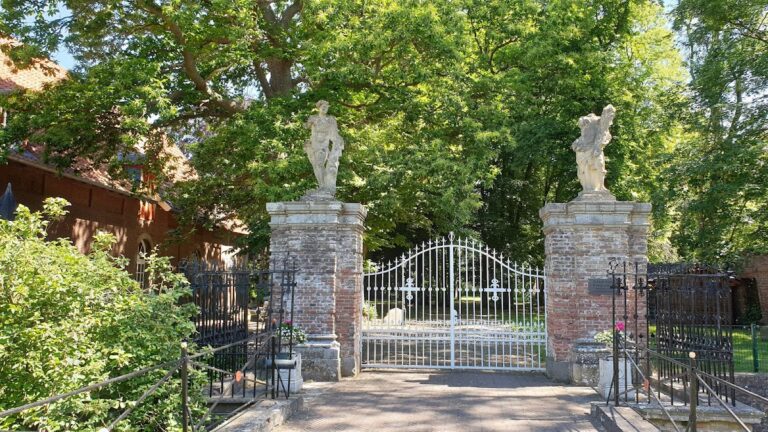
Slangenburg survives as a Classical brick water castle and estate complex enclosed by an outer moat. The castle, coach houses, and other associated buildings stand within that protected enclosure. The estate’s centuries-old avenues form a trapezoid, with a central axis and entrance drive extending for approximately 1.5 kilometres. Two ponds lie on either side of this axis. The castle and St. Willibrord Abbey occupy the eastern side of the estate, where the monastic chapel is open to the public.
Castle and estate buildings
Castle interiors
The interior spaces include a great hall, a raised room, a vestibule or entrance hall, a reception room, the Dido Hall, and the Chamber of Eternal Love. The Dido Hall contains Gerard Hoet’s painting of Dido receiving Aeneas and his Greeks. Hoet was a Dutch painter active in the late seventeenth and early eighteenth centuries.
Coach houses and associated buildings
The coach houses and other associated buildings form part of the complex within the outer moat. The coach houses belong to the rebuilding of 1675 and are used for catering and overnight accommodation.
Cemeteries
Passmann family cemetery
A private cemetery lies east of the wildlife park. It is square and enclosed by a wall, which incorporates an Italian fence dating from the early eighteenth century. Members of the Passmann family were buried there beside the flooded moat.
Slangenburg aan de Nutselaer cemetery
The adjacent municipal Slangenburg aan de Nutselaer cemetery includes a conventional cemetery, a crematorium, and a natural cemetery.
Cartographic evidence
A detail of Christian Sgrooten’s 1573 map of Gelderland and Cleves depicts Slangenburgh east of Doetinchem. Sgrooten was a sixteenth-century cartographer known for maps of the Netherlands and surrounding regions, and the depiction places the recorded castle within its historical landscape.