Huis Bergh: A Castle and Museum in the Netherlands


Site at a Glance
- Rating
- 4.5
- Popularity
- Medium
- Country
- Netherlands
- Primary era
- Medieval
- External website
- Open
- Eras represented
- Medieval, Early Modern
- Civilizations
- Holy Roman Empire
- Site type
- Military
- Remains
- Castle
On this page16 sections
History
Huis Bergh is a castle and museum in the Netherlands, located in ’s-Heerenberg, Gelderland. Its building history reaches back to the thirteenth century, with principal construction phases in the fourteenth, fifteenth, and seventeenth centuries. The castle was the ancestral seat of the Counts of Bergh, whose surrounding territory was known as the Land of Bergh before becoming the County of Bergh in 1486.
The Land and County of Bergh
Before 1486, the Land of Bergh was a banner lordship, a territory held by a noble with the right to raise a military banner. In that year it became the County of Bergh, linking the castle more formally with the territorial authority of the Counts of Bergh. Huis Bergh continued to serve as the family’s principal seat as the castle complex developed through successive medieval and early modern building phases.
Damage, Fire, and Rebuilding
Huis Bergh suffered severe damage during the Dutch Revolt, the rebellion of the Netherlands against Habsburg rule. Count Willem IV van den Bergh was dispossessed of the castle by the Duke of Alba, the Spanish governor whose military and administrative campaign affected ownership of the castle.
A fire destroyed Huis Bergh in 1735. Gerrit Ravenschot of Zutphen rebuilt the castle between 1735 and 1746, giving the complex a renewed form while retaining its long architectural history. From 1799 to 1842, during the Holland Mission, a Catholic missionary and ecclesiastical organization operating in the Dutch Republic after the Reformation, the castle housed a seminary.
Van Heek Ownership and Twentieth-Century Reconstruction
In 1912, the castle and all its associated properties passed to Jan Herman van Heek, an industrialist from Enschede who acquired them to preserve Huis Bergh as a monument. He expanded the castle’s cultural holdings in 1919 by acquiring the F. W. Mengelberg Collection, which he housed there alongside many early Italian works.
A second major fire destroyed a large part of Huis Bergh in 1939. Local residents helped rescue much of the inventory, and rebuilding began during the same year. The reconstruction was completed in autumn 1941. In 1946, Van Heek placed the castle under the Foundation for the Preservation of the Goods and Rights of Huis Bergh. Huis Bergh then became the permanent residence of the Van Heek family and housed Jan Herman van Heek’s art collection.
From Private Collection to Museum
Parts of Huis Bergh became accessible through guided tours from 1965. After his marriage to Irmela Töwe in 1966, Jan van Heek, Jan Herman van Heek’s son, lived in the castle. The Italian Room and its Italian art opened to the public from 1988, further establishing the relationship between the historic residence and its collections.
Huis Bergh functions as a museum and received national-monument status in the Netherlands on 1 December 2003. This status is known as Rijksmonument, a legal designation for a nationally important protected monument. The museum holds the largest private collection of early Italian art in the Netherlands, together with medieval and early modern paintings, portraits, manuscripts, sculpture, coins, medals, ivory works, a geological collection from the Achterhoek, an art-historical library, and a well-preserved family archive concerning the castle and its inhabitants.
From the beginning of the twenty-first century, Henk van Os, a former director of the Rijksmuseum and a specialist in early Italian art, advised Huis Bergh and reorganized its permanent display. Italian works were grouped in the Italian Room, Northern European art was placed in the Throne Room, and fifteenth- and sixteenth-century portraits were arranged in a stairway gallery. Less significant works and forgeries were moved to storage, while important works received more prominent positions and displayed works were given explanatory texts. In 2008, articles written for Van Os’s seventieth birthday appeared in the commemorative volume Adventures with a Collection: Discoveries in the Collections of Huis Bergh.
Remains
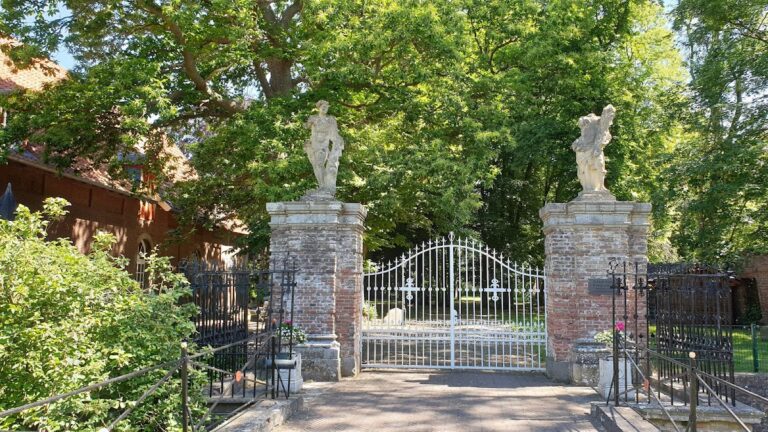
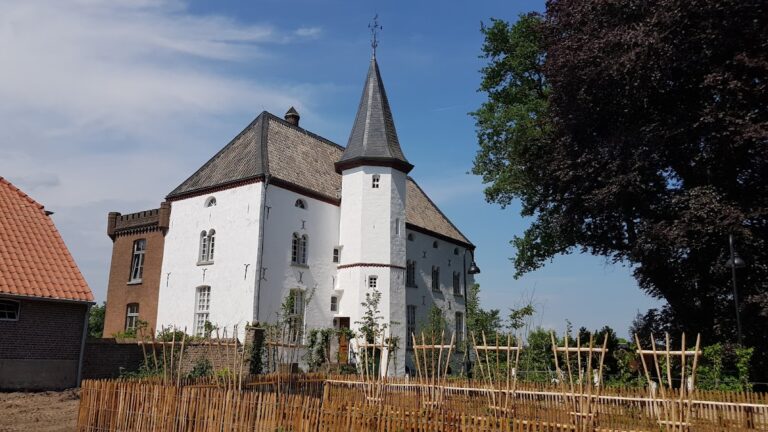
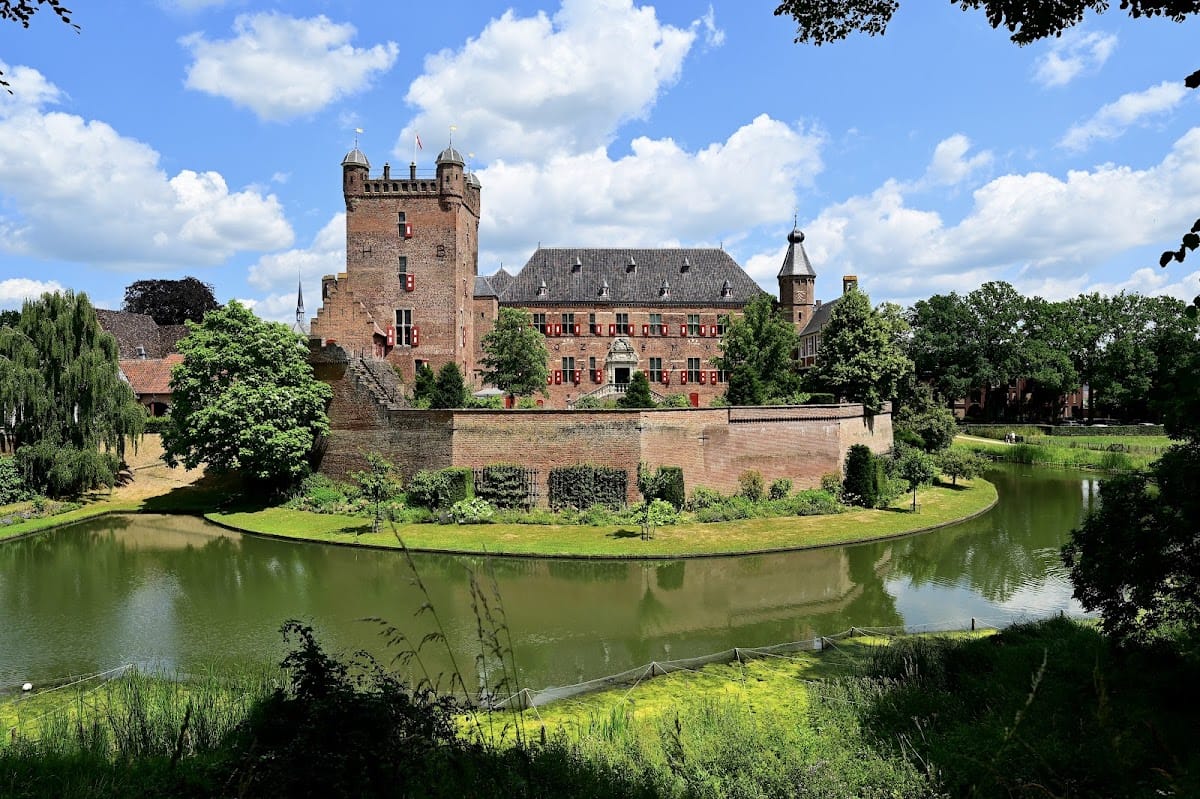
Huis Bergh is a large brick water castle, a fortified residence surrounded or partly protected by water, usually by a moat. The complex includes the castle, a forecourt, a moat, a castle-garden gate, a castle garden, and the surrounding estate. Its main fabric preserves construction phases from the fourteenth, fifteenth, and seventeenth centuries, together with the rebuilding that followed the fires of 1735 and 1939. The later reconstruction was completed in 1941. The Plantage park woodland lies immediately west of the castle, and the nearby Boetselaersborg is among its associated possessions.
Castle Grounds and Garden
Castle Complex
The brick castle stands within a wider arrangement of water, approach space, garden structures, and estate land. The forecourt, moat, castle-garden gate, and garden form parts of the surviving complex, while the estate connects the principal building with associated properties. The castle’s present fabric therefore combines medieval and early modern phases with repairs and reconstruction following the two major fires.
Castle Garden
The castle garden was restored in 2016 to the condition associated with 1727. It is sometimes described as the oldest garden in the Netherlands. Its restoration preserves the garden as a distinct element of the castle complex and relates it to the period represented by the eighteenth-century rebuilding after the 1735 fire.
Rooms and Display Areas
Italian Room and Antonius Hall
The Italian Room and the Antonius Hall are used to display works from the collection. The Italian Room contains early Italian paintings, including works by Duccio di Buoninsegna, Bicci di Lorenzo, Bartolomeo Bulgarini, Niccolò di Segna, and Vittore Crivelli. An early sixteenth-century wooden sculpture of Mary of the Crescent Moon also received a prominent position in the reorganized display.
Throne Room and Stairway Gallery
The Throne Room contains Northern European works. The stairway gallery presents portraits dating from the fifteenth and sixteenth centuries, including members of the Van den Bergh family and representatives of the Burgundians, Habsburgs, House of Orange, and Counts of Bergh. A portrait of Count Hendrik van den Bergh was painted by Otto Vaenius around 1618.
Paintings, Manuscripts, and Collections
Early Italian and Northern European Art
The early Italian holdings include a panel depicting the Archangel Gabriel that formed part of Duccio di Buoninsegna’s Maestà, a devotional image of the enthroned Virgin Mary with the Christ Child. The panel entered the castle collection in the nineteenth century and has been displayed at the Rijksmuseum in Amsterdam since 2023. The collection also contains works from the circles or schools of Jheronimus Bosch, including Wedding at Cana, as well as works associated with Lucas Cranach the Elder, Lucas Gassel, and Quentin Matsys.
Portraits and Historical Records
More than eighty Dutch and German paintings are preserved at Huis Bergh. Among the portraits is a 1581 group portrait of ’s-Heerenberg mintmaster Clemens van Eembrugge and his assistants. The holdings also include manuscripts from the Netherlands, Germany, France, and Italy, while the family archive preserves formal and informal documents concerning the castle and its inhabitants.
Other Holdings
Further collections comprise sculpture, coins and medals, ivory works, medieval manuscripts, and a geological collection assembled from finds in the Achterhoek, the historical region in the eastern part of Gelderland. Together with the art-historical library and family archive, these materials preserve evidence of the castle’s occupants, collections, and long cultural history.
Nearby sites