Plomarc’h Pella: A Gallo-Roman Sardine-Salting Settlement in France


Site at a Glance
- Rating
- 4.5
- Popularity
- Low
- Country
- France
- Primary era
- Classical
- External website
- Open
- Eras represented
- Classical, Medieval
- Civilizations
- Roman
- Site type
- Economic
- Remains
- Production Complex
On this page8 sections
History
Plomarc’h Pella in France is an ancient settlement of Douarnenez, built through the interaction of Roman and local Gallic traditions during the first and second centuries AD. It contained a habitation and a sardine-salting establishment that produced garum, a fermented fish condiment made by salting fish and allowing it to ferment. The settlement formed part of the region’s sardine-based economy and the wider Romanization of the Armorican peninsula.
Gallo-Roman settlement and industry
People were living at Plomarc’h Pella from the first century AD, although houses were not constructed until the beginning of the second century. The settlement then passed through two periods of prosperity before destruction at the end of the second century. Roman producers adopted fishing techniques associated with the Osismi, a Gallic people whose territory covered part of the Armorican peninsula, broadly corresponding to western Brittany.
The Romans established a garum factory at the site, using sardines preserved in brine. The condiment was highly valued, including by Roman legionaries, and sardines were regarded as a strategic food for the Roman armies. Plomarc’h Pella is described as the oldest known ancient sardine-salting establishment in the Bay of Douarnenez. Its production belonged to a wider concentration of such facilities around Douarnenez, including smaller establishments at Kerlaz and Poullan-sur-Mer.
A stele bearing the name Caius Varénius Varus identifies him as the first known person from Douarnenez. The inscription connects the settlement’s industrial activity with named inhabitants of the ancient community and provides an early personal association for the area.
Later occupation
A forge, a workshop for heating and working metal, was installed at Plomarc’h Pella in the fourth century. Occupation continued into the twelfth or thirteenth century, when a small building and a cemetery were established on higher ground, while several huts occupied the lower area.
Fishing village in the nineteenth century
By the nineteenth century, Plomarc’h was a fishing village. Fishing took place mainly during the summer, while men pursued other occupations during the rest of the year. In 1820, the village included three coopers, a mason, a wheelwright, a basketmaker, sailors serving the king, servants, and agricultural workers. Population registers did not identify women’s occupations before 1848. From that year, they record women working at home, as laundresses, and as net makers.
In 1820, the village contained 23 houses and three older houses, each with a small adjoining garden. The inhabitants also shared a field divided into several plots for cultivation. A bread oven stood beside the farm building that survives today. Each house accommodated more than six people, and children were born approximately every two years, although many died young.
The ancient salting vats were uncovered for detailed research in 1994 and restored in the early 2000s according to Gallo-Roman construction methods. The ancient establishment is exceptionally well preserved and is regarded as a unique example in Gaul. It is also described as the largest and best-preserved garum factory in Europe.
Remains
The ancient salting establishment occupied a small valley and the two heights flanking it. Four buildings were distributed across this area, while more than fifteen masonry vats formed the principal surviving industrial remains. The vats preserve the arrangement and construction of a facility designed for salting sardines and producing garum.
Salting vats and masonry
Each masonry vat was a built basin intended to contain liquids or mixtures such as fish brine. Its walls combine masonry, sandy-clay mortar, and natural gravel. Sand was taken from the site’s plain, while the gravel probably came from sandstone deposits around the bay. Sandy clay and fragments of roof tile helped make the structures watertight. The clay was prepared from crushed bricks and tiles mixed with gravel, giving it a brick-pink color.
The joints between the masonry stones were marked or drawn with an iron tool. The stone came from nearby quarries and from Gored Beach. Shell fossils visible in some of the wall stones indicate this coastal provenance. The vats were restored in the early 2000s, preserving their Gallo-Roman construction and allowing the industrial layout to remain legible.
Roof construction
The ancient buildings were roofed with tegula, broad flat Roman tiles, overlapped by semicircular imbrices, or curved cover tiles. Sandy clay sealed the tiles against water. The roof weighed approximately 80 kilograms per square metre and was carried by a self-supporting frame. Rafters were built into the gable ends and rested on masonry supports, distributing the load through the structure. A comparable roof-framing tradition is found in medieval barns, including those at Ploueskad.
Later village buildings
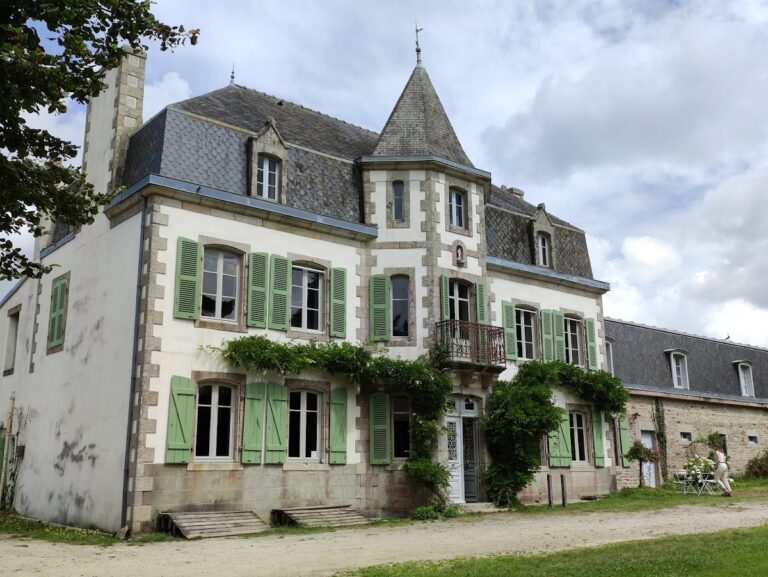
The nineteenth-century houses had granite walls coated with render, beaten-earth floors, and roofs made first from rye thatch and later from slate. They were oriented with their backs toward the cold north wind. Around Michaelmas, the feast of Saint Michael observed on September 29, residents periodically whitewashed the walls with lime. This brightened and sanitized the interiors before winter, when smoke from the hearth had darkened them.