Anfiteatro Romano di Casinum: Roman Amphitheatre in Cassino, Italy


Site at a Glance
- Rating
- 4.3
- Popularity
- Low
- Country
- Italy
- Primary era
- Classical
- Eras represented
- Classical
- Civilizations
- Roman
- Site type
- Entertainment
- Remains
- Amphitheatre
On this page5 sections
History
The Anfiteatro Romano di Casinum is a Roman amphitheatre in Cassino, Italy, built as part of the ancient town of Casinum. The settlement stood near the Via Latina, the Roman road linking Rome with southern Italy, at the foot of the mountain. Casinum originated as an Oscan community and had been a Samnite city before Roman conquest.
From Samnite City to Roman Community
Casinum probably received Roman citizenship in 188 BC. Toward the end of the Roman Republic, it became a praefectura, an administrative community governed under Roman authority. Under the Roman Empire, Casinum appeared as a colony, perhaps one established by the triumvirs, the three-man leadership associated with the transformation from Republic to Empire.
Ummidia Quadratilla and the Amphitheatre
The amphitheatre was erected by Ummidia Quadratilla, a woman belonging to the local Roman elite. Pliny the Younger mentioned her strong interest in actors when writing about her death at approximately eighty years of age. Her role in establishing the building connects the monument with the wealth and civic influence of Casinum’s leading families.
Archaeological Area
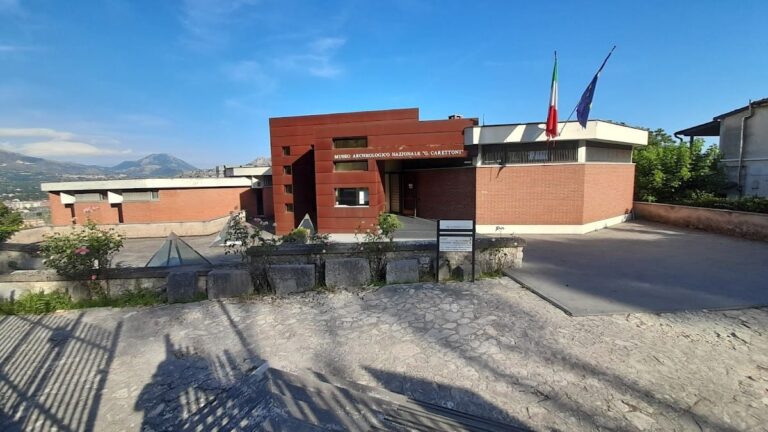
The amphitheatre now forms part of the archaeological area of Casinum, where it stands among other Roman remains. The National Archaeological Museum dedicated to Gianfilippo Carettoni was built beside the walls of ancient Casinum beginning in 1966, adding a modern institution for the study and interpretation of the ancient town.
Remains
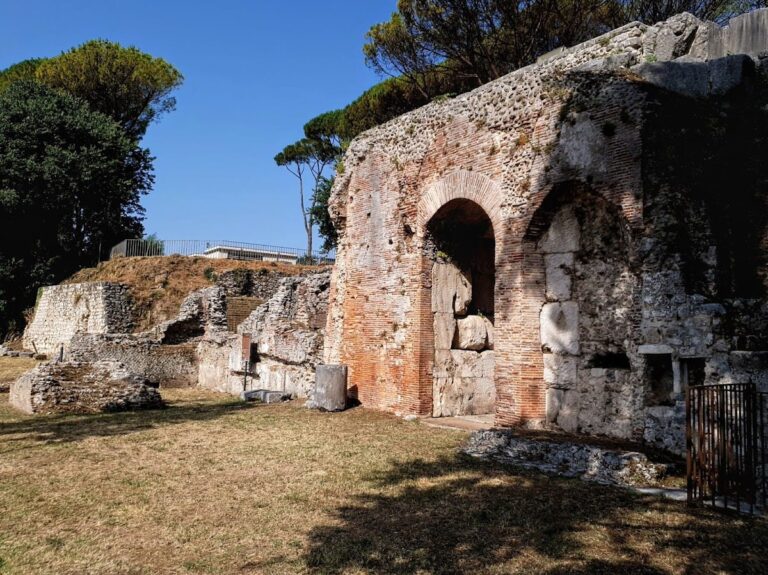
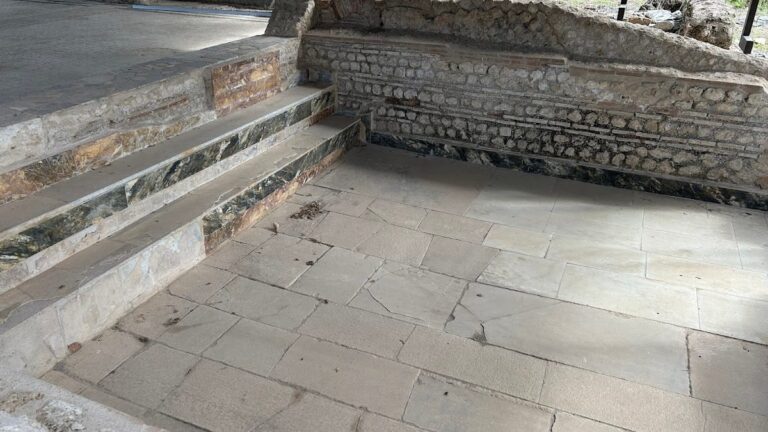
The Anfiteatro Romano di Casinum has an approximately circular plan and was constructed using opus reticulatum, a Roman technique that faced concrete walls with small diamond-shaped stones arranged diagonally in a net-like pattern. Its external walls rise about 18 metres, giving the surviving structure an imposing scale within the archaeological area.
Five entrances punctuate the outer structure. Each entrance is formed by an arch built with larger stone blocks, contrasting with the regular pattern of the wall facing and clarifying the building’s organization around its curved perimeter. Together, the circular layout, arched entrances, and high exterior walls preserve the principal form of this Roman amphitheatre.