Musée départemental breton: A Museum of Finistère Archaeology and Arts
Site at a Glance
- Country
- France
- Primary era
- Early Modern
- Eras represented
- Early Modern, Modern
- Civilizations
- Duchy of Brittany, French
- Site type
- Religious
- Remains
- Palace
On this page23 sections
History
The museum and episcopal palace
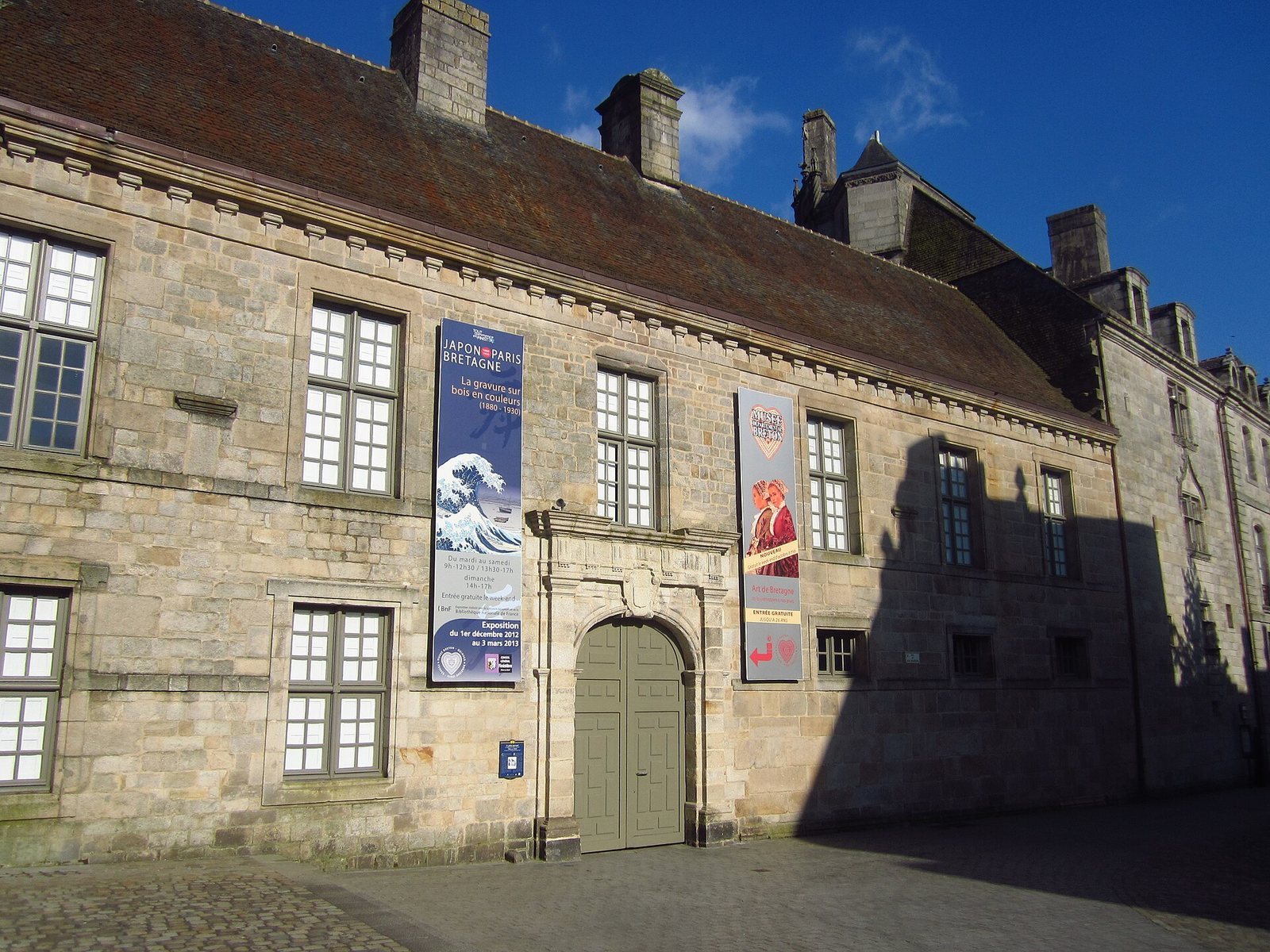
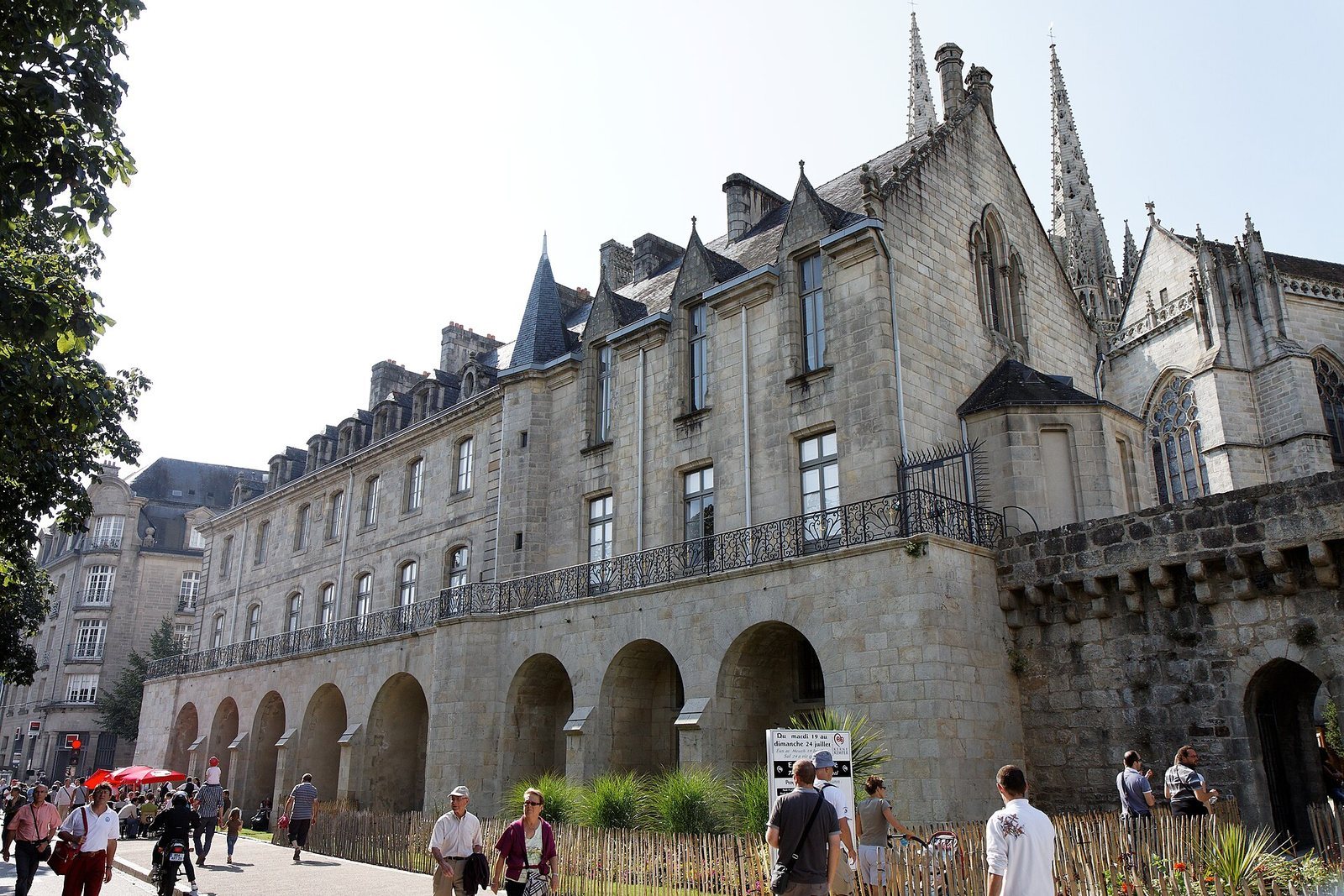
The Musée départemental breton is a museum of Finistère archaeology and arts in Quimper, France. The Finistère Archaeological Society founded it in 1846. The museum describes its purpose as that of a “museum of society,” presenting the history and artistic traditions of the region.
The museum occupies the former palace of the bishops of Cornouaille, a historic region of western Brittany that was also an ecclesiastical diocese. Construction of a new palace began in 1508 for Claude de Rohan, bishop from 1501 to 1540. The builders were Daniel Gourcuff and Guillaume Le Goaraguer, and the palace developed over the following centuries.
Museum development and protection
The museum’s rooms were restored between 1990 and 2001 and arranged in chronological and thematic sections. Since 1997, the museum’s annual acquisitions have also been presented in an article in the Bulletin of the Finistère Archaeological Society.
The former episcopal buildings have historic-monument protection. The Rohan Tower was classified in 1921, while the palace façades, roof, and first-floor rooms were registered in 1983.
Remains
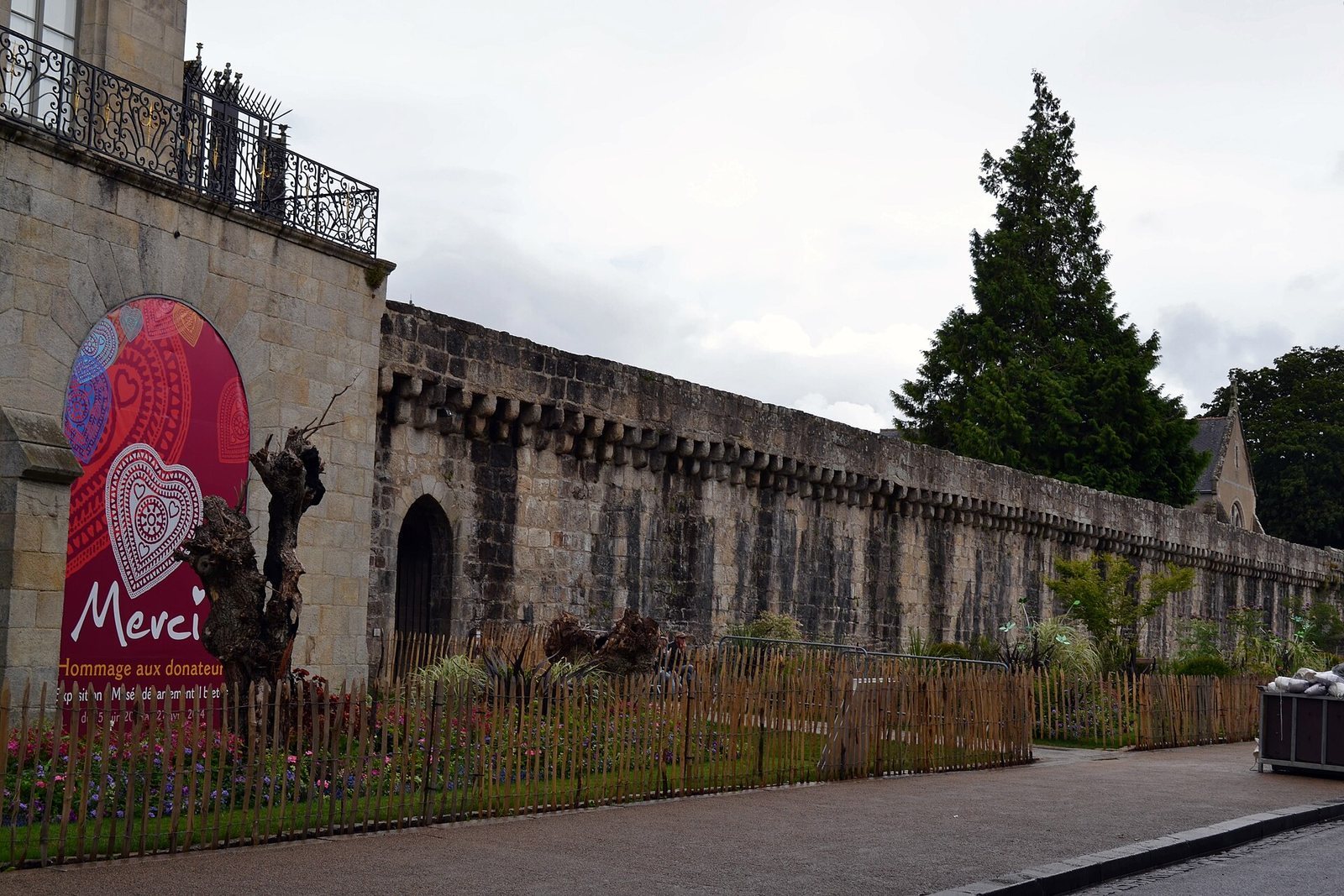
The museum occupies a group of buildings adjoining the south side of Quimper’s Saint-Corentin Cathedral. The complex dates from the 16th through the 20th century. Its collections include about 65,000 works, displayed in rotation across areas devoted to archaeology and ancient art, Finistère dress, wood sculpture and furniture, and Quimper ceramics.
The palace and Rohan Tower
The Rohan Tower is the oldest part of the palace and forms the core of its newer building. Its Renaissance design is associated with the reign of Louis XII, when French architecture was moving toward Renaissance forms, and may have drawn inspiration from Josselin Castle. A spiral staircase rises through the tower to a carved wooden ceiling shaped like a palm tree. Foliage and scrollwork cover its oak surround, among carvings of real and imaginary animals, including a lion, pig, and fox, as well as enigmatic figures such as a wild man and an acrobat.
Archaeology and ancient art
Prehistory and protohistory
The archaeological displays begin with prehistory and protohistory, a period known chiefly through archaeological evidence and accounts by peoples with written records. Among the objects are a twisted gold belt ornament from Irvillac, dating to the Bronze Age, and an Iron Age gold necklace from Tréglonou. Both are regarded as important examples of France’s protohistoric goldwork.
Roman-era collections
The Roman-period displays are arranged around a large pavement from the baths of a Gallo-Roman villa. Gallo-Roman describes the culture of Roman-era Gaul. The exhibits explore the Osismii, a Gallic people whose territory covered roughly the area of modern Finistère, through monumental religious and secular sculpture, domestic sculpture, household deities, ceramics, toilet accessories, gold coins, and a coin hoard. Named works include the Four Gods stele, an upright carved stone, and a statue of Neptune, the Roman god of the sea, from Douarnenez.
Other works include the Kervadol stele from Plobannalec-Lesconil, a Late Iron Age stone with reliefs of five deities from the Gallo-Roman period, and a Gaulish stone from Kergonniou, Lennon, carved with two heads set back-to-back. A vessel from Carhaix-Plouguer, dated to AD 180–250, bears a warrior, Bacchus, the Roman god associated with wine, and grapevines. A statue of Hercules, the mythological hero, was found in a salting vat at Port-Rhu in Douarnenez and dates to the 3rd century AD.
Later archaeological works
Later objects include an armorial stone from Brest’s Tour de la Motte-Tanguy bearing the arms of the Duchy of Brittany, granite funerary slabs from Quimper dated to 1336 and the 15th century, and the Kerscao milestone from Kernilis. A separate display pairs a 14th-century hoard of gold coins from Saint-Pol-de-Léon with the terracotta money boxes in which they were found.
Medieval and Renaissance sculpture
Church and funerary sculpture
Medieval works include 12th-century Romanesque capitals, the sculpted tops of columns or piers, a 14th-century tombstone for Grallon de Kervastar, and 15th-century angel reliefs. A 15th-century calvary from Gouesnac’h represents the Crucifixion, while a painted wooden group of Saint Anne, the Virgin, and Child came from the chapel of Trévarez manor in Saint-Goazec and dates to the 13th or 14th century. Another devotional work is a Pietà, an image of the Virgin Mary with the dead Christ, showing the Virgin praying beside his body with Saint John the Apostle.
A mausoleum with the recumbent figure of the knight Troïlus de Mondragon dates to about 1550. The museum also holds a 17th-century mausoleum for Yves Le Bervet du Parc, made by sculptor Roland Doré, and a painted wooden group of the Holy Trinity with musician angels. The latter, from Saint-Corentin Cathedral, probably originated in the Rhineland and dates to around the turn of the 16th century. It represents the Christian doctrine of one God in three persons.
Works from Koat-Keo
A group from the former chapel of Koat-Keo at Scrignac includes a double statue of Saints John the Apostle and Peter, a child Saint Trémeur holding his head, and an unidentified female saint. The group also contains painted wooden figures of Saint Apolline and her executioners, dating to about 1560.
Stained glass and goldsmiths’ work
Two large 16th-century stained-glass windows illustrate Italian and Germanic influences on Renaissance glassmaking in Brittany. The Saint Exupère window from Dinéault, dated 1535, shows the Virgin and Child with Mary Magdalene, Saint Paternus, and the donor Raoul de Kersauson. A Crucifixion window from Langolen is another example. A further window of unknown provenance, dated to the 16th or 17th century, depicts Christ between the Good and Bad Thieves.
Goldsmiths’ work includes a 15th-century book reliquary, a book-shaped container for relics, a 16th-century silver-and-vermeil cup from Quimper, and wedding cups from the 17th and 18th centuries. Vermeil is silver gilded with gold.
Costumes and related paintings
Finistère dress
Four rooms on the second level retain the paneling and parquet flooring of the former 18th-century bishop’s suite. About 30 mannequins and old photographs show 19th- and 20th-century dress from areas including Bigouden, Quimper, Fouesnant, and Douarnenez. The displays present embroidery, lace, and jewelry alongside work and everyday clothing. They also show outfits for major life events, with distinctive cuts and embroidered, painted, or beaded decoration, and use film excerpts to depict work and markets. Together, the examples trace changes in dress over roughly a century in relation to local economies, outside influences, and enduring regional features.
Paintings of regional life
Works displayed in connection with the costume collections include Louis Caradec’s Pardon at Ploaré and Breton Festival, both from about 1850. A pardon is a local religious observance associated with a saint or sacred place, often involving a procession. Other paintings include François-Alfred Delobbe’s Young Lace-makers of Beuzec-Conq from about 1905 and Henri Guinier’s The Miraculous Fountain, Pardon of the Blind (1914), associated with the Chapel of La Clarté at Combrit.
Wood sculpture and furniture
Historic furnishings and carvings
Two rooms follow wood sculpture and furniture from the 15th through the 20th century. One is in the Rohan Tower and has 18th-century frescoes. The displays include carvings from medieval house façades, a Renaissance table, chests and chest fronts, a flax press, wedding cupboards, and a dish cupboard. They also include a closed bed, an enclosed bedstead, and Henry Mosler’s The Return of the Prodigal Son (1879).
Breton design between the wars
Works from the interwar period include furniture by Jeanne Malivel and pieces René-Yves Creston designed for the Breton pavilion at the 1925 Paris International Exhibition of Decorative Arts. The collection also contains Paul Fouillen’s disassemblable living-room set, made about 1935 and decorated with pyrography, a technique that uses heat to draw or pattern wood.
Quimper ceramics and later design
Faience from the 18th and 19th centuries
The Quimper faience collection, made up of tin-glazed earthenware, began to form in the mid-19th century and has continued to grow. It includes luxury pieces from the 18th century and popular pottery and faience from the 18th through the 20th centuries. After 1870, makers developed a range of refined styles, including paintings on faience by Alfred Beau, work decorated by Yan’ Dargent, botanical designs, and pottery featuring Breton figures.
Ceramics between the world wars
The collection traces renewed Quimper ceramic production between the world wars. Mathurin Méheut’s works include Service of the Sea (1925), Service of the Galette, and Ex-voto. René Quillivic is represented by Head of a Young Bigouden Woman and The Old Fisherman. Other artists include René-Yves Creston, Georges Robin, Pierre Abadie-Landel, Émile-Just Bachelet, François Bazin, and François Caujan. Creston, Robin, and Abadie-Landel belonged to the Seiz Breur, a Breton artists’ and designers’ group. Odetta Art Deco stoneware dates to the 1920s and 1930s, while works by Émile Monier draw on colonial themes.
Later and contemporary works
Works from the Keraluc faience factory represent another renewal of Quimper ceramics in the second half of the 20th century. Artists include Pierre Toulhoat, René Quéré, Paul Yvain, Xavier Krebs, and Jos Le Corre. Toulhoat’s group of low-relief carvings, dated 1952 and displayed on the staircase to the ceramic galleries, depicts Breton beliefs and traditions. Later works include pieces by Guy Trévoux, Jean-Claude and Marjatta Taburet, Enrique Marin, and Michel Costiou. The collection also includes two processional banners made by Toulhoat in 1988 and 40 prints by the engraver Jean Urvoy.