Brion Archaeological Site: An Iron Age and Roman Settlement in France
Site at a Glance
- Popularity
- Medium
- Country
- France
- Primary era
- Classical
- Eras represented
- Iron Age, Classical, Medieval
- Civilizations
- Celtic, Duchy of Aquitaine, English, Roman
- Site type
- City
On this page15 sections
History
The Brion archaeological site is an archaeological complex at Saint-Germain-d’Esteuil, France, with evidence of activity from the Neolithic onward and of an Iron Age settlement and Roman urban center. The Roman settlement developed from the middle of the first century AD, becoming a secondary urban center in Aquitania, the Roman province in southwestern Gaul.
Early settlement and Roman urban development
Stone tools point to Neolithic activity at Brion. More sustained settlement and craft production began in the Iron Age, particularly in the third century BC. The site may also be the location of Noviomagus Medulorum, a proposed identification that remains unconfirmed. Around AD 130, the Greek geographer Ptolemy placed a city called Noviomagus in the Médoc. If Brion was that city, it belonged to the territory of the Meduli, an ancient people associated with the region.
Brion was one of roughly twenty cities in Roman Aquitania, alongside Burdigala, the ancient name for Bordeaux. Its Roman settlement grew from about the middle of the first century AD and acquired monumental buildings in the century’s second half. A commercial role has been proposed partly because magus means “market” and partly because of Brion’s position near the Gironde. A port or landing place for small, flat-bottomed boats may have operated through temporary channels in some seasons, but its existence and scale remain uncertain. The marshy bay was unsuitable for large vessels.
Permanent settlement declined by the end of the second or the beginning of the third century AD. Activity continued into the middle of the fourth century, particularly around the temple, where materials were apparently recovered from ruined buildings. Brion was abandoned by the end of antiquity.
Medieval reoccupation
After a long period when the ruins served as a source of building stone, Brion was briefly occupied again around the middle of the fourteenth century. A fortified residence was built over the theater. Coins and ceramics indicate occupation from the early 1340s to the early 1360s, after which the site was abandoned permanently.
Rediscovery and archaeological investigation
In 1784, the cleric and antiquarian Jacques Baurein was the first to describe Brion’s ruins and suggested that they might be Roman. After visiting in 1853, the architect and antiquarian Léo Drouyn published a detailed account and identified the site with Ptolemy’s Noviomagus. The historian Camille Jullian supported that identification in 1890.
In 1966, Charles Galy-Aché and Jean Chevrier arranged for Jacques Coupry, director of historical antiquities, to identify the remains of an Early Roman Empire theater. Test excavations by M. Cathérineau in 1976 revealed evidence of pre-Roman settlement. From 1985 to 1990, a major training excavation brought together students from Bordeaux-Montaigne University and members of the local archaeological association, under the initiative of Pierre Garmy and with professors Louis Maurin and André Coffyn.
An electromagnetic survey by Vivien Mathé in 2011 located further buried remains. The theater has been listed as a historic monument since 1984, and the wider archaeological site is recognized as an area of ecological value.
Remains
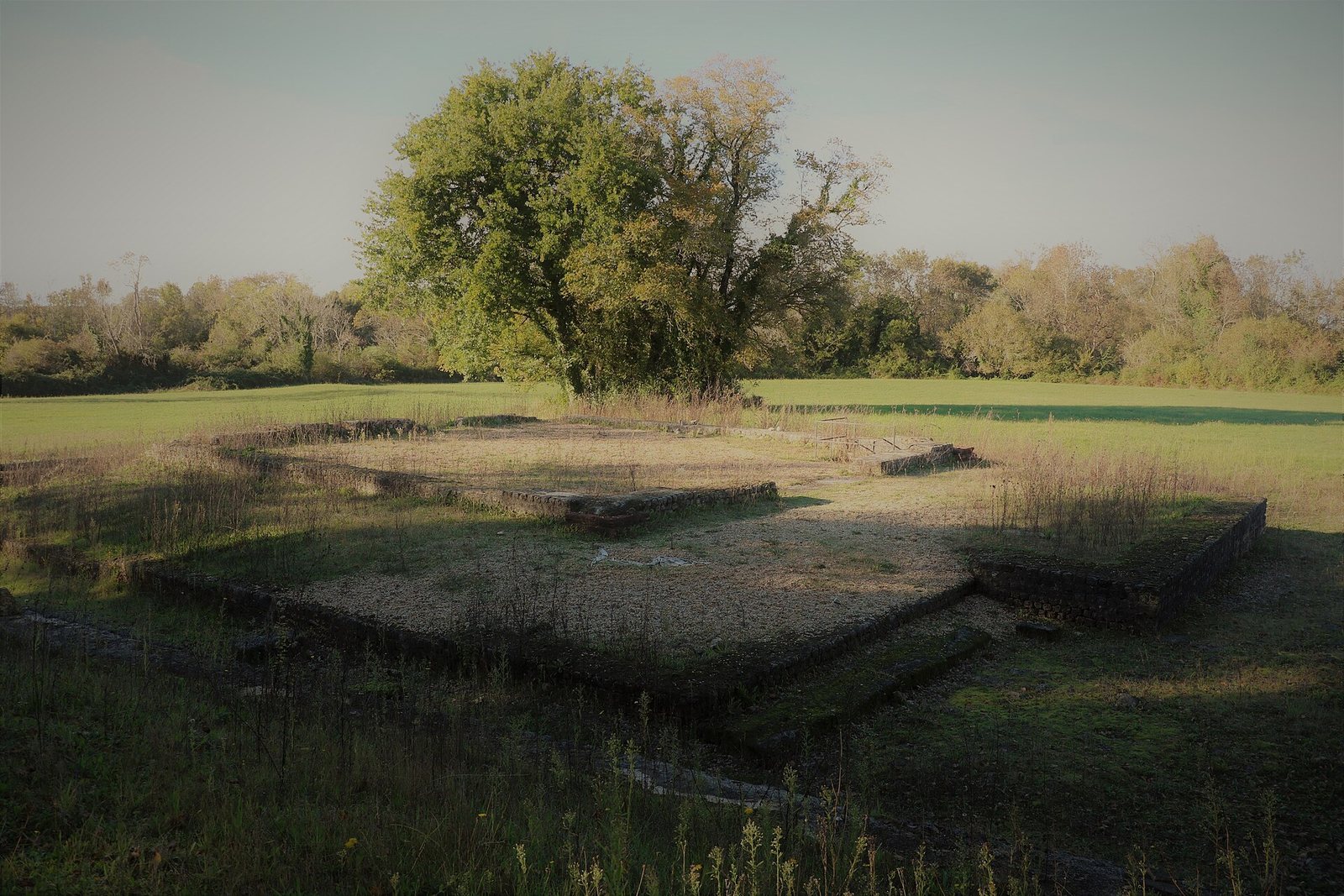
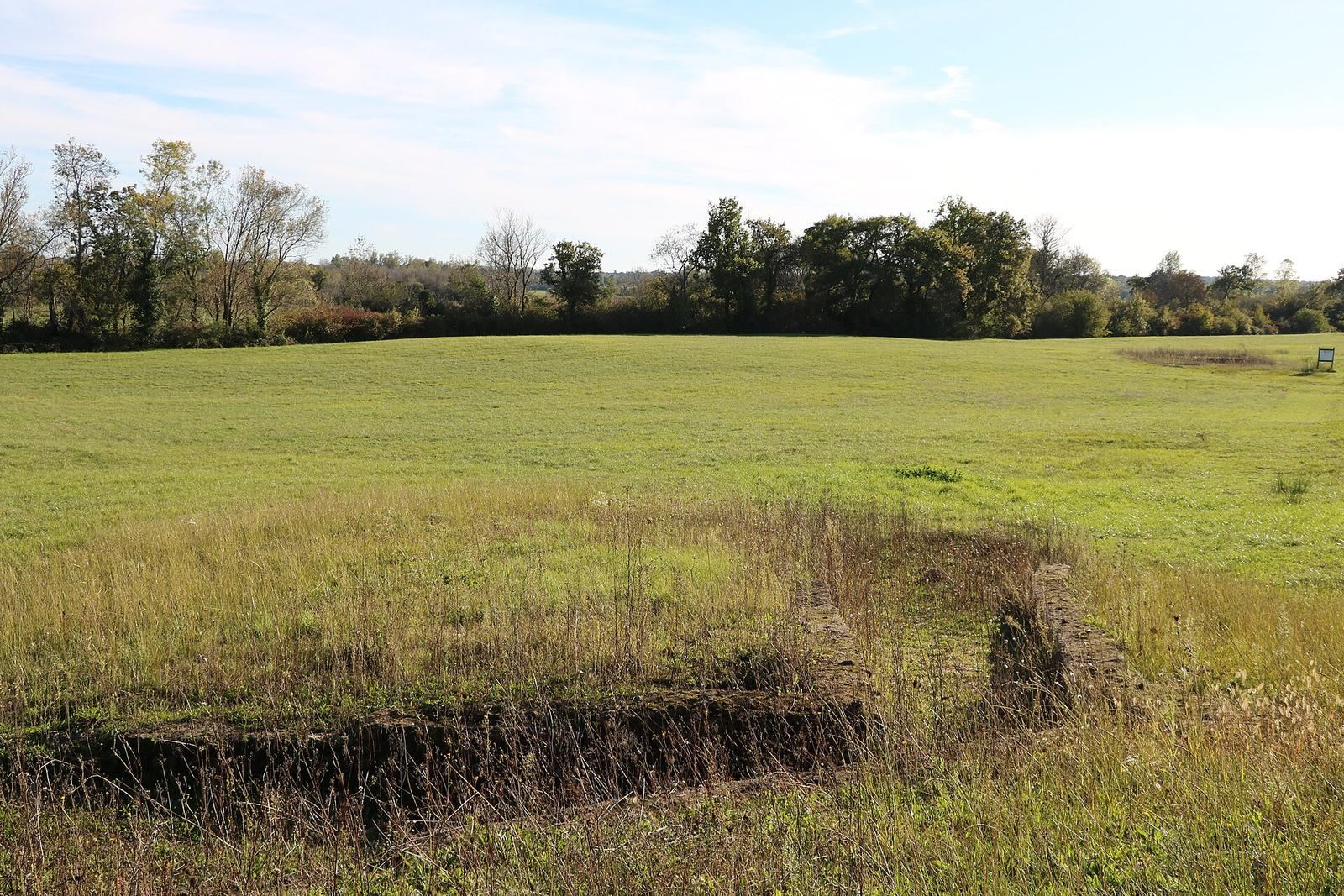
The site covers about 18 hectares on an Upper Eocene limestone platform within the Reysson marsh, roughly five kilometres west of the Gironde estuary and 600 metres west of the hamlet of Brion. Its Roman buildings include a theater, a temple, a public building, streets, and residential areas. Several monumental structures use mixed masonry, called opus mixtum, which combines different materials or building techniques. The street pattern follows the terrain more closely at the settlement’s edges and is more regular near the temple.
Roman buildings and settlement plan
Theater
Built in the second half of the first century AD, the theater stands at the southwestern edge of the ancient settlement. It is the only known Gallo-Roman theater in the Aquitaine basin south of the Garonne. Its reconstructed plan has a semicircular seating area arranged in four concentric rings, surrounding a 23-metre-wide orchestra, the central performance space. A small stage stood before a stage wall 57 metres long, equal to the seating area’s diameter. The theater’s estimated capacity was about 2,200.
Temple and sacred enclosure
The square-plan fanum, a type of Gallo-Roman temple, was probably built between AD 69 and 80. Its central sanctuary, or cella, measures 12 metres on each side. A masonry feature within it is interpreted as the base for a cult statue. The walls stood on foundations two metres deep, set on limestone bedrock. Today, the temple survives as wall bases and floor surface.
A gallery, probably roofed and four metres wide, surrounded the sanctuary. It had a colonnade and an eastern opening marked by a podium; processions took place within the gallery. The temple stood inside a walled sacred enclosure, whose southwestern corner contains a small structure. Tiles, painted plaster, marble fragments, capitals, and frieze pieces in the Fourth Pompeian Style, a form of Roman wall decoration, were found during excavation and help date the temple.
Other Roman buildings
A large rectangular building lies south of the temple, at the site’s highest point, 7.90 metres above sea level. It measures 23 metres long and has carefully faced mixed-masonry walls and numerous interior rooms. Its size and construction suggest a public building, though its function is unknown.
The small structure in the temple enclosure was enlarged and reused as a rudimentary dwelling in the early fourth century. A separate building southeast of the temple connects directly with it, although its different orientation suggests it may have been built later. Its purpose is uncertain, and it is sometimes described as a “pseudo-bath.” Tubes and knobbed tiles used in bath heating were found during excavation of the temple, supporting the possibility of a bath building nearby, perhaps to the south.
Streets and housing
A junction with a roughly stone-paved surface is visible for a few metres west of the temple. Parallel walls belonging to separate buildings provide evidence of planned streets and blocks. Several organized residential areas occupy the northeastern half of the site. At the margins, some houses had aligned rooms opening onto a gallery, with ancillary buildings and enclosures that may point to agricultural activity. Other buried buildings have been identified at the northeastern end and around the temple. Nineteenth-century observations noted small-block masonry, bricks, roof tiles, and pottery sherds. Shallow bedrock has limited the reconstruction of the street plan in some places.
Medieval fortified residence
The four-part residence occupied the theater’s footprint, incorporating a square tower, a separate rectangular residential building, an enclosed court, and a boundary made up of ancient structures together with medieval banks and ditches. The tower was placed at the former stage and measures ten metres on each side; it survives to a height of two to three metres. Rubble obscured its form, and Drouyn’s drawings depict it as an almost circular mound, a mistaken interpretation of the square structure. The residential building has four rooms and rests against the lower part of the theater seating. The northern end of the promontory appears to have served as the residence’s enclosed court.
Archaeological finds
Prehistoric and Iron Age evidence
Neolithic finds include polished flint axes and an arrowhead associated with the Peu-Richard culture, a Neolithic culture of western France. Iron Age remains include postholes, occupation surfaces, numerous sherds of wheel-made pottery, and traces of tin and gold working.
Pottery and amphorae
The site has yielded remains of 140 amphorae, large ancient transport jars, now held at the heritage center in Saint-Germain-d’Esteuil. Imported wares, including Italian amphorae, gave way around the transition from the third to the second century BC to products of Gallic workshops, including Dressel 1A jars. A fragment of a flat-bottomed wine jar, probably made in the Bordeaux region, belongs to a type that replaced Pascual 1 and Dressel 2–4 forms in the Garonne basin around AD 70.
Pottery spans the settlement’s occupation through its abandonment in the fourth century. Finds include handmade common wares and Saintonge pottery from the second half of the first century BC; fine Roman tableware known as terra sigillata, including a Dragendorff 15/17 dish fragment from the first half of the first century AD; and bowls, urns, and carinated vessels. Locally made fine “sponge” pottery dates to the third and fourth centuries. After use, pottery and amphorae were broken, and many sherds were reused with other pottery and oyster shells in heat-resistant hearth bases.
Coins
An inventory contains 121 Gallic, Roman, and medieval coins from excavations, surface finds, private collections, and earlier investigations. Of the 24 Celtic or Republican coins issued before 31 BC, 23 are Celtic and one is Republican; these bronze or billon coins, an alloy of copper and silver, came from nearby and were found in the central area. Sixty coins date to the Early Roman Empire, mainly under Augustus and Claudius, followed by Trajan and Hadrian. Most are low-value bronze issues from mints in Gaul or Rome, found across the site.
Twenty-five coins from the third and fourth centuries were issued no later than 350–353. They came from mints in continental Gaul, London, or Ticinum, and their distribution narrows over time toward the monumental center. The twelve medieval coins include one dated to 1087–1137 from its partly legible inscriptions. The others belong to the reign of England’s Edward III, whose crown held Aquitaine during this period. Most cluster in the 1350s and 1360s, with the latest possibly dating to 1361–1363. These generally low-value coins, used for everyday purchases, were found in the residence’s rubble.