Sirkap: An Archaeological Site in Taxila, Pakistan
Visitor Information
Google Rating: 4.4
Popularity: Very Low
Country: Pakistan
Civilization: Greek
Site type: City
History
Sirkap is an archaeological site in Taxila, Pakistan, founded by the Bactrian Greeks.
The city was established in the 2nd century BCE after the Greco-Bactrian king Demetrius extended his power into the region around 180 BCE. In the generations that followed, the Indo-Greek ruler Menander I undertook major rebuilding, and Sirkap became an important urban center in the Taxila valley under Hellenistic influence.
Control over Sirkap changed hands several times. Indo-Greek rule continued until roughly 90 BCE, after which groups described as Scythian and Parthian (often called Indo-Scythians and Indo-Parthians) held the site. The Kushan dynasty later dominated the area through the early centuries of the common era, maintaining occupation until about 80 CE, when the Kushans shifted their principal settlement to a newly founded site named Sirsukh, located some 1.5 kilometres to the northeast.
Archaeological work beginning with Sir John Marshall from 1912 to 1934, and later investigations by Mortimer Wheeler in the 1940s, exposed a deep sequence of occupation. Excavators identified roughly seven layers spanning about four centuries, documenting phases that include pre-Greek, Bactrian Greek, Saka (Scythian), and Kushan periods. The Greco-Roman writer and philosopher Apollonius of Tyana, who visited Taxila in the 1st century CE, recorded Greek-style buildings in the area, a description that most scholars associate with the Hellenistic city of Sirkap.
Remains
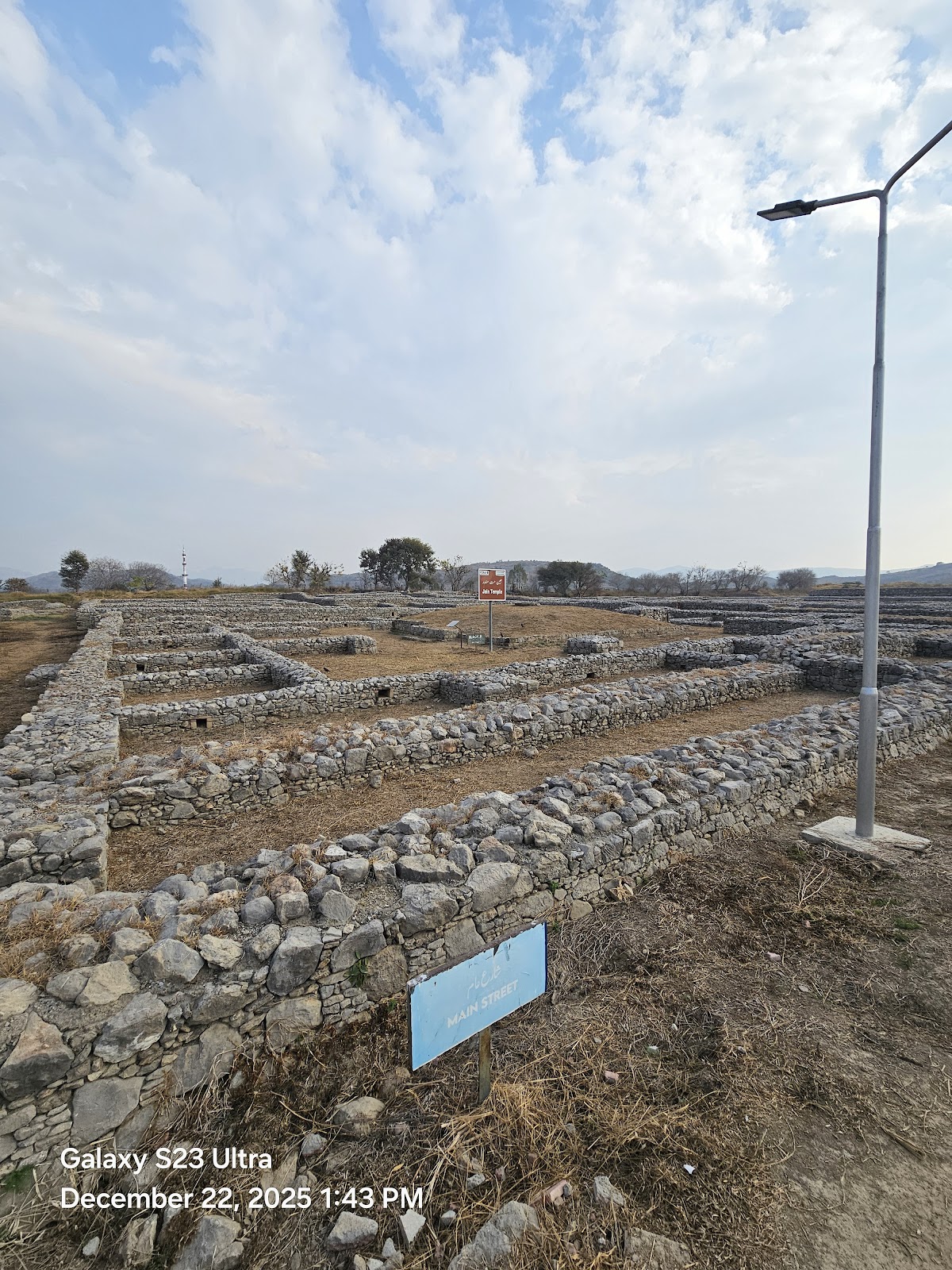
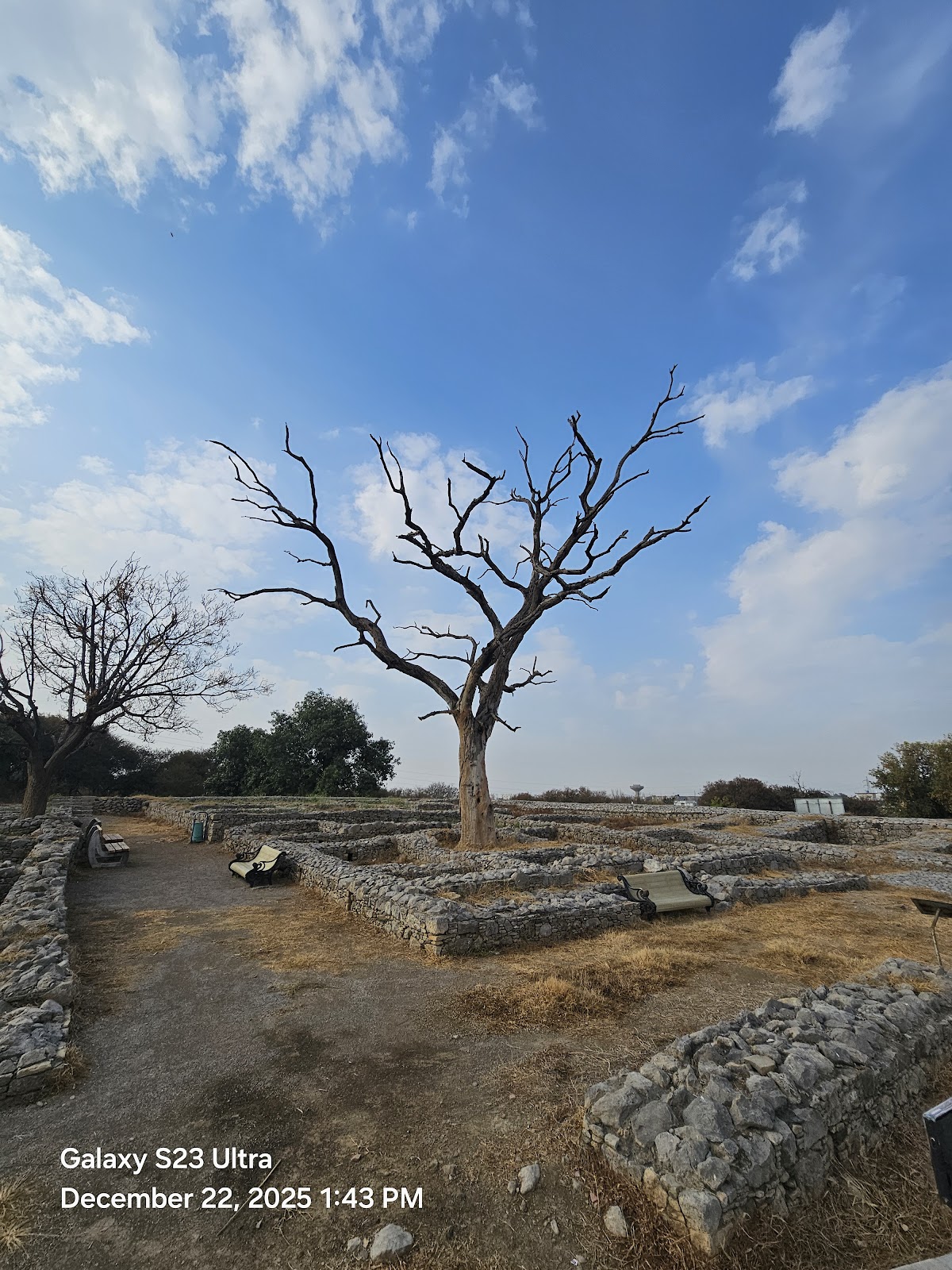
Sirkap was laid out on a Hippodamian grid plan, a rectangular street pattern named after the Greek planner Hippodamus, covering about 1,200 by 400 metres. A principal avenue ran north to south and was crossed by fifteen roughly perpendicular streets, producing regular blocks. The town was ringed by a defensive wall built of coarse rubble masonry using locally quarried stone, with regularly placed rectangular bastions. The fortification circuit measured on the order of five kilometres, and evidence points to multiple gates, with the northern gate exposed by excavation. These elements survive as excavated stone and foundation remains.
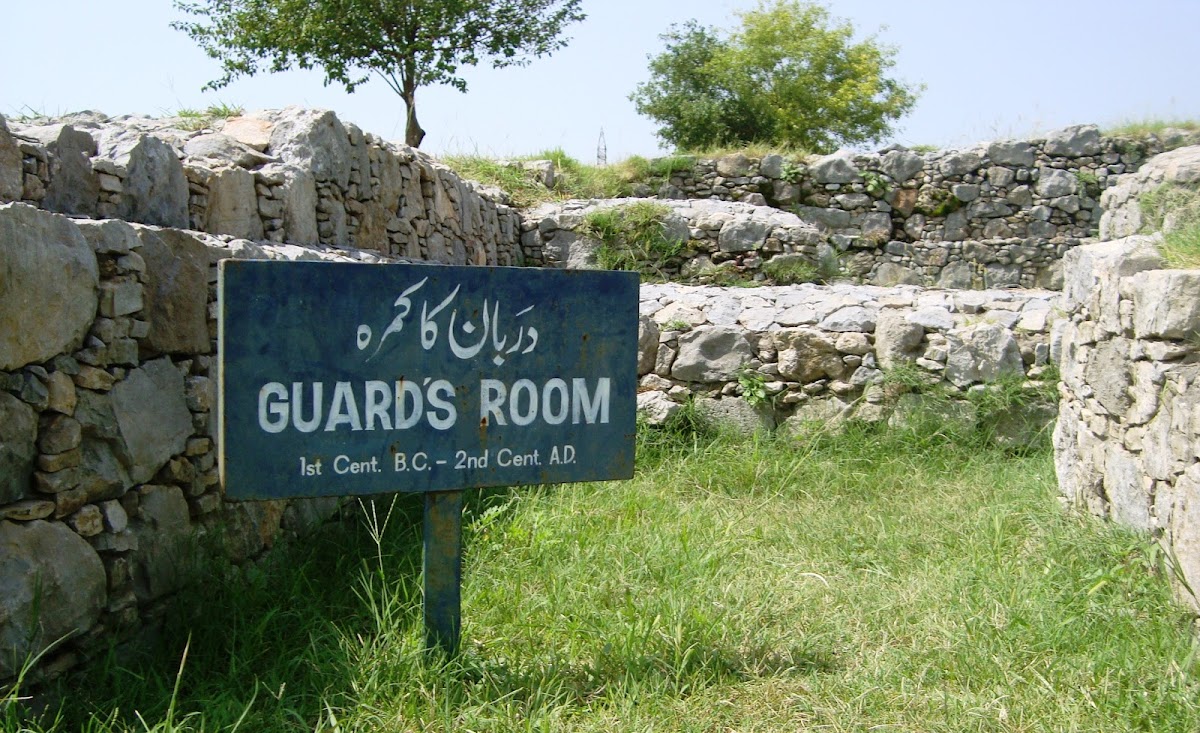
At the southern end of the settlement excavators uncovered a palace complex composed of five suites of apartments grouped around a central courtyard. The complex contained areas identified as women’s quarters, halls for audiences, administrative rooms, guest chambers, and a formal audience court. Walls and room arrangements were revealed in situ by archaeologists, and the overall plan and some decorative affinities recall palace types known from Assyrian sites in Mesopotamia, a comparison made on architectural grounds.
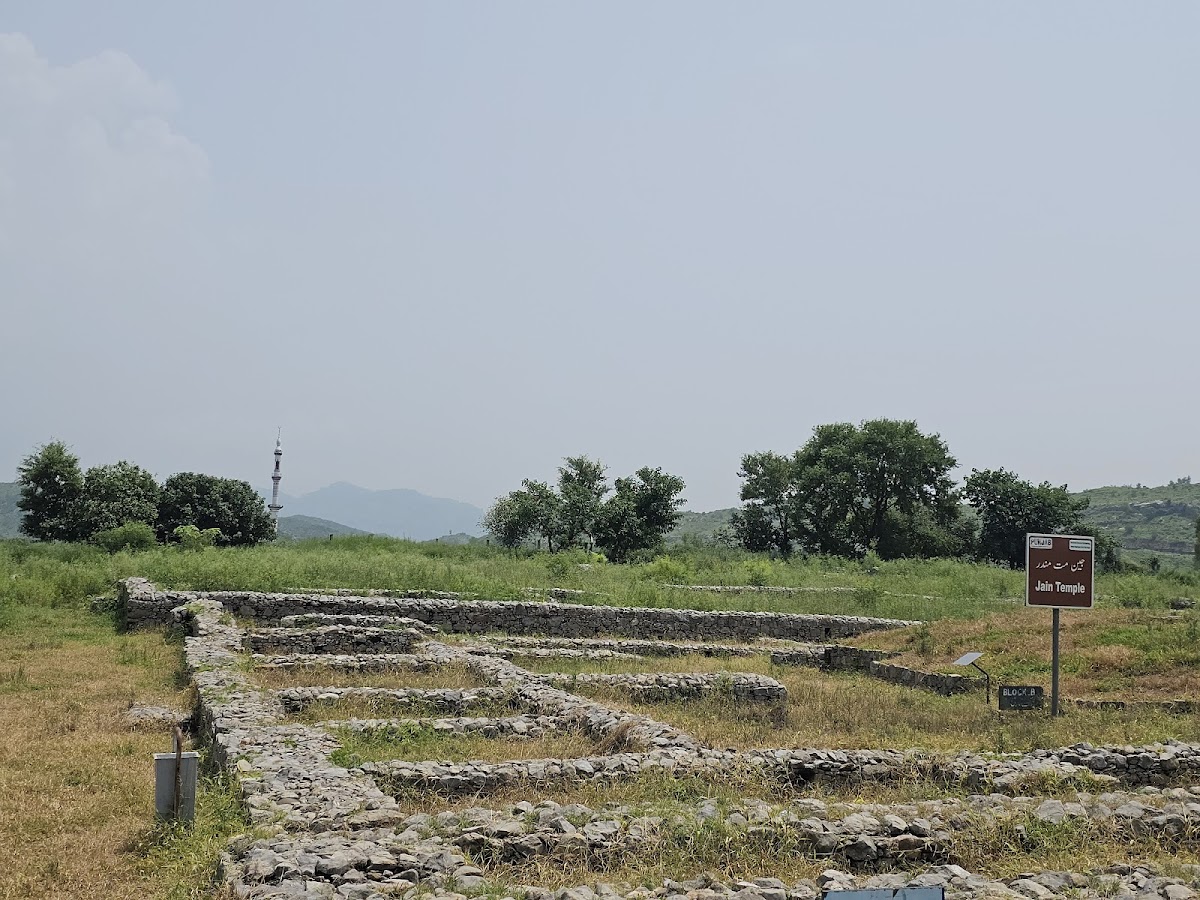
Religious constructions appear throughout the excavated layers. A temple associated with Jain practice was found with columns in the Persepolitan manner, their capitals decorated with lion motifs. There is also a Parthian-period Buddhist temple with an apsidal, that is, rounded end chamber; this building measures about 70 by 40 metres and includes a square nave flanked by several rooms, with a circular apsidal space that likely held a small stupa. Several free-standing Buddhist stupas were excavated as well, many displaying decorative motifs drawn from Hellenistic art. These sacred structures survive as excavated foundations and partial superstructures.
One notable monument from the Indo-Parthian phase is the so-called Double-Headed Eagle Stupa. Its masonry and ornament include Corinthian pilasters, Corinthian referring to a richly carved Greek column style, and a base articulated with three arches that appear to reflect Greek, Hindu, and local building traditions. The stupa’s drum bears Hellenistic decorative motifs, and a carved double-headed eagle motif placed atop the structure indicates influences traced to Babylonian and Scythian visual culture. This stupa remains known from its excavated sculptural and architectural fragments.
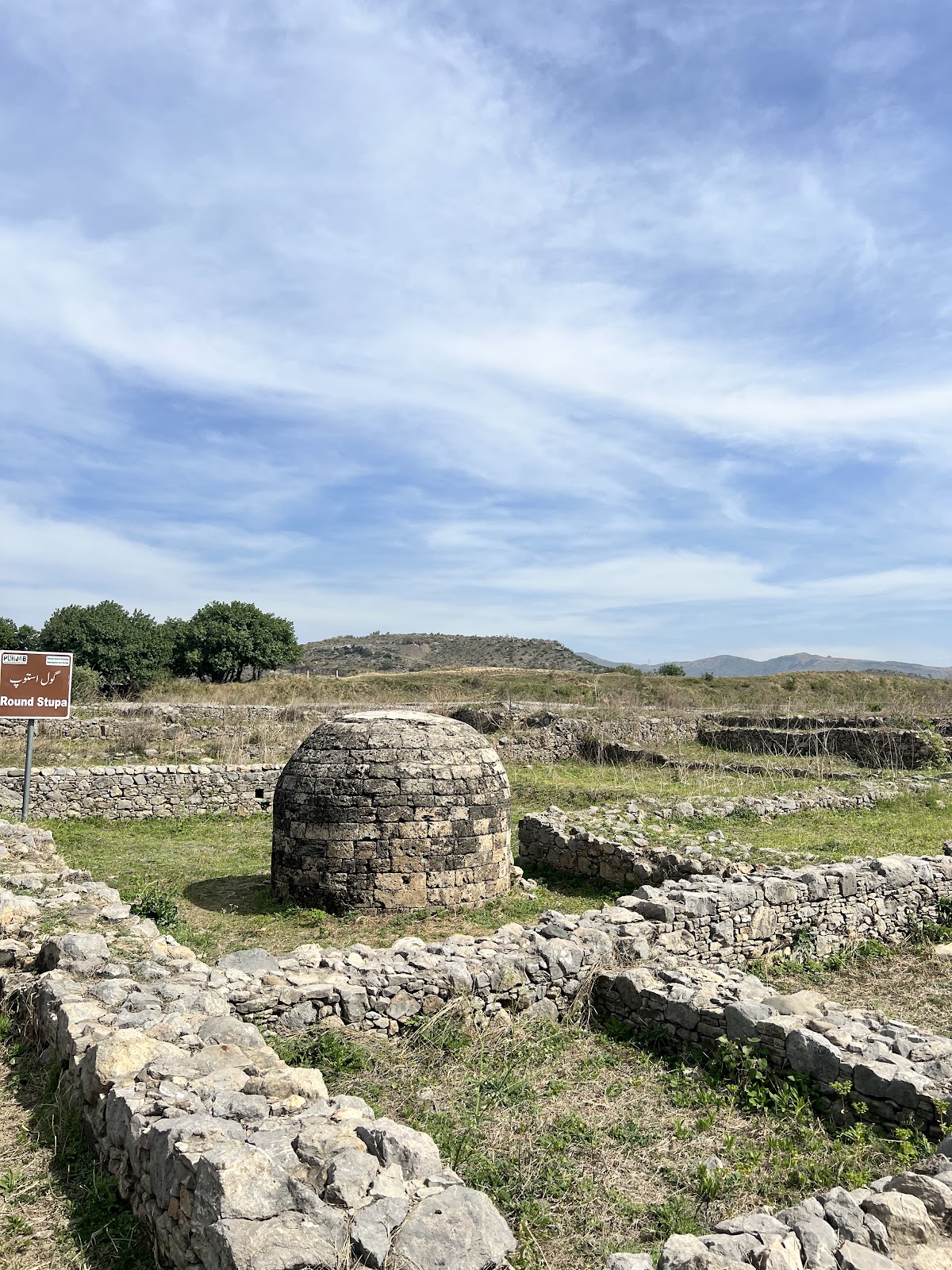
A round stupa at Sirkap, among the oldest such examples on the subcontinent, was affected by an earthquake around the 1st century CE and subsequently encompassed by a protective wall when the town was rebuilt in later phases. The change in its treatment is visible in the sequence of masonry revealed by excavation, showing deliberate reuse and safeguarding of an earlier monument within newer construction.
Excavations yielded a range of movable finds that illuminate the city’s cultural contacts. Archaeologists recovered coins of Greco-Bactrian rulers, stone palettes carved with scenes from Greek myth rendered with Indianized details, and personal ornaments including gold earrings, bangles, necklaces, and pendants. A deep vertical trench revealed seven distinct archaeological strata, and the masonry techniques change markedly between these layers, demonstrating the long-term development and shifting craft practices at the site. About 650 metres from the main settlement lies the Jandial Temple, an Ionic temple, Ionic denoting the Greek column order with scroll-like capitals, that is roughly contemporary with Sirkap’s early occupation and has been interpreted by some scholars as connected with a Zoroastrian cult.