Sieben Steinhäuser: A Group of Neolithic Tombs in Germany
Site at a Glance
- Popularity
- Medium
- Country
- Germany
- Primary era
- Stone Age
- Eras represented
- Stone Age, Modern
- Civilizations
- German
- Site type
- Burial
- Remains
- Necropolis
On this page12 sections
History
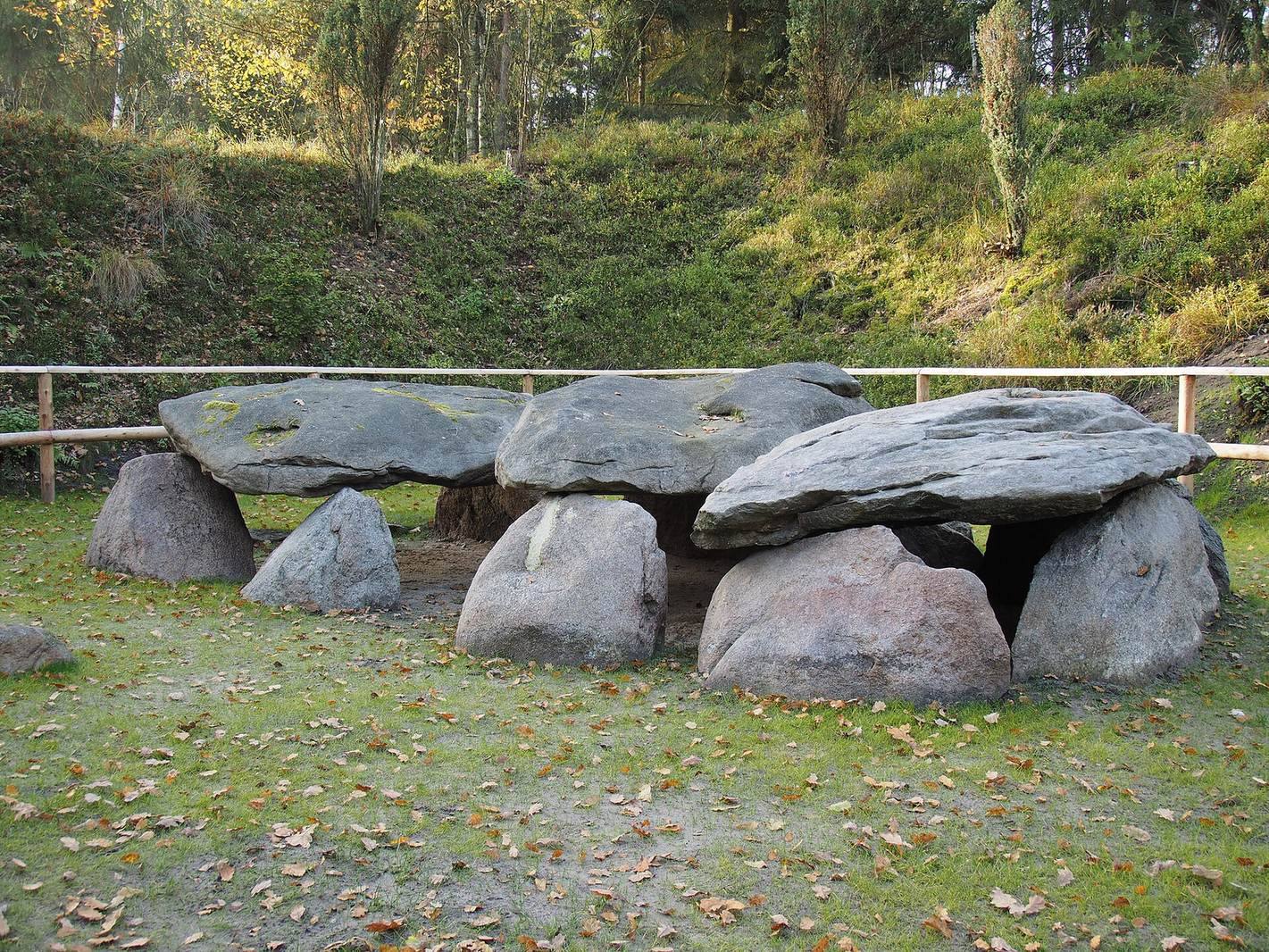
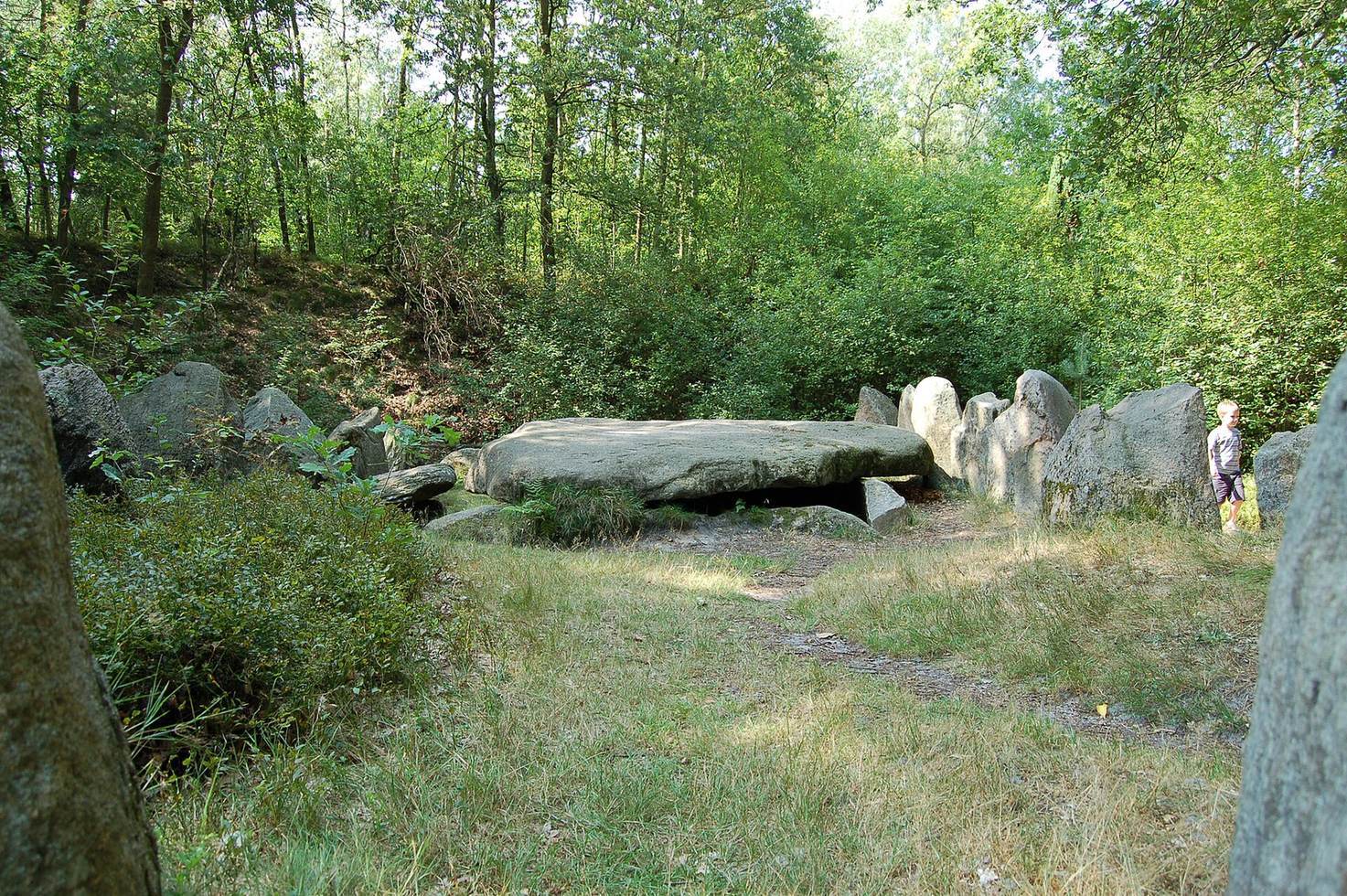
Sieben Steinhäuser is a group of five prehistoric stone tombs in the Bergen-Hohne military training area on the Lüneburg Heath in Germany. Settled farming communities built the tombs during the third millennium BC. They are associated with the late phase of the Neolithic Funnelbeaker culture, an archaeological culture named for its funnel-shaped pottery and dated to 3500–2800 BC. Grave D is the oldest of the group.
Recognition and excavation
The scholar and travel writer Johann Georg Keyßler made the first written mention of the tombs in 1720. In 1823, local official Heinrich von Quintus-Icilius secured protection for the site. Regional writer August Freudenthal later helped bring the tombs wider attention. Before the military training area was established, people visited them as a walking destination. Pine planting across the area from the mid-nineteenth century left the tombs within woodland.
Prehistorian Karl Hermann Jacob-Friesen excavated the tombs. Four were excavated and restored between 1924 and 1937. In summer 1936, the military administration enclosed the area with an earthwork, and restoration work began the following year. Several-metre-high banks were built in 1958 to protect the tombs from shell impacts on the training range. They also altered the tombs’ original relationship with the surrounding landscape.
Damage and conservation
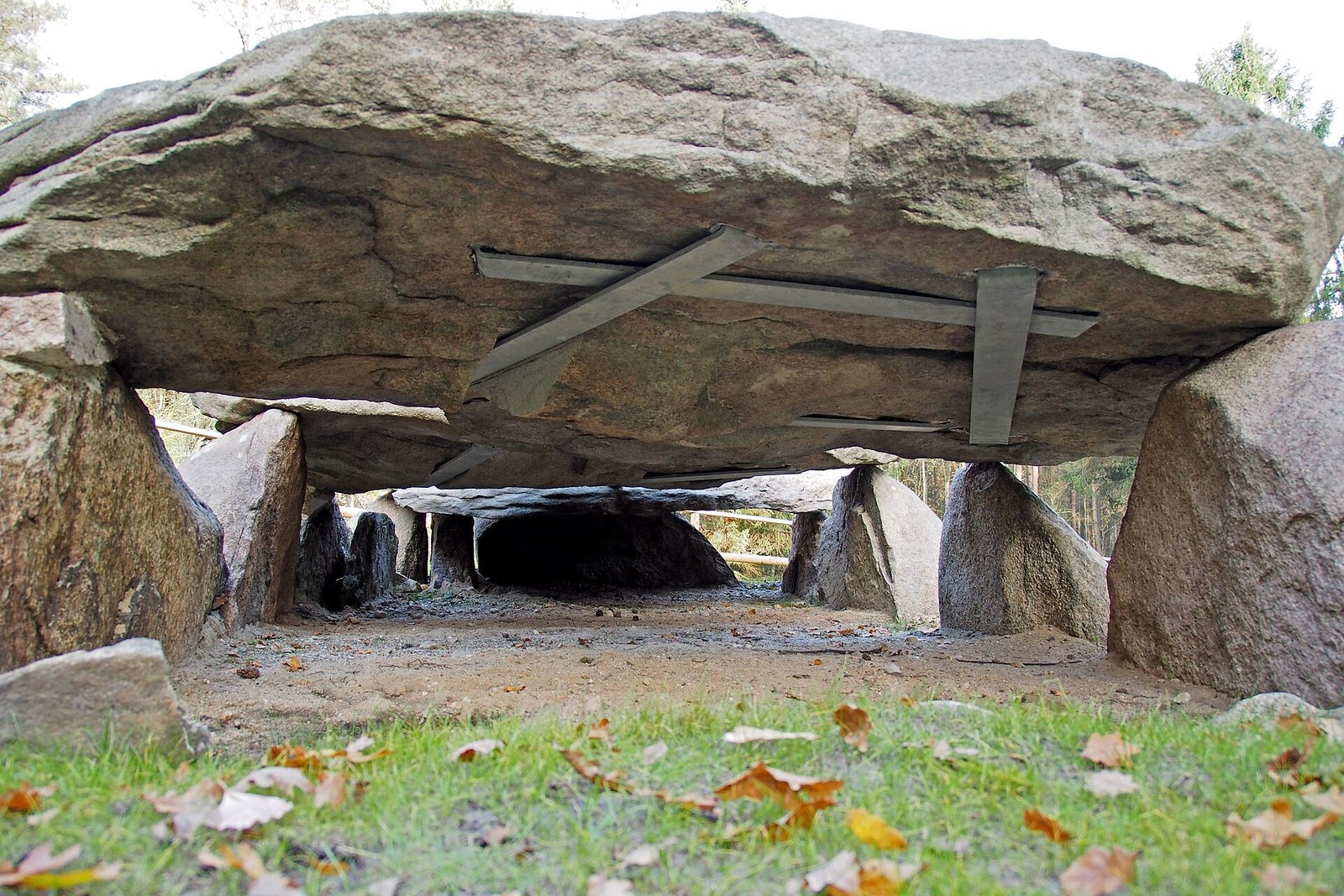
Grave C collapsed in December 2013. The cause could not be established; erosion after heavy rain was suspected, while vibration from military exercises was ruled out. In July and August 2015, the site underwent structural repairs. Workers raised and stabilized Grave C’s fallen stones and stabilized stones in the other tombs.
Stories associated with the tombs
The theologian Louis Harms proposed that the granite blocks had served as sacrificial altars. In the story he related, the Saxon leader Wittekind captured 4,000 people in battles at Osnabrück and Detmold during the Saxon Wars, and some prisoners were killed at the tombs. Harms said that a monk named Landolf, converted by the missionary Liudger, had witnessed a sacrifice. He referred to a parish archive at Hermannsburg and a Lüneburg chronicle, but local historian Hans Stuhlmacher wrote in 1939 that intensive research had failed to find these traditions.
A local legend explains the largest stone as a giant’s work. The giant supposedly hurled it from Elferdingen with a sling, carrying the two largest supporting stones in his coat pockets. On his way through Fallingbostel, he emptied sand from his shoes; the sand was said to have formed the Tutberg and Weinberg hills.
Remains
Setting and construction
The tombs stand between about 56 and 67 metres above sea level. The Hohe Bach runs past them from north to south and is a northeastern tributary of the Meiße, within the Aller river basin. The long sides of all five chambers point almost exactly northeast to southwest. Each tomb was originally covered by an earthen mound; as the soil eroded, the stones became exposed. Dry-laid stonework, fitted without mortar, closed the joints, and small remnants survive. Sand and granite grit formed the chamber floors to help water drain. An earthwork about 1.5 metres high surrounds the area, while taller protective banks shield the tombs from shell impacts. By March 2005, two tombs were partly collapsed. Grave D has been compared with French burial structures; the other four are likened to tombs of the Elbe-Weser region.
Burial chambers
Grave A
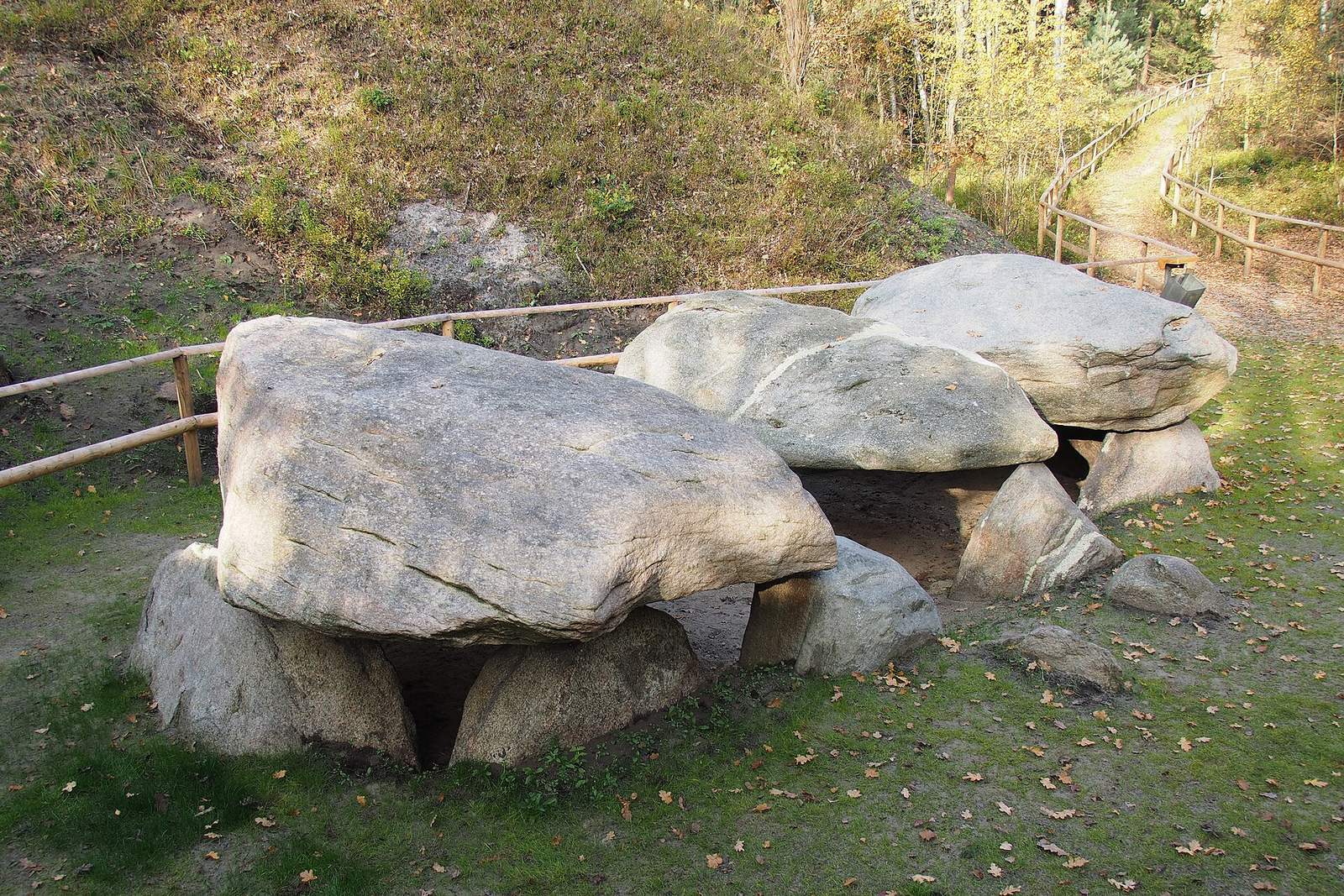
Four supporting stones make up each long side of the chamber, with an end stone at either end. Three capstones, the large slabs covering the chamber, rest on the supports. The middle capstone is markedly narrower than the others and is broken. The chamber measures 6.5 by 2 metres internally. Its entrance is halfway along the southeast side, where a pair of supporting stones survives.
Grave B
Four supporting stones form each long side, and four capstones cover the chamber. One is especially narrow and lies between the others as a horizontal entrance-like slab. The chamber measures 7 by 2.2 metres internally. At the entrance, midway along the chamber, the southern supporting stone survives. Excavated finds include human bone fragments, pottery discs from a beaker, flint objects, an amber pendant, and a copper band, an early example of a metal grave offering. The objects are displayed in the Lower Saxony State Museum in Hannover, in its MenschenWelten section.
Grave C
This shorter chamber has three supporting stones on its southeast side and four on its northwest side, together with two end stones and three capstones. Before restoration, the northeastern three-point support, the middle support on the southeast side, and the southwestern end stone remained in place. Two capstones had probably fallen under their own weight after the supports were disturbed. The chamber measures 5 by 2 metres internally. Its entrance appears to have been off-centre, between the first and middle supports on the southern part of the southeast side. The fallen stones were raised and stabilized during the 2015 restoration.
Grave D
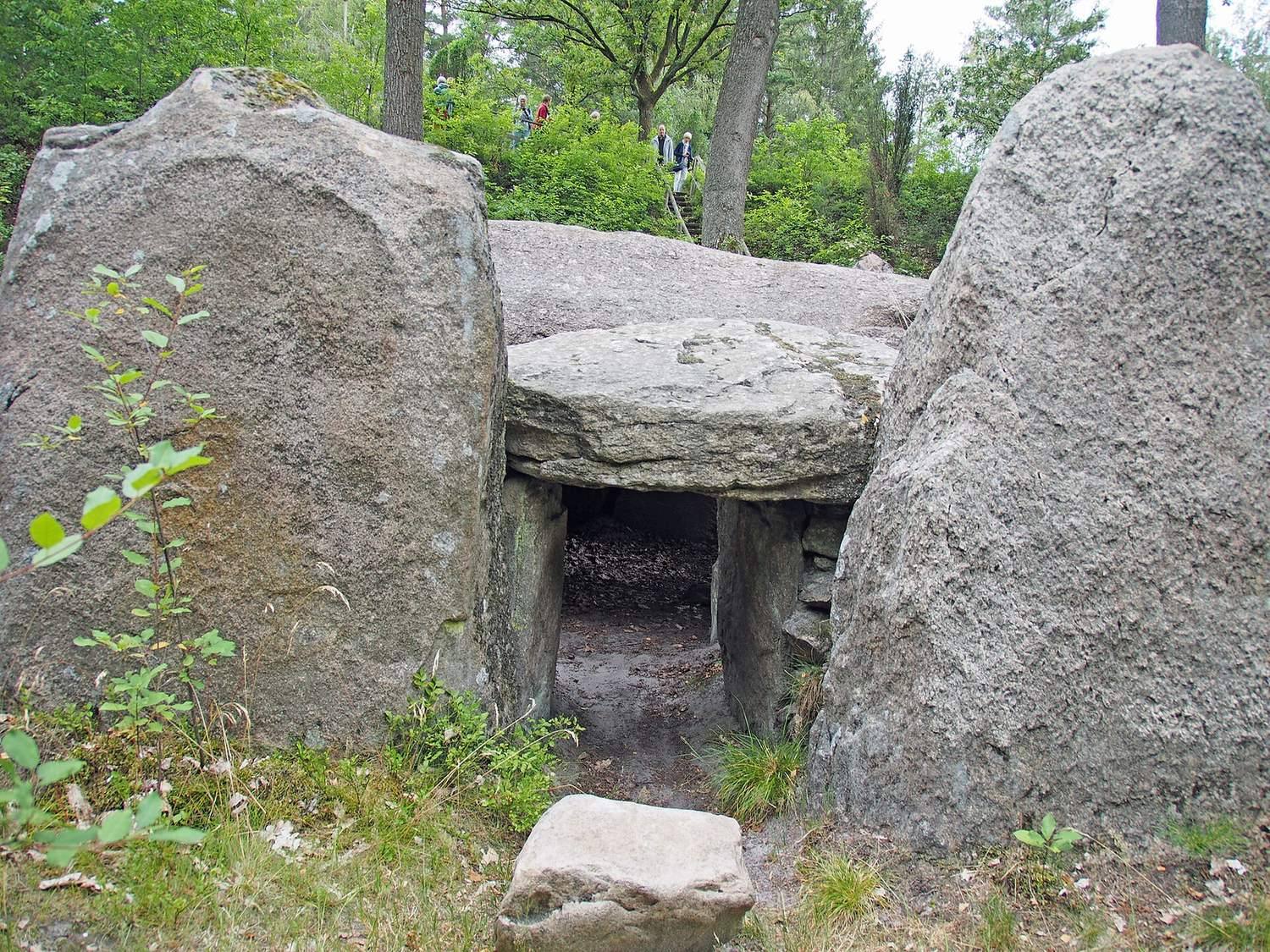
This short, nearly square chamber has one slab on its southwest side and two supporting stones on each of its other sides. Its massive capstone measures 4.6 by 4.2 metres and is half a metre thick; the chamber is about 4 by 3 metres internally. The entrance is centred on the southeast side. Its supporting stones are original, while the capstone above the entrance is a replacement.
A rectangular enclosure associated with Grave D is an elongated burial monument known as a long barrow. Its restored perimeter measures about 7 by 14 metres and ends abruptly on the southwest. A further 3–4 metres may have been intended for another tomb during the Neolithic.
Grave E
Four supporting stones form each long side, with three capstones above them. The support at the southwestern end is a replacement. The southwestern and middle capstones are halves of the same boulder, though this does not establish that people deliberately split it in prehistoric times. During restoration, the slightly displaced capstones were reset. The chamber measures 5.6 by 2 metres internally. Its entrance lies midway along the southeast side and had two horizontal supports; the two outer supporting stones survive.