Shōden-ji Temple: A Rinzai Zen Temple in Kyoto


Site at a Glance
- Rating
- 4.6
- Popularity
- Low
- Country
- Japan
- Primary era
- Early Modern
- External website
- Open
- Eras represented
- Early Modern, Modern
- Civilizations
- Japanese, Toyotomi regime
- Site type
- Religious
- Remains
- Monastery
On this page9 sections
History
Shōden-ji Temple is a Rinzai Zen temple in Kyoto, Japan, founded in the thirteenth century and associated with the Nanzen-ji branch. Formally called Shōden Gokoku Zenji, it belongs to the ranked network of recognized Zen monasteries known as shozan temples and enshrines Shaka Nyorai, the historical Buddha Shakyamuni, as its principal image.
Foundation and destruction
The temple’s foundation is dated either to 1273 or, in another tradition, to 1268. Tōgan E’an established it at Karasuma-Imadegawa with imperial permission from Emperor Kameyama. He invited his teacher Gottan Funei to serve as founding abbot. Gottan was a Chinese Chan Buddhist monk who had come to Japan from the Southern Song and had returned to his homeland in 1265.
Monks from Enryaku-ji destroyed the temple. Tōgan E’an later moved to Shōkai-ji in Kamakura, a temple that no longer survives, and died there in 1277.
Revival at Nishigamo
In 1282, with assistance from Mori Tsunehisa, a member of the hereditary priestly family of Kamo Shrine, Shōden-ji was moved and revived at its present location in Nishigamo, where Kamo Shrine held an estate. By 1323, its halls and other buildings had been completed. In that year, Emperor Go-Daigo issued an imperial document recognizing Shōden-ji as a temple for imperial prayers, and the institution was renowned as a major temple of northern Kyoto.
War, patronage, and restoration
During the Muromachi period, Shōden-ji received the patronage of the imperial family and the Ashikaga shogunal house. Fire damaged the temple during the Ōnin War of 1467–1477, a civil conflict that weakened central authority in Japan, and Shōden-ji subsequently declined.
In 1585, Toyotomi Hideyoshi, a late-sixteenth-century military ruler, issued a vermilion-seal document guaranteeing the temple’s landholdings and mountain forests. This attempted revival did not succeed. The temple was later restored under Tokugawa Ieyasu, founder of the Tokugawa shogunate, after he issued a similar guarantee. During the Edo period, Shōden-ji had five subtemples.
The temple’s main hall, its wall paintings, and a portrait of Gottan Funei are nationally designated Important Cultural Properties. Its garden is designated a Scenic Place by Kyoto City.
Remains
Main hall and painted interiors
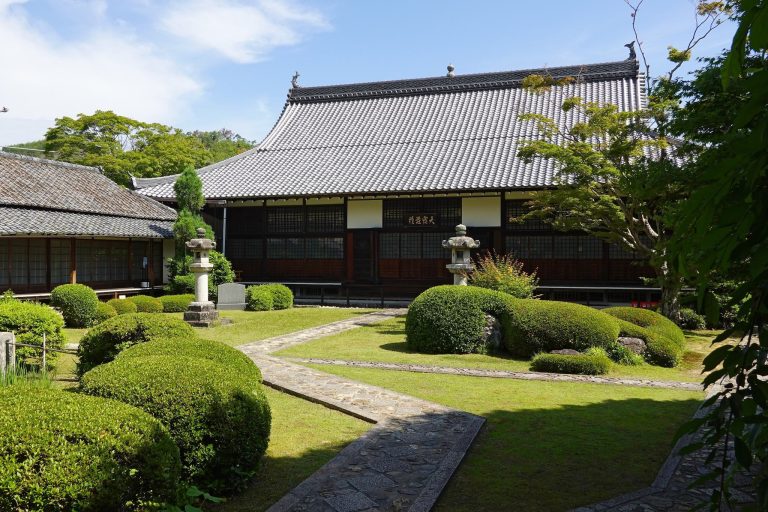
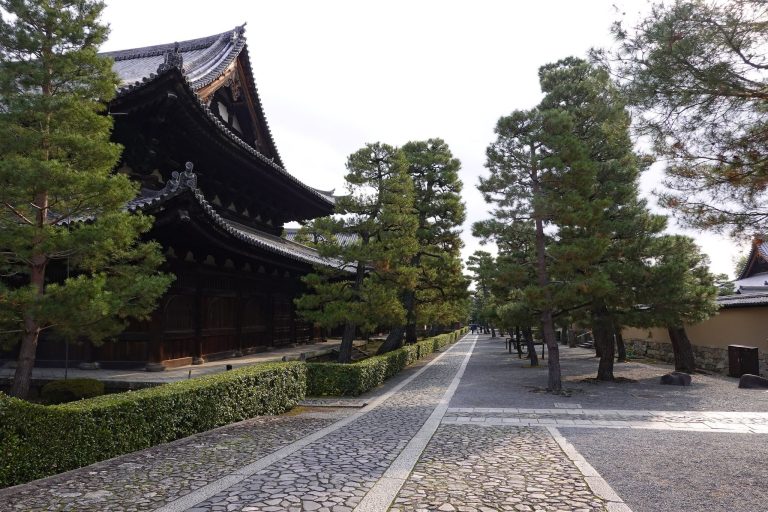
The main hall also serves as the abbot’s quarters. It is an irimoya-style building, a form combining a central gable with sloping hipped sections, and has a shingle roof. Built during the Azuchi-Momoyama period, it was originally a ceremonial reception hall in the main enclosure palace of Fushimi Castle. It was later transferred to Konchi-in, a Nanzen-ji subtemple, where it served as a small abbot’s residence. In 1653, it was moved again and became Shōden-ji’s main hall.
Inside are 58 wall-painting panels showing pavilions and landscapes in ink and light colors. Three further panels depict flowers and plants, while four show confectionery designs on a gold ground. Their style and other characteristics have led to an attribution to the school of Kanō Sanraku.
Blood ceiling
The corridor ceiling is known as the “blood ceiling.” Its floorboards came from a corridor at Fushimi Castle and retained bloodstains associated with Torii Mototada and others who committed suicide when the castle fell during the battle for Fushimi Castle.
Garden of the Lion Cubs Crossing
In front of the main hall lies the dry landscape garden known as the Garden of the Lion Cubs Crossing. A dry landscape garden represents natural scenery through elements such as sand and stones rather than water. The garden uses borrowed scenery, a technique that incorporates a distant landscape into the composition, with Mount Hiei visible beyond the white wall.
Its arrangement consists of white sand and clipped satsuki azaleas, without rocks. Tradition attributes the garden to Kobori Enshū, an early-modern Japanese garden designer, architect, and tea practitioner, while the existing arrangement was made during the Shōwa period by Mirei Shigemori, a twentieth-century garden designer and scholar known for restoring and reinterpreting historic Japanese gardens.
Other buildings and associated objects
The precincts also contain a kitchen and living-quarters building and a bell tower. Associated cultural properties include two silk portraits of Gottan Funei with accompanying self-inscriptions, one of which bears an artist attribution.
The temple preserves a one-volume prayer text by Tōgan E’an for the defeat of the Mongols, dated 1270–1271. Another work, written by Tōgan E’an and carrying a 1273 colophon, consists of two volumes on the continuity of the teachings of the ancient sages. An imperial document from 1413 grants Tōgan E’an a religious title.