Hida Kokubun-ji Temple: A Provincial Buddhist Monastery in Takayama


Site at a Glance
- Rating
- 4.3
- Popularity
- Medium
- Country
- Japan
- Primary era
- Medieval
- External website
- Open
- Eras represented
- Medieval, Early Modern
- Civilizations
- Ashikaga shogunate, Tokugawa, Yamato
- Site type
- Religious
- Remains
- Monastery
On this page15 sections
History
Hida Kokubun-ji Temple is a Buddhist temple in Takayama, Gifu Prefecture, Japan, established during the Nara period, probably in the mid-eighth century, as part of Emperor Shōmu’s provincial monastery system. It belongs to the Kōyasan Shingon school, a major Japanese Buddhist tradition associated with esoteric ritual, and uses Medicine King Mountain as its honorific mountain name. Its principal image is Yakushi Nyorai, the Buddha of healing and medicine.
The Nara-period foundation
In 741, Emperor Shōmu ordered the creation of a monastery and a nunnery in every province. These institutions formed the kokubunji system, a state-sponsored network intended to promote Buddhism as the national religion while strengthening imperial control across the provinces. Hida Kokubun-ji was the province’s monastery within this framework.
Emperor Shōmu is regarded as the temple’s imperial founder. Tradition instead attributes its actual foundation to Gyōki, a wandering Nara-period Buddhist prelate known for itinerant preaching and public religious works, although no historical evidence supports that attribution. The original temple burned in 819 and was rebuilt around 855.
Medieval rebuilding and destruction
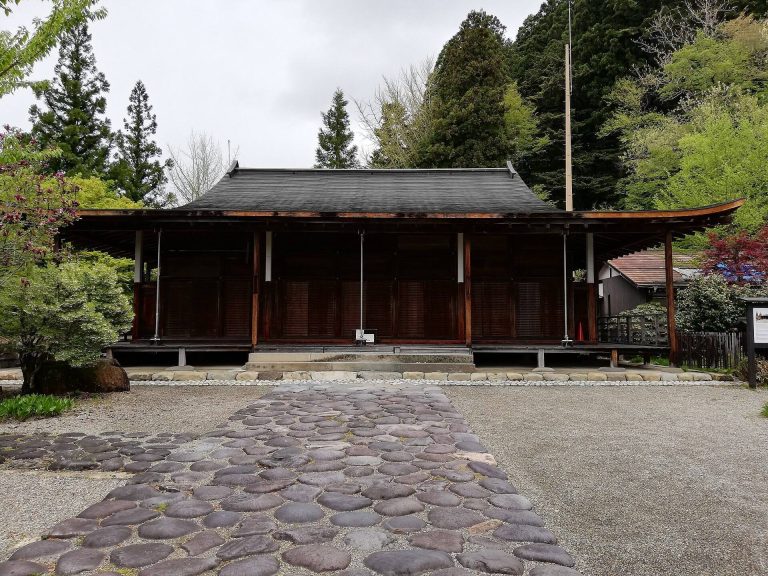
The present main hall was rebuilt during the Muromachi period, which lasted from the fourteenth to the sixteenth century. It dates approximately to 1440–1462 and is the principal surviving historic building at Hida Kokubun-ji.
The original seven-story pagoda burned during the Ōei period. It was rebuilt, but burned again in 1585 during the conflict in which Kanamori Nagachika attacked Anegakōji Yoritsuna’s Matsukura Castle. The surviving foundation stones preserve the location and construction evidence of this earlier pagoda.
Edo-period changes
A three-story pagoda was rebuilt in 1615. After collapsing in a storm in 1791, it was reconstructed in 1821, and the present pagoda dates from that rebuilding. During the Edo period, which lasted from 1603 to 1868, the temple also acquired structures connected with Takayama Castle. In 1695, after Hida became a directly administered shogunal domain and the castle was dismantled, some of its structures were transferred to Hida Kokubun-ji and incorporated into the temple, including a bell-tower gate.
Hida Kokubun-ji is the first site on the Hida Thirty-Three Kannon pilgrimage and the forty-first site on the Chūbu Forty-Nine Yakushi pilgrimage. The former Hida provincial nunnery stood about 600 meters west of the temple. Its site is now occupied by a shrine complex, where foundation stones from its main hall have been excavated. An associated tile-kiln site, interpreted as the complex that supplied roof tiles to Hida Kokubun-ji, is also designated as a National Historic Site.
Protection and surviving associations
The temple’s historic buildings and associated remains are protected through national, prefectural, and municipal designations. The Nara-period pagoda foundation stones became a National Historic Site in 1929. The main hall and several associated objects are National Important Cultural Properties, while the three-story pagoda and two Buddhist statues are Gifu Prefecture cultural properties. Takayama City designates the bell-tower gate and rear gate. The large ginkgo tree is protected as a National Natural Monument.
Remains
Buildings and pagoda foundations
Main hall
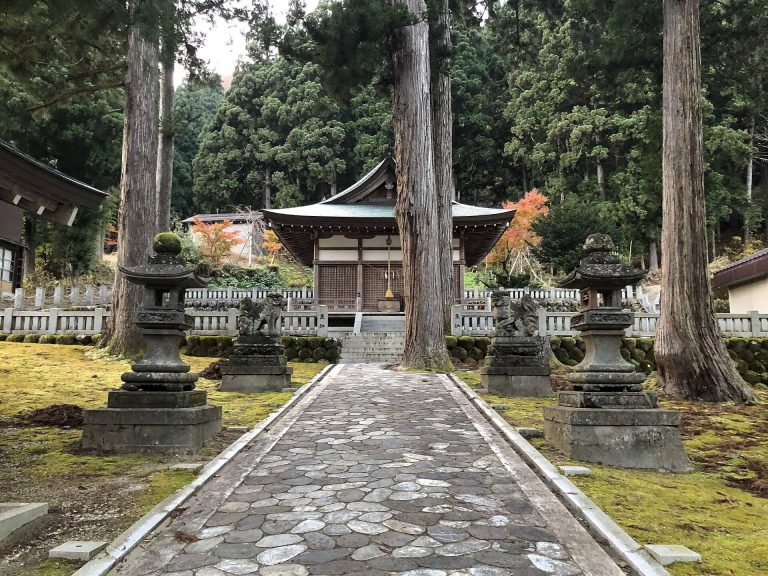
The main hall, or Hondō, is a wooden building from the middle of the Muromachi period, dated approximately to 1440–1462. It is the temple’s principal surviving historic structure and provides the central architectural focus of the preserved complex.
Seven-story pagoda foundation
East of the main hall are the remains of the Nara-period seven-story pagoda. Its central foundation stone has a roughly square body topped by a cylindrical pillar base. A circular hole lies at its center, and the circular pillar seat measures approximately 1.3 meters in diameter. The stone no longer stands in its original position, but it preserves part of the pagoda’s foundation system, including a cavity intended to hold relics.
Three-story pagoda
The present three-story pagoda is a wooden Edo-period structure rebuilt in 1821 after the earlier pagoda collapsed in a storm. It stands more than 22 meters high and represents the later pagoda phase of the temple’s architectural history.
Gates
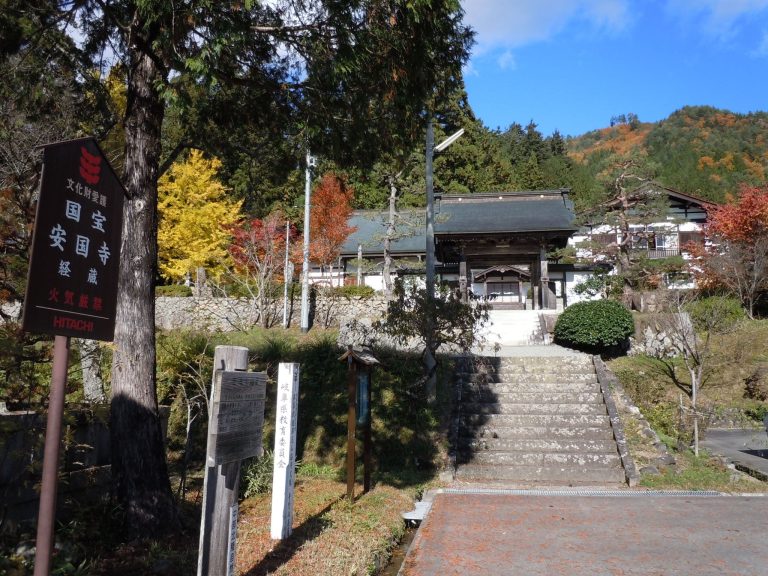
The Rōmon bell-tower gate, a gate with a tower-like upper structure, was built in 1764 and contains a bell dated 1514. A separate rear gate also survives, with an attached construction plaque from the Edo period. These gates form part of the temple’s later building fabric, including structures associated with the transfer of buildings from dismantled Takayama Castle.
Sculptures, sword, and ginkgo
Wooden Buddhist statues
The principal image is a seated wooden statue of Yakushi Nyorai from the Heian period. Carved from a single block of wood, it measures 145.7 centimeters in height. A standing wooden statue of Kannon Bosatsu, a bodhisattva associated with compassion, dates from the same period, stands 204 centimeters high, and is traditionally regarded as the principal image of the former Hida provincial nunnery.
Other temple sculptures include a seated wooden statue of Amida Nyorai, the Buddha of the Pure Land, from the Kamakura period. It is traditionally attributed to Eshin Sozu, a sculptor and monk. A standing wooden statue of Fudō Myō-ō, a Buddhist protector of the religious teachings, dates from the Kamakura period and serves as the principal image of the goma hall, a hall used for Buddhist fire rituals.
Kogarasumaru sword
An associated tachi sword is identified as a Kogarasumaru sword. The Ema clan donated it, and tradition regards it as a family heirloom of the lords of Takahara Suwa Castle, who belonged to that clan.
Large ginkgo
A large ginkgo tree stands on the temple grounds. It is estimated to be approximately 1,250 years old, with a trunk circumference of about 10 meters and a height of approximately 28 meters. Tradition has given it the name “milk ginkgo.”