Kengō-in Temple: Head Temple of the Kengō-in School

Site at a Glance
- Rating
- 4.5
- Popularity
- Very Low
- Country
- Japan
- Primary era
- Unclassified
- Eras represented
- Unclassified
- Civilizations
- Unclassified
- Site type
- Religious
- Remains
- Temple
On this page9 sections
History
Kengō-in Temple is a Japanese Buddhist temple in Japan whose origins date to 1194 and whose foundation as a temple followed in 1201 during the Kamakura period. Its history is tied to the courtly Kujō family, Pure Land Buddhism, and the movement of the institution through several locations in Kyoto.
Origins and Pure Land foundations
In 1194, the regent Kujō Kanezane commissioned the sculptor Kaikei to create images of Shaka Buddha and Amitabha Buddha. Kanezane enshrined the statues at his private Tsukinowa residence. In 1201, his grandson Kujō Michiie established a temple around them at Hosshōji Temple, although another tradition places the original foundation at Shirakawa.
Michiie invited Shōkū, a disciple of Hōnen and the founder of the Seizan branch of Japanese Pure Land Buddhism, to serve as the temple’s founding master. He named the institution Kengō-in. The name refers to the relationship between its two principal Buddhas: Shaka Buddha directs believers toward the Western Pure Land, while Amitabha Buddha receives them there. Shōkū died at Kengō-in in November 1247.
Religious and courtly roles
Kengō-in later became a center for studying four Buddhist traditions, Tendai, Shingon, Ritsu, and Pure Land Buddhism. From the Nanboku-chō period through the Meiji Restoration, it was one of four Kurodo temples responsible for Buddhist rites connected with the imperial court. The other three were Rozanji, Nison-in, and Hanju-in. In 1575, Kengō-in received the status of a formally recognized temple, known as a jōgakuji.
Relocation and division
In 1583, Hashiba Hideyoshi, later known as Toyotomi Hideyoshi, planned to construct the Great Buddha Hall of Hōkōji on Kengō-in’s grounds. The plan forced the temple to begin moving. When the proposed building site changed to the grounds of Shibutani Bukkōji, the relocation stopped, but the process divided Kengō-in into two institutions.
The branch that remained at the original site in present-day Higashiyama was renamed Jigen-in and later recovered the name Kengō-in. It was abolished in February 1868 during the anti-Buddhist movement associated with the Meiji Restoration. In 1914, it was revived as a temple of the Seizan-Zenrinji branch of Jōdo Buddhism and became known also as Minami Kengō-in.
The branch that moved received permission from Emperor Ōgimachi to relocate to Kitanobe-chō on Teramachi Street, in present-day Kamigyō Ward, east of the Kyoto Imperial Palace and south of Rozanji. It became a Tendai temple and was also called Kyōgoku Kengō-in. This branch is the present Kengō-in Temple.
Fire and later movement
The Great Tenmei Fire of January 30, 1788, destroyed every temple building except the Ganzan Daishi Hall. The other buildings were rebuilt afterward. Ganzan Daishi is a title for Ryōgen, a tenth-century Tendai monk and influential Buddhist leader.
In 1955, Kengō-in sold its former grounds to the Ritsumeikan educational corporation and moved to Takamine, where a wealthy person’s villa had previously stood. There it formed the Kengō-in school of Jōdo Shinshū, a later Pure Land tradition centered on reliance on Amitabha Buddha, and became the school’s head temple. It is therefore also called Takamine Kengō-in. Yōgen-in Temple in Higashiyama, known for its association with Yodo-dono, belongs to the Kengō-in school. Kengō-in has no mountain name, and its principal images remain Shaka Buddha and Amitabha Buddha. It is also associated with Kyoto’s Seven Lucky Gods tradition through Fukurokuju.
Remains
Takamine buildings and grounds
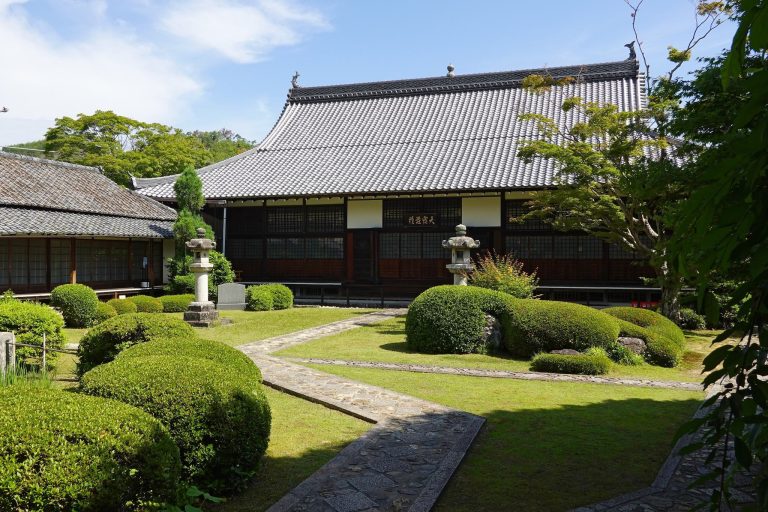
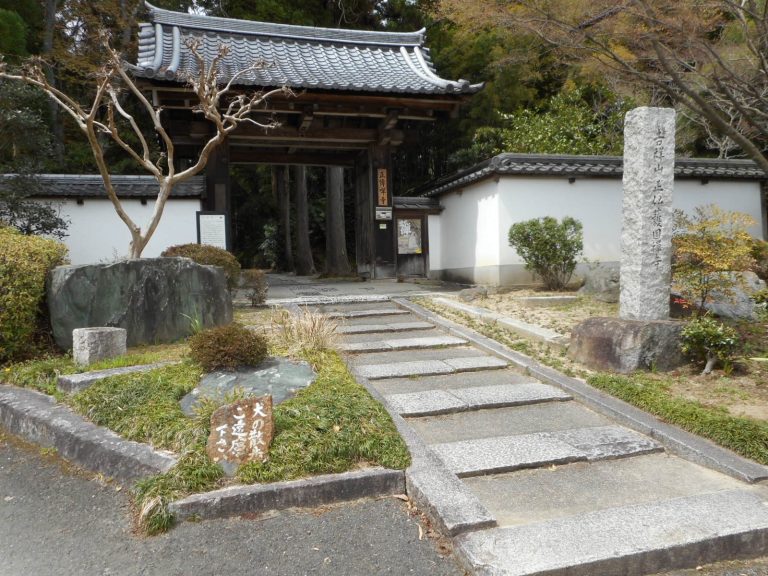
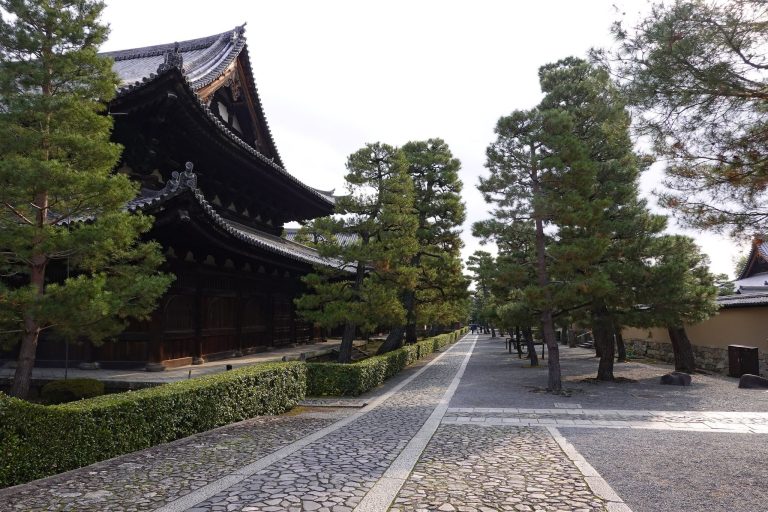
The Takamine complex contains a main hall, residential quarters for the temple, a shoin reception and study building, a garden, and a longhouse-style gate. The shoin and gate belonged to the villa that previously occupied the site. They are relocated remains from Bitchū Takamatsu Castle, giving the present complex architectural elements connected with both the former villa and an earlier castle site.
Principal Buddhist images
The temple’s principal images are wooden standing statues of Amitabha Buddha and Shaka Buddha from the Kamakura period. The Amitabha statue is attributed to Kaikei, the sculptor commissioned by Kujō Kanezane in 1194. The statues and associated material are Important Cultural Properties.
The associated material includes 68 sheets of paper printed with images of Amitabha Buddha and related Buddhist images. They were placed inside the principal statue, and one sheet bears a date corresponding to 1194. Together with the statues, this material preserves physical evidence connected with the temple’s earliest origins.
Relocation sites
The former temple grounds and the Takamine complex represent different stages in Kengō-in’s movement and division. The Tendai branch first moved to Kamigyō and later transferred to Takamine, while the branch that stayed at the original Higashiyama location developed separately as the institution later known as Minami Kengō-in.