Bandai-ji Temple: A Sea-Cliff Rinzai Zen Temple in Japan


Site at a Glance
- Rating
- 4.4
- Popularity
- Medium
- Country
- Japan
- Primary era
- Early Modern
- Eras represented
- Early Modern, Modern
- Civilizations
- Japanese, Tokugawa
- Site type
- Religious
- Remains
- Temple
On this page13 sections
History
Bandai-ji Temple is a Rinzai Zen temple in Fukuyama, Japan, belonging to the Myoshinji branch and also known as Abuto Kannon. Its principal image is an Eleven-Headed Kannon, a form of the Buddhist bodhisattva of compassion represented with multiple heads symbolizing expanded spiritual perception. The temple stands above the Seto Inland Sea and has long been associated with protection for people travelling by sea.
Early traditions and uncertain origins
The temple’s beginnings are not certain. One tradition places them in the late tenth century, when Retired Emperor Kazan, a former Japanese emperor associated with religious patronage and pilgrimage traditions, enshrined a stone image of Eleven-Headed Kannon and prayed for safe navigation. The institution later declined.
Another tradition connects the foundation with Hōtō Kokushi during the 1330s. Hōtō Kokushi was the posthumous honorific of a Zen monk, with “Kokushi” meaning “National Teacher.” A related account gives the credit to Kakusō Kenchi. This attribution presents a chronological difficulty because Hōtō Kokushi died more than forty years before the period in which the foundation is placed. The temple is recorded again after its revival in 1570.
A 1665 temple origin account preserves another tradition. A fisherman from Tomonoura is said to have drawn a stone image repeatedly from the waters off Numakuma. After a dream identified the image as Kannon, he placed it on a reef or on rocks at Abuto. The details vary, but the tradition consistently links the image with recovery from the sea and its enshrinement at Abuto. Whether it was the same image associated with Emperor Kazan remains unresolved.
Revival and early modern patronage
Mori Terumoto, a major warlord of the Mori clan during Japan’s late sixteenth-century Warring States period, is traditionally said to have built a hall for the image in 1570. The account names Kenchi, a monk of Hōdaiji, as the founding priest. The identity of this Kenchi and the earlier Kakusō Kenchi is uncertain, since the traditions place them more than two centuries apart.
After the hall was built, Bandai-ji attracted daimyo, merchants, sailors, travellers, and people from every social rank. Vessels passing below the Kannon Hall were traditionally expected to offer coins from the sea while praying for safe navigation. A priests’ residence was built in the late sixteenth century, and a large bell was cast during the Keicho period. The successive lords of Fukuyama, including the Mizuno and Abe families, continued to support the temple.
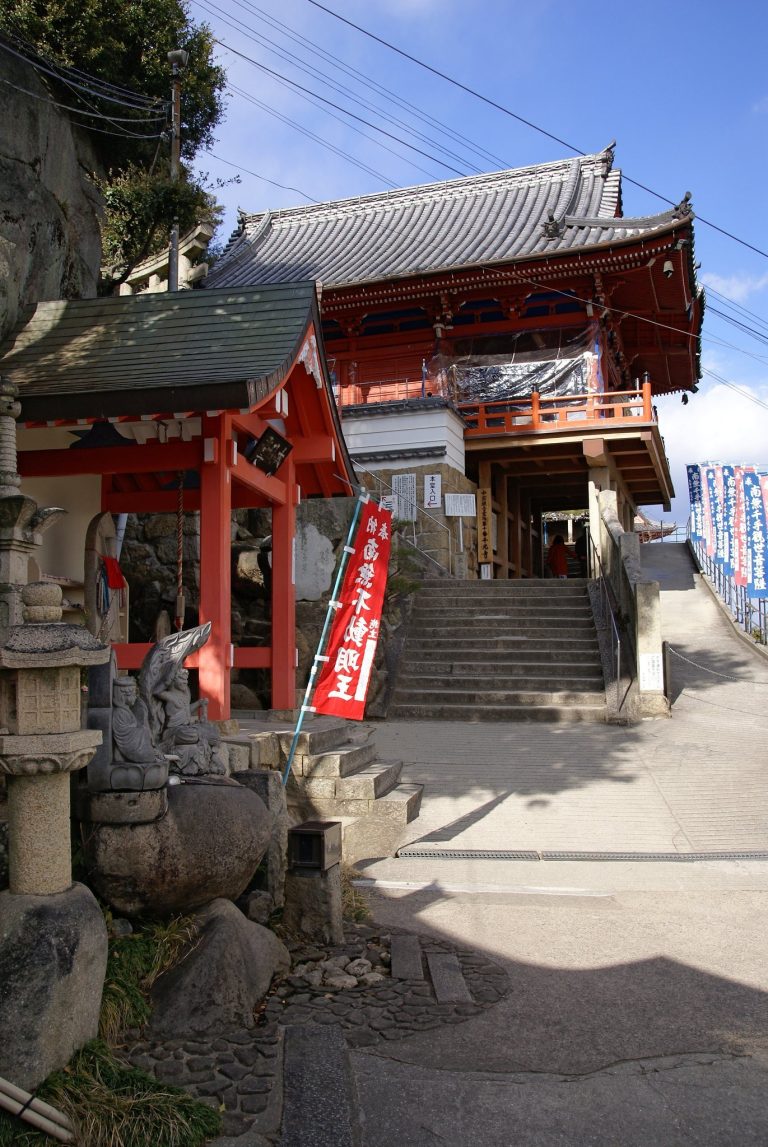
Donations recorded during the seventeenth and eighteenth centuries paid for repairs to the Kannon Hall, corridor, stone walls, and guest hall. A major renovation in 1667 added stone walls and steps to improve the difficult approach, built a corridor between the abbot’s quarters and the Kannon Hall, and rebuilt the bell tower. These works brought the precinct close to its present arrangement.
Modern preservation and religious traditions
The sea-facing Kannon Hall continued to receive repairs despite its exposure to deterioration. During the Meiji period, a projecting worship porch was added to the guest hall, and the priests’ residence was rebuilt in the early Showa period. The Kannon Hall was dismantled and repaired between October 1951 and May 1952. Three wooden ridge tags, construction tablets placed in a roof structure to record building work, were found during the repairs. They belonged to the Kanbun, Genbun, and An’ei periods.
The Kanbun ridge tag records the hall’s foundation in 1570 under Mori Terumoto. It was a later historical record rather than the original foundation tag, but the hall’s architectural style and construction methods are considered consistent with that tradition. The hall and its three ridge tags became a nationally Important Cultural Property in 1956, while the guest hall received designation as an Important Cultural Property of Hiroshima Prefecture in 1962.
Bandai-ji is the 24th station on the Setouchi Thirty-Three Kannon pilgrimage and the fourth station on the Bingo Saigoku Thirty-Three Kannon pilgrimage. Its principal Kannon has long been revered for protection against maritime disasters, safe childbirth, and child-rearing. Devotion to these latter concerns continues through offerings of breast-shaped votive tablets and protective charms.
Bandai-ji and nearby Tomonoura were included in Setonaikai National Park in 1934, among the first areas in Japan to receive national-park designation. A commemorative postal stamp issued by the Communications Ministry depicted the Kannon Hall with Sensuijima at Tomonoura. The temple and its surroundings have also appeared in Korean diplomatic writings, Utagawa Hiroshige’s Famous Places in the Sixty-odd Provinces, landscape prints by Kawase Hasui, Shiga Naoya’s novel A Dark Night’s Passing, and Michio Miyagi’s essay Tomonoura.
Remains
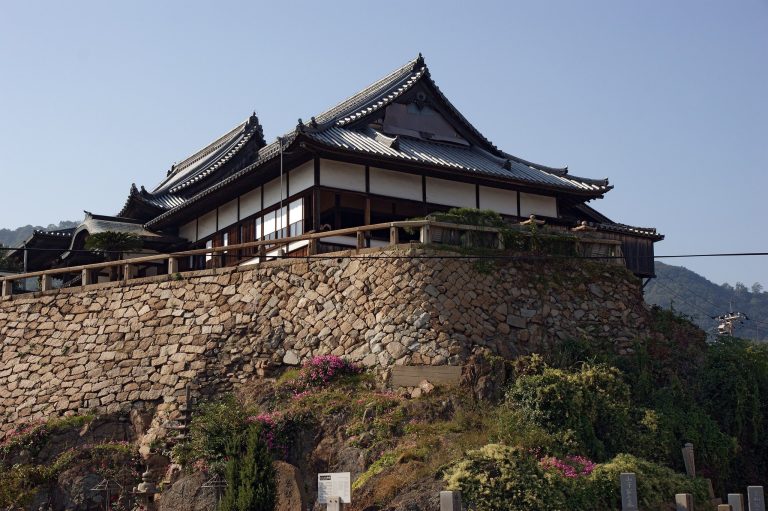
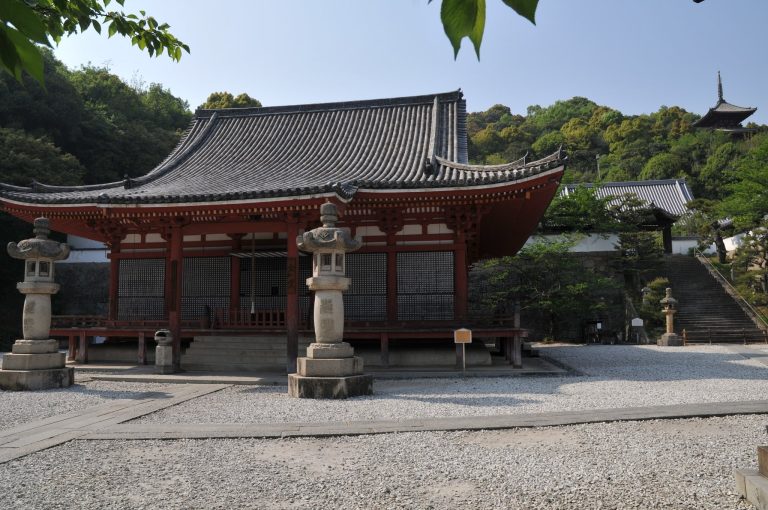
Bandai-ji occupies the precipitous headland of Abuto Cape, at the southern end of the Numakuma Peninsula. Rugged cliffs shaped by the sea continue along the coast, and the Kannon Hall stands on rocks at the cape’s tip directly above the Seto Inland Sea. The vermilion-painted hall, together with the connected buildings, stonework, and sea-facing features, forms a compact temple precinct adapted to steep and exposed ground.
Sea-facing buildings
Kannon Hall
The Kannon Hall is a vermilion-painted structure built on the rocks of Abuto Cape. Its position leaves it exposed to the sea and has made the building vulnerable to deterioration. Repeated repairs have preserved it, including the dismantling and repair carried out from 1951 to 1952. The hall enshrines the stone statue of Eleven-Headed Kannon, whose possible identification with the image traditionally associated with Emperor Kazan remains unresolved.
Guest hall
The guest hall dates from 1738 and has a projecting worship porch added during the Meiji period. It forms part of the precinct’s connected group of religious and residential buildings and survives as an Important Cultural Property designated by Hiroshima Prefecture.
Precinct structures and approach
Corridor and stone approach
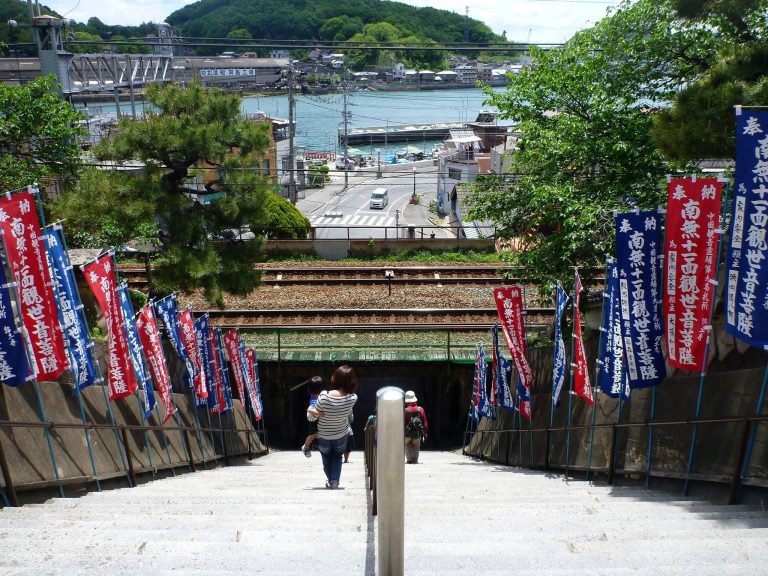
The approach to the Kannon Hall follows steep ground that formerly required a winding rocky path. Seventeenth-century improvements introduced retaining stonework and steps, then connected the abbot’s quarters with the hall by a corridor. The stone walls, steps, and corridor remain important elements of the precinct’s physical organization.
Bell tower and priests’ residence
The precinct includes a bell tower rebuilt during the major renovation of 1667 and a large bell cast during the Keicho period. A priests’ residence was first built in the late sixteenth century and newly constructed in the early Showa period, adding a residential component to the temple complex.
Hakuhō Inari Shrine and Six Jizo figures
Bandai-ji also contains the Hakuhō Inari Shrine, an Inari shrine associated with the period of Buddhist-Shinto syncretism. Inari is a Japanese religious deity especially associated with rice, food, prosperity, and commerce. A group of Six Jizo figures stands within the precinct as well. Jizo is a Buddhist bodhisattva traditionally regarded as a protector of travellers, children, and the dead.
Ashizuri-yama stone tower
A stone tower called Ashizuri-yama stands on rocks facing the sea. Its position adds another built feature to the rocky maritime setting surrounding the Kannon Hall.