Shibushi Castle: A Medieval Hill-Castle Complex in Japan


Site at a Glance
- Rating
- 3.7
- Popularity
- Low
- Country
- Japan
- Primary era
- Medieval
- Eras represented
- Medieval
- Civilizations
- Ashikaga shogunate, Kamakura shogunate
- Site type
- Military
- Remains
- Castle
On this page14 sections
History
Shibushi Castle was a medieval Japanese hill castle in Shibushi, Japan, developed across the medieval period as warfare shaped the region. Its origins and founder are uncertain, but its earliest possible beginnings are associated with Kujūin Hiranari, who became a local land steward and military administrator in 1189. The castle later formed a dispersed complex of fortified hills around Shibushi Bay and the port settlement.
Early development and clan control
Shibushi Bay served as the principal port of the Shimazu landed estate, while the Niiro clan fortified the surrounding hills. Matsuo Castle is traditionally regarded as the earliest part of the complex, possibly beginning in the late Kamakura period. It became the Niiro clan’s principal base. The earliest surviving written reference to Shibushi Castle dates to 1336, when the Kimotsuki clan at the castle was attacked by the Shigehisa clan.
The castle expanded as Shibushi became involved in the Nanboku-cho period, the fourteenth-century conflict between Japan’s Northern and Southern Imperial Courts. By this time, the main enclosure and a weapons-storage area already existed. Warfare around Matsuo Castle continued from 1336 to 1357, indicating that Matsuo and the Inner Castle served complementary roles within the wider complex. Control passed successively among the Kujūin, Nii, Hatakeyama, Niiro, and Kimotsuki clans. During the Niiro period, additional enclosures were developed beside the Inner Castle.
Shimazu administration and abandonment
The Shimazu, a powerful warrior clan that controlled territories in southern Kyushu, also used Shibushi Castle as a base. Shimazu Ujihisa is specifically associated with this role. The Niiro clan held Shibushi until the early sixteenth century, when the castle became involved in an internal Shimazu conflict between Shimazu Takahisa and Shimazu Sanehisa. The Niiro were dispossessed in 1538, and the Shimazu briefly governed the area directly. The Kimotsuki clan seized the castle in 1562, but the Shimazu recovered it in 1577.
In 1577, Shibushi became a directly administered Shimazu territory. Kamata Masachika was appointed its first jito, a local land steward with military and administrative duties. The castle continued to function within the Shimazu outer-castle system, which combined central authority with affiliated fortified settlements to administer and defend a territory.
Shibushi Castle was abandoned in 1615 after the Tokugawa shogunate introduced the One Country, One Castle policy. This regulation restricted each feudal domain to one officially maintained castle. The castle buildings were dismantled, but its stone walls remained substantially intact. Investigations at the Inner Castle took place in 2013–14, 2016–18, and 2020, while Matsuo Castle was investigated in 2003. The Inner Castle ruins became a Kagoshima Prefectural Historic Site on March 24, 1993, and a National Historic Site on July 14, 2005. In 2017, Shibushi Castle was selected for the Continued Top 100 Japanese Castles list as number 197.
Remains
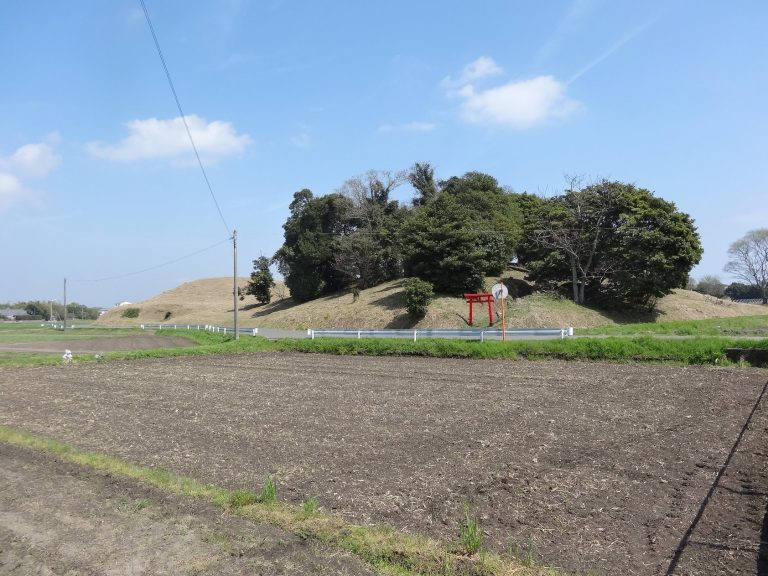
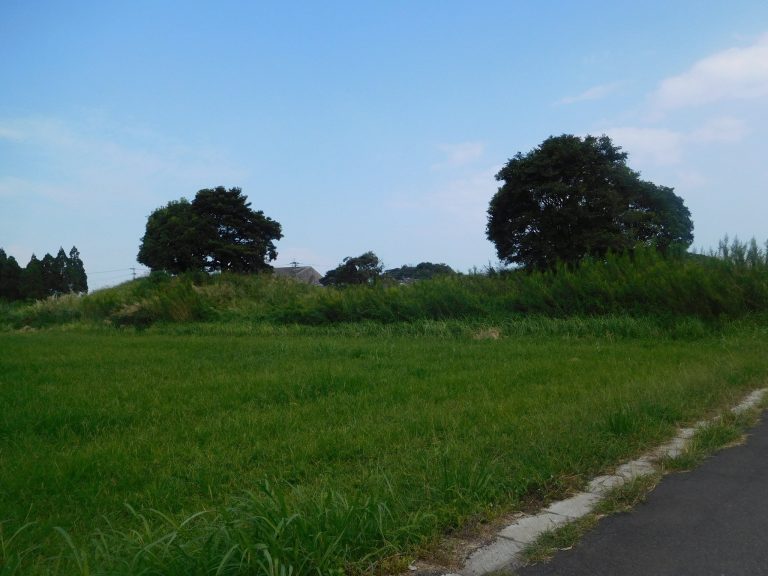
Shibushi Castle was a South Kyushu-type hill castle formed by cutting fortified enclosures into a white, sandy plateau of volcanic ash. Rather than occupying one compact fortress, the complex spread across four separated strongholds, the Inner Castle, Matsuo Castle, Taka Castle, and Shin Castle, together with smaller associated enclosures on the hills around the urban center and port. Surviving features include earthworks, gate approaches, cut dry moats, stone walls, enclosures, and garden remains.
Inner Castle
Enclosures and defenses
The Inner Castle occupies an elongated hill running from northeast to southwest. It measures approximately 600 meters from north to south and 300 meters from east to west, at an elevation of about 50 meters. Its northeastern side joins neighboring hills, while deep, extensively cut dry moats divide the other sides into separate hillocks. Four lines of enclosures were arranged across the hill, with two straight dry-moat lines protecting both sides. The enclosures occupy different levels and are separated by steep slopes and sharply cut walls. The main gate stood at the southwestern edge, while the rear gate was on the eastern side.
Six enclosures made up the Inner Castle, organized around the Honmaru, or principal enclosure, and the Nakano Kuo and Ono Kuo areas. The Honmaru formed the central section and existed by the Nanboku-cho period. Nakano Kuo and Ono Kuo were added or strengthened after attacks to improve the defenses. In enclosure 3, postholes indicate a large building. The castle buildings themselves no longer survive, and no reconstructed sections are present.
Archaeological finds
Excavations at the Inner Castle recovered a Song-dynasty Chongning Zhongbao coin, a Ming-dynasty Hongwu Tongbao coin, and a Taisei Tsuho coin from the Ryukyu Kingdom. Chinese ceramic fragments tentatively dated from the fourteenth to sixteenth centuries were also found. Together with the building traces, these materials provide archaeological evidence for activity within the fortified hill complex.
Matsuo Castle
Layout and defensive works
Matsuo Castle extends approximately 400 meters from northwest to southeast and measures about 250 meters across. Its elevations range from 16 to 55 meters. Houses occupy its eastern side near the road. A dry-moat structure was found between the second and third enclosures, forming part of the castle’s defensive arrangement.
Recovered materials
The 2003 investigation recovered Chinese ceramics dating approximately from 300 to 600 years ago, including celadon fragments. Hongwu Tongbao coins, whetstones, metal objects, and cannonballs were also found. The investigated sections yielded these materials without the clear postholes identified in Inner Castle enclosure 3.
Taka Castle and Shin Castle
Taka Castle
Taka Castle is divided into a Honmaru, the principal enclosure, and a Ninomaru, or second enclosure. A road now separates the two areas. Its surviving landscape forms part of the dispersed arrangement of strongholds that made up Shibushi Castle.
Shin Castle
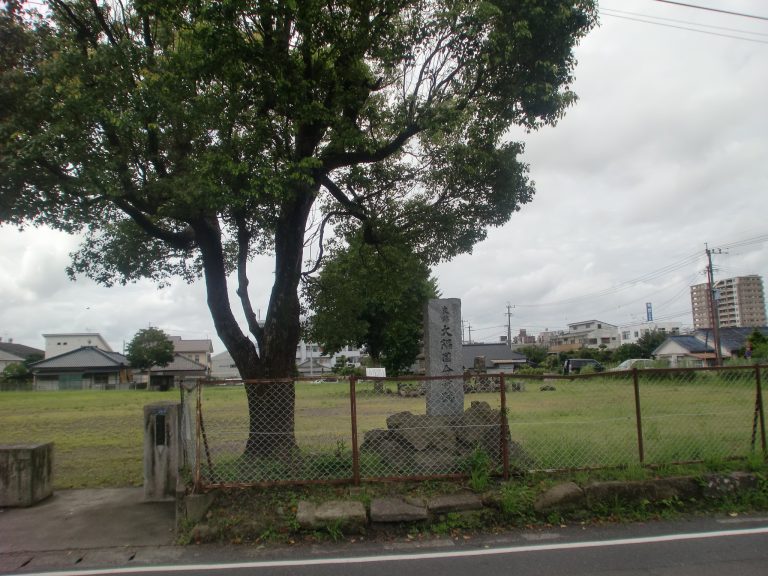
Shin Castle and Taka Castle occupy the area in front of Shibushi Junior High School. Their castle spaces are incorporated into the modern occupied landscape, while other former castle areas and gardens are surrounded by private residences. The edge of the Inner Castle is also occupied by Shibushi Elementary School, and abandoned houses or their boundary walls remain along parts of the approaches.
Surviving fabric
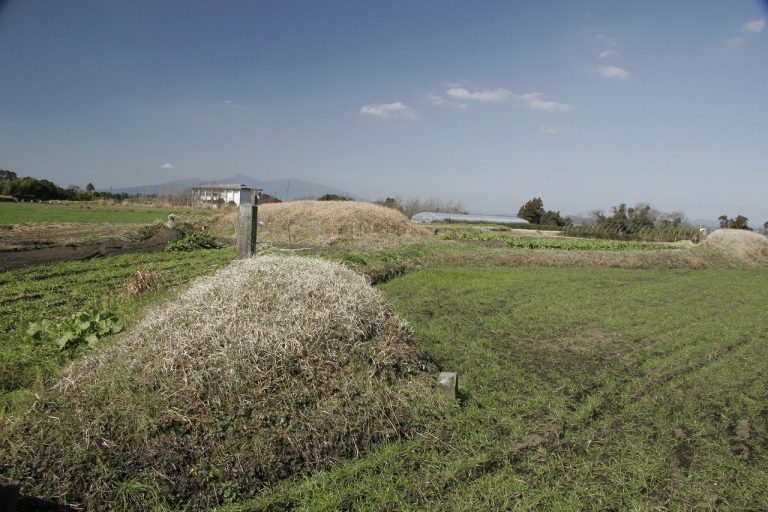
The dismantling of 1615 removed the castle buildings, but associated stone walls survived in substantial condition. Earthworks, moats, gate approaches, enclosures, and garden remains continue to define parts of the complex. Most of the remains are undeveloped, and several sections lie among school grounds, private residences, and abandoned houses.