Shōryūji Castle: A Sengoku Fortress and Hosokawa Residence in Japan


Site at a Glance
- Rating
- 4
- Popularity
- Low
- Country
- Japan
- Primary era
- Early Modern
- External website
- Open
- Eras represented
- Medieval, Early Modern
- Civilizations
- Ashikaga shogunate, Oda regime
- Site type
- Military
- Remains
- Castle
On this page14 sections
History
Shōryūji Castle is a historic Japanese castle in Nagaokakyō, Japan, whose surviving form reflects its development from a fifteenth-century administrative center into a fortified residence and military base during the Sengoku period, an era of prolonged competition among military lords and regional coalitions. The castle stood from the Nanboku-chō period, the fourteenth-century conflict between rival Northern and Southern Imperial Courts, into the early Edo period. Its name came from nearby Shōryūji Temple, south of the castle.
Origins and the Ōnin War
Tradition places the castle’s foundation in 1339, attributing it to Hosokawa Yoriharu, a Northern Court commander and major samurai leader under Ashikaga Takauji, founder of the Ashikaga, or Muromachi, shogunate. This attribution is uncertain. It may have been developed to support the later Hosokawa lord Fujitaka’s claim of descent from Yoriharu’s family.
Shōryūji Castle first appears securely in the historical record in 1457, when Hatakeyama Yoshinari, the military governor of Yamashiro Province, probably established it as a district administrative office. By 1470, during the Ōnin War, a civil conflict fought from 1467 to 1477 that badly destabilized the Muromachi government, the site was being used as a military facility. Its role had therefore expanded from administration to warfare.
The Miyoshi and Oda conflicts
By the late Sengoku period, Shōryūji Castle and Yodo Castle were subordinate strongholds of Matsunaga Hisahide and the Miyoshi Triumvirate, an alliance of three Miyoshi leaders that exercised power in the Kinai region. Iwanari Tomomichi held Shōryūji for the Miyoshi side.
As Oda Nobunaga prepared to enter Kyoto in support of Ashikaga Yoshiaki, he ordered Shibata Katsuie, Hachiya Yoritaka, Mori Yoshinari, and Sakai Masanao to attack the castle on 26 September 1568. Iwanari’s forces resisted, but Oda’s troops captured more than fifty heads and delivered them to Nobunaga’s camp at Tōfukuji. Three days later, on 29 September, Nobunaga personally led an army of approximately 50,000 against Shōryūji. The Miyoshi forces surrendered and opened the castle, influenced by the rapid fall of Kan’nōji Castle, which had been expected to halt Nobunaga’s advance.
Hosokawa Fujitaka’s lordship
After Ashikaga Yoshiaki became shogun, Nobunaga granted Shōryūji Castle to Hosokawa Fujitaka, also known as Yūsai. Fujitaka was a prominent warrior, cultural figure, and castle lord. He had entered Shōryūji by January 1569 and remained in control until his transfer to Tango Province in 1581.
Fujitaka strengthened the castle with double moats. In October 1568, Nobunaga ordered households west of the Katsura River to provide three days of labor for construction at the site. The improvements appear to have been complete by 1571, when Shōryūji and Makishima Castle served as two major western forward bases of Nobunaga’s power.
Shōryūji was also a residence associated with the Hosokawa family. In August 1578, Fujitaka’s eldest son, Hosokawa Tadaoki, married Tama, the daughter of Akechi Mitsuhide, at the castle. Tama, later known as Hosokawa Gracia, was a Christian convert. The couple lived at Shōryūji during the early part of their marriage and had two children before the Hosokawa transfer to Tango.
The Honnōji Incident and abandonment
After Fujitaka’s departure, Yabe Iezada and Inoko Hyōsuke became castle lords as retainers of Murai Sadakatsu, the official who administered Kyoto. They also surveyed the land formerly controlled by Fujitaka. During the Honnōji Incident of 1582, when Akechi Mitsuhide turned against and killed Oda Nobunaga, Mitsuhide’s forces occupied Shōryūji as a base. Inoko Hyōsuke was killed at Nijō Castle during the Akechi attack, while Yabe Iezada fought for Hashiba Hideyoshi, the leader who later completed much of the political unification begun by Nobunaga.
After Mitsuhide’s defeat at the Battle of Yamazaki, he returned to Shōryūji while Hideyoshi’s army pursued him. Mitsuhide abandoned the castle and escaped through its north gate while attempting to reach Sakamoto Castle. He died during the flight, and Hideyoshi entered Shōryūji the following day.
Fujitaka refused Mitsuhide’s request for military assistance, shaved his head, transferred the family succession to Tadaoki, and moved his residence to Tanabe Castle. Because Tama belonged to Mitsuhide’s family, Fujitaka later confined her. Under Hashiba rule, Shōryūji received little attention and fell into disrepair. Stone from the site was used to repair Yodo Castle.
Early Edo repair and modern presentation
In 1633, Nagai Naokiyo became lord of Yamashiro-Nagaoka Domain and repaired the ruined castle. The shogunate ordered him not to alter the moats and required his residence to stand north of the old castle. The surviving works may therefore reflect an incomplete early-modern reconstruction. When Naokiyo was transferred to Takatsuki Domain in 1649, Shōryūji Castle was completely abandoned.
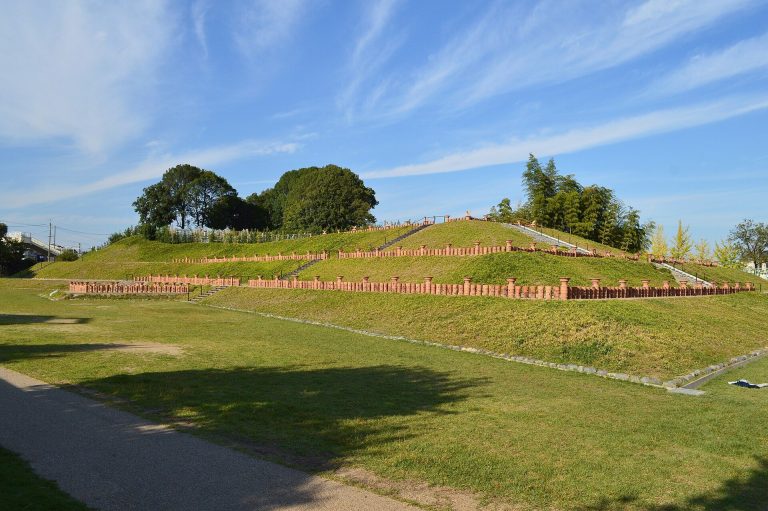
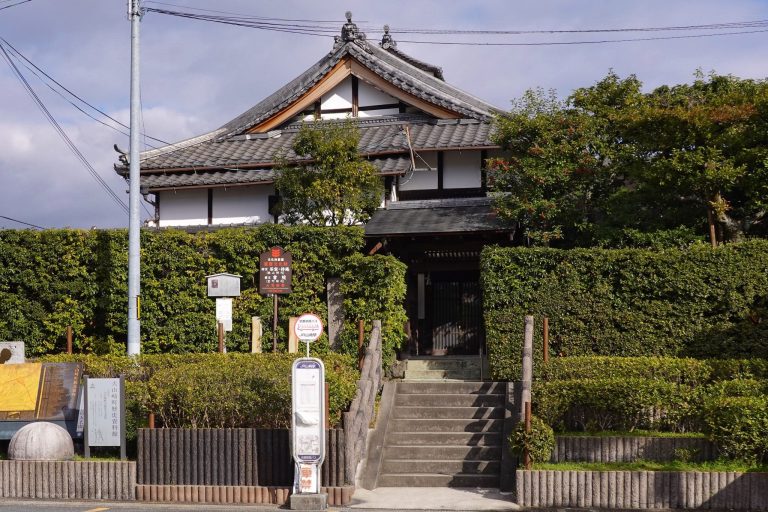
The main bailey and Numata-maru were developed as Shōryūji Castle Park in 1992, with imitation turrets and other facilities. The exhibition room and interpretive signage were renewed in November 2019. Displays present the castle’s connections with Fujitaka, Tadaoki, Tama, and Mitsuhide, together with excavated roof tiles and a five-ring stone monument. The annual Nagaokakyō Garasha Festival commemorates Tama’s marriage to Tadaoki through a procession modeled on the historical occasion.
Remains
Shōryūji Castle occupied a strategic position in the southwestern Kyoto Basin at the confluence of the Obata and Inukawa rivers, where the Saigoku Highway and Kuga Causeway intersected. It was regarded as Kyoto’s second major defensive stronghold after Yamazaki Castle. The site is organized around a rectangular main bailey, a separate western compound, and outer defensive works to the northeast and south. Surviving earthworks, water-filled and dry moats, limited historical stonework, an earthen bridge, and reconstructed park features preserve parts of this layout.
Main bailey and western compound
Main bailey
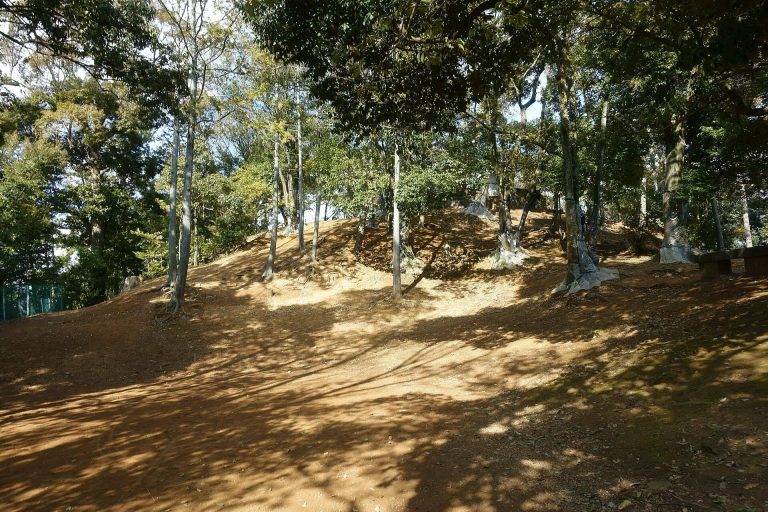
The main bailey is a rectangular enclosed area measuring approximately 120 meters from east to west and 80 meters from north to south. A water-filled moat about 12 meters wide survives along its eastern and northern sides. Earthen ramparts remain on the eastern, western, and northern edges, with the western rampart rising approximately 10 meters and measuring about 5 meters across. A 1922 map shows the southern rampart and moat, indicating that the enclosure was formerly completed by earthworks and water defenses.
The castle is thought to have been a square, single-bailey fortified residence until the Eishō period, an era of the Muromachi period lasting from 1504 to 1521. Fujitaka extensively remodeled it in 1571. The resulting combination of roof tiles, stone walls, and a castle tower represents an early form of the Japanese castle associated with the Azuchi–Momoyama period, which followed the Sengoku era and brought increasingly monumental castles. Shōryūji’s form preceded Azuchi Castle.
Numata-maru
Numata-maru was a separate compound west of the main bailey. Tradition identifies it as the location of a residence belonging to the Numata family, the family of Fujitaka’s wife. A moat surrounds the compound on the 1922 map, while the area is now occupied by the castle park’s parking area. The proposed reuse of an ancient burial mound by the castle remains unconfirmed in the main bailey and Numata-maru.
Northern and southern defenses
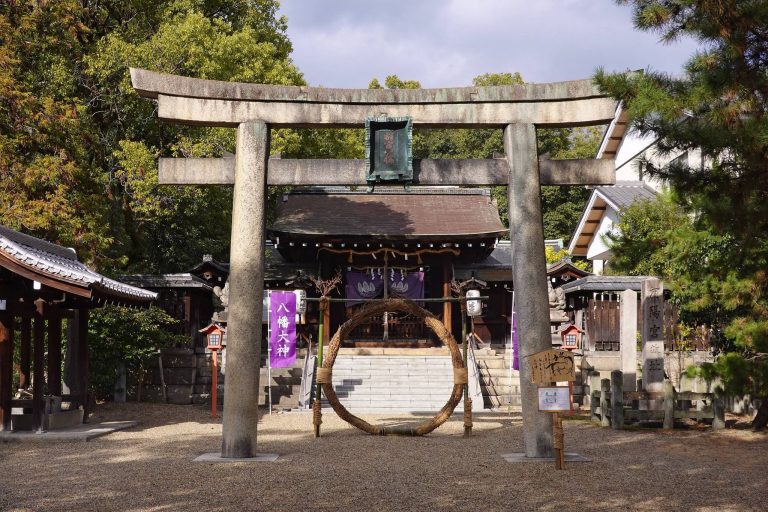
About 200 meters northeast of the main bailey, the grounds of Kōtari Shrine contain restored earthen ramparts and a dry moat. An earthen bridge crosses the middle of the moat, and a projecting part of the western rampart creates a flanking position against the bridge. The 1922 map shows one rampart extending from this area toward the present JR Kyoto Line, with another parallel rampart farther north. These works probably formed part of the castle’s northern defenses and may correspond to the outer double moat associated with Fujitaka’s 1571 renovations.
The area south of the main bailey is now densely built up. The 1922 map nevertheless records possible moats and ramparts there, and these features are considered likely to have belonged to the castle. Together with the northern defenses and the main bailey’s surviving earthworks, they indicate a broader fortified area than the park’s principal enclosure alone.
Castle tower, gate, and stonework
Castle tower
A castle tower, called a tenshu in contemporary records, stood at Shōryūji by approximately 1571. On 6 June 1573, Fujitaka and the poet Satomura Jōha held a linked-verse gathering in the tower. On 17 June 1574, Sanjōnishi Sanetane conducted the Kokin denju transmission there. This was the passage from teacher to disciple of authorized interpretations and secret learning concerning the tenth-century imperial poetry anthology Kokin Wakashū and related scholarship. The tower consequently served cultural purposes as well as military ones.
North gate and entrance complex
Part of the original stonework survives at the north gate. A 1979 excavation uncovered two stone Buddhist figures, several stone blocks, and a large quantity of packing stones. These finds, together with other evidence, indicate that much of the castle was originally constructed with stone walls. The entrance, or koguchi, was arranged as a square-shaped masugata, a fortified gate complex built around an enclosed space where defenders could attack troops entering the approach. This arrangement identifies the entrance as an Oda–Toyotomi-style feature.
The present park retains earthworks, dry moats, stonework, and an earthen bridge. Imitation stone walls and turrets have been reconstructed to present parts of the castle’s appearance, while historical stonework survives in limited sections.