Uenohara: An Early Jomon Archaeological Settlement in Japan


Site at a Glance
- Rating
- 4.2
- Popularity
- Low
- Country
- Japan
- Primary era
- Stone Age
- External website
- Open
- Eras represented
- Stone Age
- Civilizations
- Unclassified
- Site type
- Domestic
- Remains
- House
On this page9 sections
History
Uenohara is a complex archaeological site in Japan, located in Kirishima, Kagoshima, with settlement remains from the Early Jomon period and later traces extending through the medieval, early-modern, and modern periods. Built and used initially by Jomon hunter-gatherer communities, the site preserves evidence of relatively permanent settlement before the development of rice agriculture. Its earliest materials were once dated to about 9,500 years ago, but accelerator mass-spectrometry redating placed them at approximately 10,700 to 10,400 years ago.
Discovery and Chronological Reassessment
Uenohara came to light in 1986 during development of the Kokubu Uenohara Technopark, when the area belonged to the former city of Kokubu. The Kagoshima Prefectural Board of Education excavated the site between 1986 and 1996. At the time of its discovery, the earliest settlement was described as the oldest large-scale permanent settlement in the Japanese Archipelago, based on a date of about 9,500 years ago.
A later study by a team from Chuo University and the Kagoshima Prefectural Buried Cultural Properties Center revised the chronology by 2020. Materials formerly assigned an age of about 9,500 years were dated to approximately 10,700 to 10,400 years ago, while artifacts previously dated to about 7,500 years ago were placed at approximately 8,800 to 8,550 years ago. These changes clarified the great antiquity of the settlement and its associated activities.
Jomon Settlement in Southern Japan
The finds from Uenohara demonstrated that substantial Jomon settlement and food-processing activity existed in southern and western Japan. This challenged the older assumption that Jomon culture had flourished mainly in eastern Japan. The site therefore helped broaden the historical understanding of the geographical range and organization of Jomon communities.
Pottery from Uenohara received designation as a National Important Cultural Property in 1998, and part of the archaeological site became a National Historic Site in 1999. After excavation, the remains were reburied to protect them. The area was subsequently preserved and developed as the Uenohara Jomon-no-Mori historical park in 2002 and 2003, with reconstructed Jomon dwellings, exhibition facilities, and the Kagoshima Prefectural Buried Cultural Properties Center. Excavated artifacts are displayed in the Jomon-no-Mori Exhibition Hall, while the park and its research facilities provide a base for archaeological work in Kagoshima Prefecture.
Remains
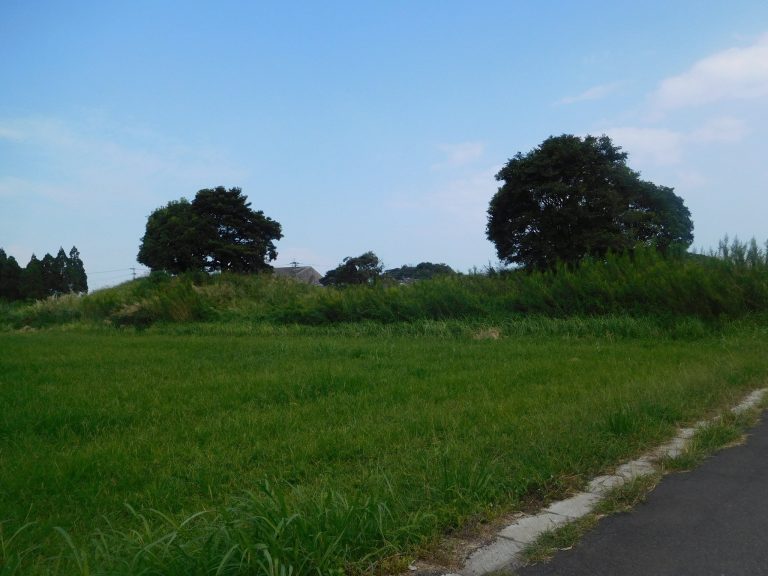
Uenohara occupies a plateau about 260 metres above sea level beside Kinko Bay, also known as Kagoshima Bay. Thick deposits of pumice and volcanic ash from Mount Sakurajima form part of the plateau. The park covers approximately 36 hectares, while the principal settlement extends across about 15,000 square metres. A shallow natural valley runs from the centre toward the northern edge, and the settlement spread along two roads.
Stratified Archaeological Deposits
Seventeen stratigraphic layers, or distinct deposits formed during different phases of human activity or natural deposition, were identified during excavation. Volcanic-ash horizons from Sakurajima separate some of these deposits and provide chronological markers. The upper layers contain evidence from several periods, including modern agricultural soil with Sakurajima ash deposits P1 to P3, Haji ware, and ceramics. Haji ware is an ancient Japanese earthenware associated chiefly with the Kofun period and later historical periods. A lower historical layer contains Yamanokuchi-style and Mizonaka-style pottery together with six pit dwellings linked to the medieval and early-modern periods.
Another layer contains a post-built building, stone grinding slabs, and stone axes associated with the Yayoi and Kofun periods. The Yayoi period followed the Jomon period and was associated with expanding agricultural communities, while the Kofun period was marked by large burial mounds and emerging political authority. A thin dark reddish-brown layer contains Sakurajima ash P5, numerous pits, and Kurokawa-style pottery from the Final Jomon period. Other deposits contain Sakurajima ash P7, Kikai-Akahoya volcanic ash, Sakurajima ash P11, and the P14 deposit, also called Satsuma volcanic ash.
Early Jomon Settlement
Pit Dwellings
The principal Early Jomon settlement lay in dark soils containing Maehira-style pottery, twisted-cord-marked pottery, pit-dwelling remains, stone-collection features, linked-hole pits, and other traces of daily activity. A pit dwelling was a house partly dug into the ground, creating a sunken floor and lowering the height of its walls. Fifty-two such dwellings were identified in one layer, and volcanic ash filling ten of them showed that those buildings existed between the P14 and P13 Sakurajima ash deposits.
In the basal settlement area immediately above the P14 ash layer, excavators identified 46 pit dwellings and two parallel road traces. The dwellings were square or rectangular with rounded corners. Their sides measured approximately 2 to 5 metres, and their floor areas ranged from 3 to 10 square metres. Together, these remains show a settlement organized around repeated domestic structures and routes across the plateau.
Cooking and Food Processing Features
The basal settlement also contained 39 stone-collection features, 15 linked-hole pits, and approximately 125 other pits. Stone-collection features were arrangements of heat-used or heat-fractured stones used for stone-heating cooking. They were also interpreted as places where food was prepared or preserved. The site produced more than 150,000 pieces of pottery, stone tools, and ornaments, providing a substantial material record of Early Jomon activities.
Linked-hole pits consisted of several large and small holes connected by tunnel-like spaces along their bases. Burnt soil on their floors and walls indicates heating or fire-related use. Fatty acids derived from deer and wild boar were detected inside some examples, supporting the interpretation that at least some linked-hole pits served as smoking facilities for preserving processed food.
Ritual and Southern Plateau Features
The southern part of the plateau contains stone-collection features dating to approximately 7,500 years ago, together with ritual remains. These include large Jomon pot-shaped vessels and polished stone axes. Their placement in this part of the archaeological area adds evidence for activities that extended beyond domestic cooking and food processing within the settlement.