Seyifler Castle: A Byzantine Fortress and Ottoman Campaign Base in Türkiye


Site at a Glance
- Rating
- 3.7
- Popularity
- Very Low
- Country
- Turkey
- Primary era
- Medieval
- Eras represented
- Medieval
- Civilizations
- Byzantine
- Site type
- Military
- Remains
- Fort
On this page5 sections
History
Byzantine Origins
Seyifler Castle is a Byzantine fortress in Türkiye, near Kemalpaşa in Sakarya Province, generally dated to the twelfth or thirteenth century. Its precise construction date remains uncertain. The Byzantine Empire was the medieval continuation of the eastern Roman Empire, centered on Constantinople until 1453. The fortress is also known as Kara Çepiş.
The castle occupies a strategic position at the junction of the Sakarya River and Çark Creek. In antiquity, this area was called Mesonesion, meaning “Middle Island.” Its location made the fortress part of the struggle for control of the lands north of the Sakarya River.
Ottoman Conquest
Seyifler Castle and Harmantepe Castle, also known as Ab-ı Sufi, were regarded as important objectives in the conquest of the territory north of the river. Akça Koca, an early Ottoman military leader associated with the expansion of Ottoman control in northwestern Anatolia, personally proposed their conquest to Orhan Gazi.
After the Ottoman principality was established, Seyifler became Orhan Gazi’s base for campaigns toward the Black Sea coast, westward, and southeastward. The conquest of Seyifler, together with the fortresses of Kapucak, Göl-begi, and Karasu, contributed to the rise of a major political and military power controlling the coast from Kocaali and Karasu to the boundaries of Kocaeli by August 1304. Orhan Gazi was an early Ottoman ruler whose reign saw the expansion of Ottoman control in northwestern Anatolia.
Remains
Fortress Setting and Walls
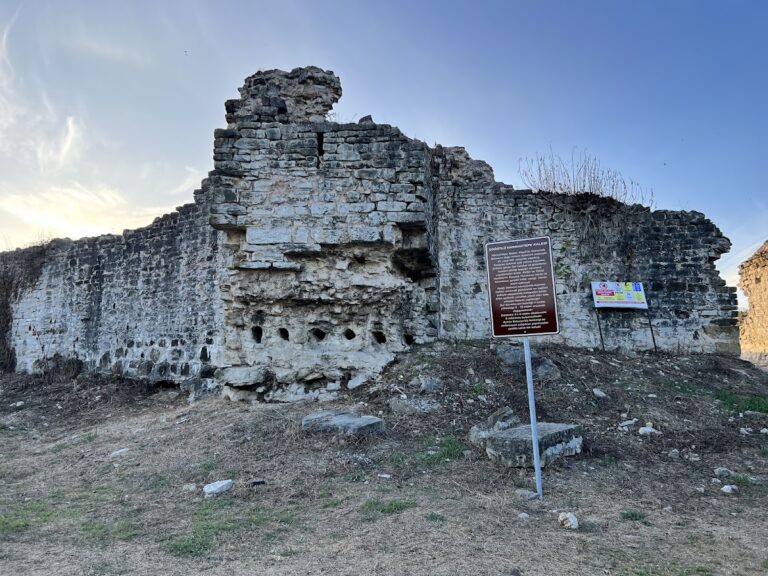
Seyifler Castle was a small fortress measuring approximately 80 by 80 metres on a peninsula formed by the Sakarya River and Çark Creek. Its surviving defenses include two towers beside the creek and part of the curtain wall, the connecting defensive wall between towers. In the agricultural field behind them, thick wall remains are largely ruined and survive mainly at foundation level.
The walls were constructed with faced masonry, formed from arranged outer stonework, and filled internally with rubble stone. The surviving remains lie near the entrance to Seyifler village in Ferizli District, Sakarya Province, preserving the outline of a strategically placed Byzantine stronghold and its later Ottoman military setting.