Seraya Loshad Fort: A Coastal Defence Battery in Russia


Site at a Glance
- Rating
- 4.6
- Popularity
- Low
- Country
- Russia
- Primary era
- Unclassified
- Eras represented
- Unclassified
- Civilizations
- Unclassified
- Site type
- Military
- Remains
- Fort
On this page9 sections
History
Seraya Loshad Fort is a coastal artillery fortification in Russia, built in 1911 on Seraya Loshad Cape near Chernaya Lakhta as part of the Kronstadt position of the Naval Fortress of Peter the Great. The broader system was designed to protect the approaches to Saint Petersburg through the Gulf of Finland. The fort’s main purpose was to engage landing ships in Koporye Bay and prevent an enemy from capturing Krasnaya Gorka Fort from the landward side.
Construction and early service
The position originated as the Seraya Loshad coastal battery, designed in accordance with a memorandum by Engineer Major General A. A. Shishkin. It comprised permanent artillery positions intended for coastal defence, linking its role to the wider naval defensive system centred on Kronstadt.
The battery’s name changed several times. From 29 August 1919 it was known as Forward Fort, from 1926 as Bukharin Fort, and from 1936 to 1953 as Krasnogvardeysky Fort.
Revolutionary-era fighting and uprising
In May 1919, Seraya Loshad Battery and Krasnaya Gorka Fort helped repel the Northern Corps’ advance on Petrograd under General A. P. Rodzyanko. In October of the same year, the battery resisted attacks during General N. N. Yudenich’s advance by the Northwestern Army. The attacks were repelled, and the battery received the Honorary Red Banner in December 1919.
An anti-Bolshevik uprising began at the battery on 13 June 1919, at the same time as the revolt at Krasnaya Gorka Fort. An officer named Ogloblin had prepared the action. Communists and the battery commissar were arrested, while the crew remained passive and barricaded itself in one bastion instead of joining the insurgents.
During the revolt, the battery’s guns shelled Kronstadt and ships of the Baltic Fleet. Because the crew refused to operate the artillery, officers alone served the guns. The uprising was suppressed during the night of 16 June, after which the insurgents abandoned the position without damaging its guns or structures.
Modernization and wartime defence
Plans in 1925 called for the installation of two 254 mm turret systems removed from the cruiser Rurik. A revised project developed in 1927 proposed two 203 mm turrets from the battleship Respublika, using a modernized 254 mm turret-battery design by Konoplev and Gabbin.
The reinforced battery was first assigned number 9 and later number 333. Together with the batteries of Krasnogvardeysky Fort, it formed the 33rd Separate Artillery Battalion of the Izhora Fortified Area, a Soviet defensive district coordinating fortifications and artillery units in the region. From April 1942, the formation belonged to the Izhora Sector of the Baltic Fleet’s Coastal Defence.
During the Second World War, Seraya Loshad defended the Oranienbaum bridgehead, a Soviet-held coastal area west of Leningrad that remained an important defensive position. The battery was disarmed during the liquidation of the Kronstadt Fortress in the 1950s.
Seraya Loshad Fort is a regional cultural-heritage monument of the Russian Federation. It also forms part of the UNESCO World Heritage property “Historic Centre of Saint Petersburg and Related Groups of Monuments: Defensive Installations and Forts of Kronstadt,” inscribed in 1990 under criteria i, ii, iv, and vi.
Remains
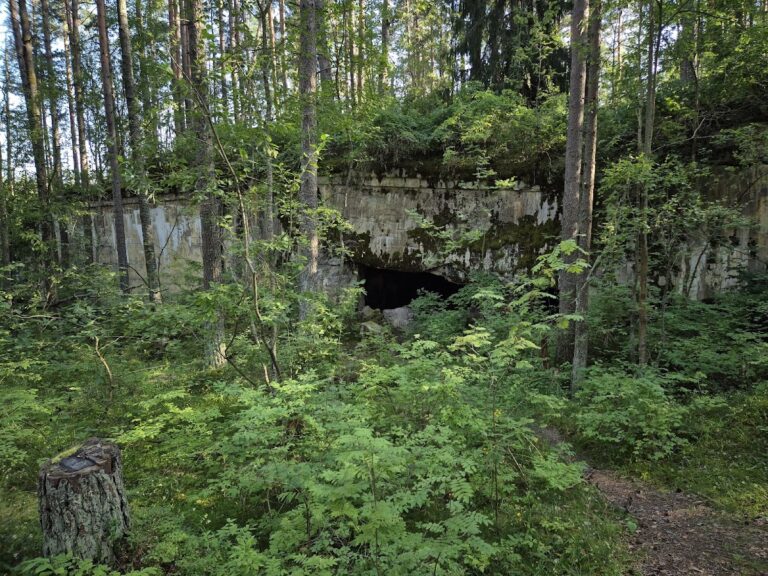
The position consisted of two open permanent coastal batteries arranged on separate flanks. Its artillery included a four-gun battery on the left and a three-gun battery on the right, while the later Battery No. 333 used two armoured turrets set in separate concrete pits. The fort is classified as a lost or destroyed structure, and its surviving condition is ruined or destroyed.
Open coastal batteries
Left-flank battery
The left flank held four 120 mm Vickers guns. In the Soviet numbering system this position was later designated Battery No. 332. Its open coastal layout formed one of the two principal artillery groups within the fort.
Right-flank battery
The right flank contained three 152 mm Canet guns and was later designated Battery No. 331. Together with the left-flank battery, it provided the original open artillery arrangement of the coastal position.
Battery No. 333
The later reinforced battery used two artillery turrets installed in separate concrete pits rather than in a single concrete mass designed to accommodate both. Their armour roofs were thickened from 2 to 5 inches, and their vertical elevation range increased from 25 to 35 degrees. A gun-director fire-control system, which calculated and transmitted firing data to the artillery crews, was installed, and ammunition provision rose to 195 rounds per gun. The original 120 mm Vickers guns were replaced in 1943 by 130/50 mm B-13 guns.
Nearby sites