Risbank Fort: A Nineteenth-Century Defence of Kronstadt
Site at a Glance
- Rating
- 4.7
- Popularity
- Very Low
- Country
- Russia
- Primary era
- Modern
- External website
- Open
- Eras represented
- Modern
- Civilizations
- Russian
- Site type
- Military
- Remains
- Fort
On this page8 sections
History
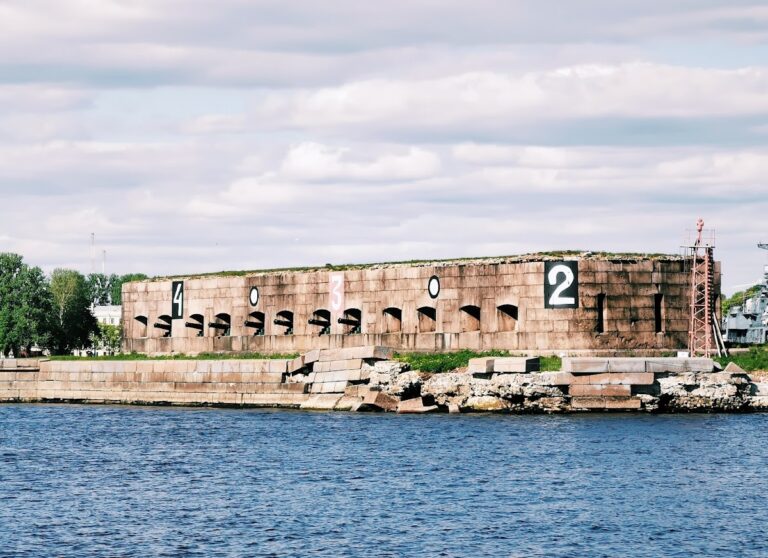
Risbank Fort, also known as Fort Paul I, is a nineteenth-century Russian defensive monument near Kronstadt in Russia, built to protect the naval town from the south. It was established after shallow-draft vessels found ways to bypass the main channel, exposing the approaches defended by Kronstadt and the early fort of Kronshlot. The site was first mentioned in 1800. Its initial battery was built between 1800 and 1801 and completed in 1801, while the fort’s recorded foundation date is 1807.
The first batteries
The original work stood south of the channel, about 2 kilometres west of Kronshlot. It consisted of two projecting bastions, defensive sections designed to direct fire along the adjoining walls, linked by a curtain wall. The battery rested on timber crib foundations, a load-bearing framework of interlocking timbers suited to wet or unstable ground. It was named Risbank, a German expression meaning “a notch on a shoal.” A second battery was built behind it in 1808.
A flood in 1824 destroyed almost the entire installation, leaving the western bastion standing. Reconstruction followed quickly and enlarged the battery with a second level about 7 metres above the reference water level. The rebuilt position gained additional military and storage functions. In 1834, three further curtain walls on timber crib foundations were added, together with two barracks and powder magazines. The expanded work mounted 122 guns and housed 610 soldiers.
The stone fort and the Crimean War
The wooden battery was intended to be replaced by a permanent stone fortification. Destrem’s project received approval in 1844, after Nicholas I ordered modifications designed to shorten the work and reduce its cost. The new fort was built over the inner harbour of the earlier battery, allowing labour and materials to remain on site instead of being carried each day from Kronstadt. Nicholas I visited the construction frequently, but the fort was unfinished when the Crimean War began in 1853. It was nevertheless armed during construction and eventually received 171 guns.
In 1854, the fort was renamed Fort Paul I after Paul I, who had been emperor of Russia from 1796 to 1801 and was the father of the reigning emperor. That year, a mine barrier, a line of explosive underwater mines intended to block ships, was placed between Fort Paul I and Fort Alexander. The Jacobi-system mines destroyed two British ships during an attempted attack on Kronstadt. The British force then relied on long-range shelling rather than trying to pass the defended waterway. Work on the fort continued after the war, and by 1859 it held more than 200 guns with 1,000 men stationed there.
Reduced military use and destruction
By the end of the nineteenth century, advances in artillery allowed Kronstadt to be attacked from the Oranienbaum shore on the southern side of the Gulf of Finland. In 1896, many older forts were removed from the active defensive system as newer positions were built farther from the coast. Risbank remained in service but was reduced to a storage facility for cartridges, rifles, mines, and other weapons. Some obsolete guns remained in its armament.
During the Russian Civil War, an explosion at Fort Paul I in 1919 signaled the uprising in Kronstadt by Mensheviks and Socialist Revolutionaries. The revolt was quickly suppressed, but the fort was badly damaged and removed from the defensive system. Its continued use for ammunition storage led to a further disaster on 20 July 1923. Sailors on leave from the battleship Paris Commune landed at the fort and argued over whether mines in the store were still charged. One mine was tested by setting it alight, causing a fire followed by multiple explosions. Four sailors from the cruiser Aurora died while trying to extinguish the blaze.
Fort Paul I was not restored after the 1923 destruction. During the Siege of Leningrad, several long-range guns were placed in the surviving section of its wall. The remains form part of the federal cultural heritage of the Russian Federation and are included within the UNESCO World Heritage property “Historic Centre of Saint Petersburg and Related Groups of Monuments,” which includes the defensive installations and forts of Kronstadt. The World Heritage inscription dates from 1990.
Remains
The surviving site represents successive defensive layouts built on unstable ground south of Kronstadt’s main channel. The earliest battery had a 408-metre defensive front and carried 66 guns and mortars. Its timber-supported construction, later enlargement, and eventual stone replacement reflect the fort’s changing role as artillery and naval warfare developed.
Early battery remains
The first battery comprised two bastions joined by a curtain wall and supported by timber crib foundations. The western bastion survived the flood of 1824 and formed part of the basis for the rapid rebuilding. The rear battery added in 1808 carried 19 guns. After the flood, the rebuilt position acquired a second gun level arranged as a gallery, together with a guardroom and an ammunition store. The 1834 expansion extended the defensive line with three additional curtain walls and added two barracks and powder magazines.
Stone fortification and later use
The later stone fortification occupied the inner harbour of the earlier battery. Its design allowed construction materials and workers to remain at the site, while its armament grew from 171 guns during the unfinished phase to more than 200 guns by 1859. When the fort became a storage facility, its spaces held cartridges, rifles, mines, and other weapons, while older guns remained in position.
Surviving wall fragment
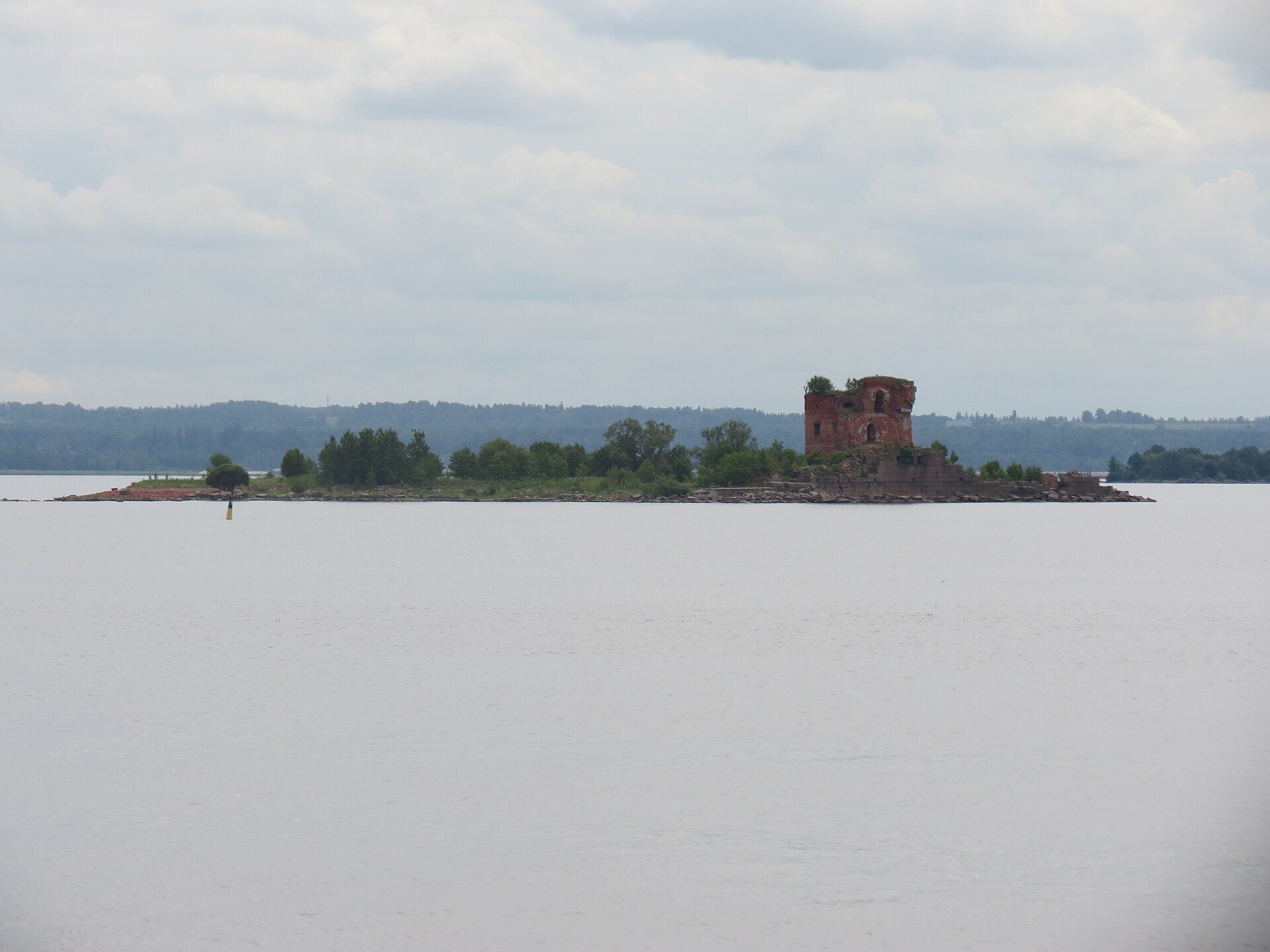
The fire and explosions of 1923 left a small fragment of the fort’s wall as the principal surviving fabric. Long-range guns were positioned on this fragment during the Siege of Leningrad. A model of the fort in its late-nineteenth-century form is displayed in the model of the Kronstadt forts at the Dutch Kitchen.