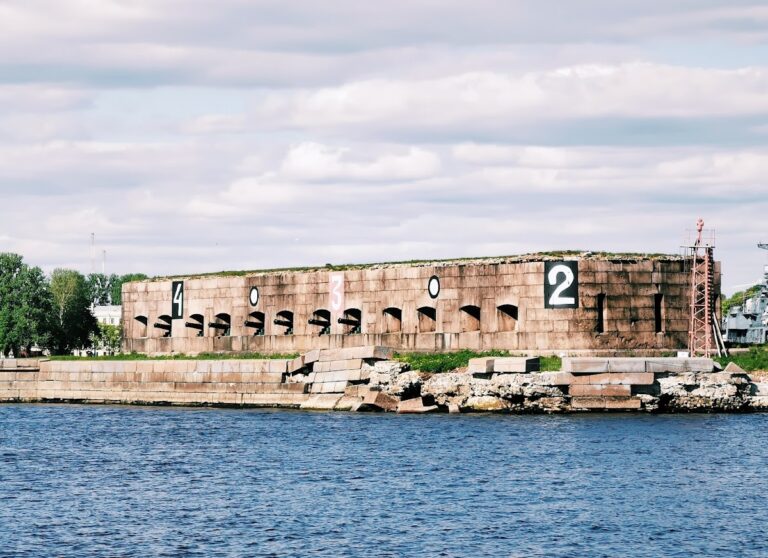
Fort Ino: An Imperial Russian Coastal and Landward Defense


Site at a Glance
- Rating
- 4.6
- Popularity
- Low
- Country
- Russia
- Primary era
- Modern
- Eras represented
- Modern
- Civilizations
- Russian
- Site type
- Military
- Remains
- Fort
On this page12 sections
History
Fort Ino, also known as Fort Nikolaevsky, is a coastal and landward fortification in Russia, built by the Russian Empire between 1909 and 1916 as part of the late imperial defense of Saint Petersburg and Kronstadt. It formed part of the Kronstadt position of the Naval Fortress of Emperor Peter the Great and guarded the narrowed section of the Gulf of Finland against a possible attack by the fleet of the German Empire.
Foundation and construction
In 1909, the Russian General Staff approved an advanced mine-and-artillery position about 60 kilometers west of Saint Petersburg, near Cape Stirsudden. Its two principal forts were Fort Nikolaevsky on the northern shore near Ino and Fort Alexeyevsky at Krasnaya Gorka on the southern shore. Additional batteries were established about 6 kilometers farther west on both sides of the gulf. Together, these works were intended to protect Petrograd and Kronstadt while controlling the maritime approach through the gulf’s constricted passage.
Fort Ino incorporated features associated with the “Russian fort” developed by the military engineer K. I. Velichko, although its design placed unusual emphasis on heavy-caliber artillery rather than following his classical model closely. Its 305 mm guns were the first weapons of that caliber to be used in coastal fortifications. Construction began in 1909, and work continued under several military engineers, including Lieutenant Colonel Smirnov, Captain Lobanov, Captain Poplavsky, Captain and later Lieutenant Colonel Budkevich, Lieutenant Colonel Krasovsky, and the engineer Rosenthal. The principal artillery batteries were complete and ready for combat by 1 January 1917.
Land, garrison, and wartime service
Before construction, Ino had been the largest village in the Uusikirkko administrative district of Viipuri Province in the autonomous Grand Duchy of Finland. The Grand Duchy was an autonomous part of the Russian Empire from 1809 until Finland declared independence in 1917. The land assigned to the fort included Finnish farmsteads and many private plots. Before the Revolution, 68 dachas and villas belonging to residents of Saint Petersburg stood in the area, and some were later used as accommodation for the garrison. The state paid 418,379 rubles for the expropriated land. Valentin Serov’s dacha was demolished during construction of the railway, while Milyukov and Maté voluntarily transferred their properties to the state at the beginning of the works. A church was also built on land belonging to Bobrov, using his funds.
The planned minimum garrison comprised two fortress-artillery companies and two infantry companies, with emergency capacity for two artillery battalions and one infantry battalion. At the beginning of the First World War, the wartime garrison included about 2,000 artillery personnel, about 2,000 infantry, and more than 500 other servicemen and militia. By January 1917, approximately 5,500 people were stationed at the fort. The October Revolution, the collapse of the imperial army, and subsequent mobilization and demobilization measures then greatly reduced the garrison. In January and February 1918, a Sestroretsk Red Guard detachment led by A. Panshin, with S. P. Voskov, provided watch duty at the fort, which was then in Finland.
Siege and demolition in 1918
On 1 March 1918, during the Finnish Civil War, the Finnish Socialist Workers’ Republic agreed to transfer Fort Ino to Soviet Russia in exchange for Petsamo. Edvard Gylling and Oskari Tokoi negotiated the agreement for the Finnish side. After Finnish White Guards defeated the Red Guards, they demanded the fort’s return without offering Petsamo in exchange.
Finnish forces besieged Fort Ino on 24 April 1918. The garrison still held substantial weapons, ammunition, and provisions, and refused to surrender without instructions from the Soviet government. The commandant fled to the Finnish side with a plan of the fort. On the same day, the artillery breechblocks were removed and taken to Kronstadt, while the batteries were prepared for demolition.
Germany demanded on 5 May that the fort be transferred to Finland. The Treaty of Brest-Litovsk, the 1918 agreement through which Soviet Russia withdrew from the First World War, made the Soviet government fear that continued resistance would violate its terms. Soviet support for the garrison was therefore withdrawn. At 23:30 on 14 May, the personnel demolished the turret batteries and evacuated toward Kronstadt aboard the battleship Respublika. Finnish forces then occupied the fort. A commission sent from Kronstadt by icebreaker and warship proposed its demolition, while wooden buildings, kitchens, and barracks burned during the withdrawal.
Destruction and later military use
The Treaty of Tartu, signed in 1920 between Soviet Russia and Finland, established their postwar frontier and required Finland to disarm and destroy Fort Ino’s fortifications completely within one year. The fort was destroyed under this obligation in 1921. Some of its guns were later reused in Finnish coastal defenses, including 305/52 mm guns installed in an armored turret on Kuivasaari Island.
During the Soviet period, a 152 mm battery was built at the fort and dismantled in the early 1960s. Military units, a border-guard post, and a highly secret postwar testing ground later occupied the former fort area. The territory remained under restricted access until the mid-1980s. Experiments examining the effects of intense radiation on animals were conducted in the underground complex before the testing ground closed. A military unit and the Central Research Institute of the Russian Ministry of Defense continued to occupy the area until the end of the twentieth century. Fort Ino is now a protected cultural-heritage site of federal significance in the Russian Federation. In 2020, the Military Engineering Institute of the Academy of Material and Technical Support of the Russian Ministry of Defense prepared a project for reviving the fort.
Remains
Fort Ino stood on Cape Inoniemi on the northern shore of Neva Bay in the Gulf of Finland, opposite Fort Krasnaya Gorka on the southern shore. It occupied part of an advanced mine-and-artillery position controlling the narrowed gulf. A railway and harbor served the installation. The harbor was bounded by an eastern mole and a southwest mole, while a planned railway branch about 3 kilometers long ran along the southwest mole and beside the batteries.
Artillery defenses
Heavy-gun batteries
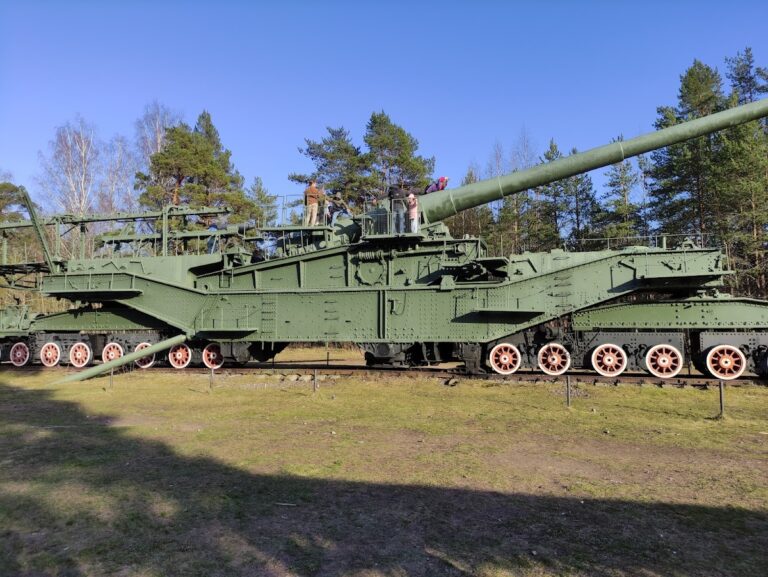
The principal artillery included two flank coastal batteries, each equipped with four 152 mm Canet guns, a battery of eight 254 mm guns, and a battery of eight 279 mm howitzers with a range of approximately 15 to 18 kilometers. Two four-gun 305 mm batteries were begun in 1912 and were ready for combat by 1916. One was a turret battery and the other an open battery, meaning that its guns stood in exposed or lightly protected positions.
Turret battery
The turret battery was a concrete structure containing two twin-gun armored turrets designed by A. G. Dukelsky. Its associated facilities included casemates, shell magazines, barracks, an underground railway for moving shells in small wagons, an electric hoist, and steam-and-water heating. Concrete trenches with shelters for guns and infantry surrounded the 305 mm batteries, and underground passageways connected these positions with the turret battery.
Underground complex and defensive works
The artillery positions were linked to an underground complex described as an entire subterranean town. It contained shell magazines, barracks, command posts, observation posts, and a railway for transporting shells to the guns. Approximately 2 meters of concrete covered the complex, designed to withstand impacts from heavy naval artillery. The gun positions were protected by a concrete parapet about 3 meters thick, while a rifle rampart with concrete strongpoints surrounded the fort and allowed for defense in all directions.
Harbor and associated structures
The harbor had three lifting cranes, including two with a capacity of 1 ton each and one capable of lifting 32 tons. A former dacha staircase belonging to A. N. Kurpatkin also survives. During the First World War, the staircase was adapted for use by a temporary hospital and leads toward the Gulf of Finland.
Surviving ruins
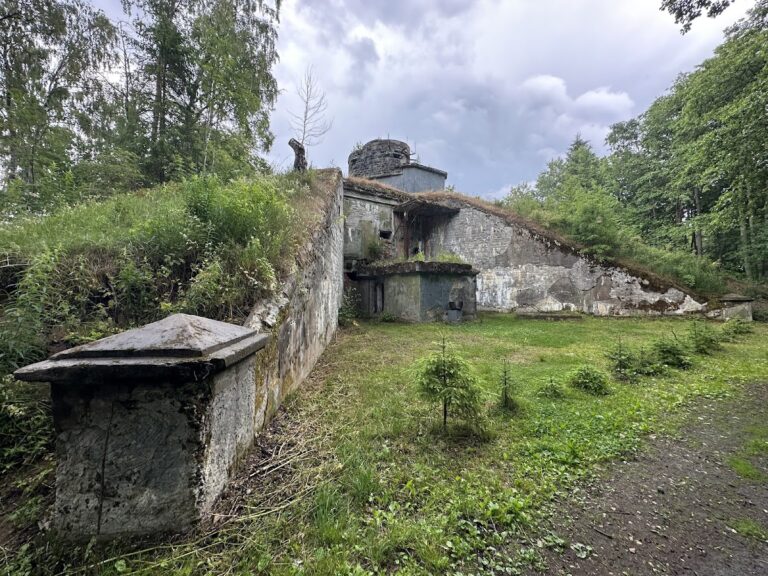
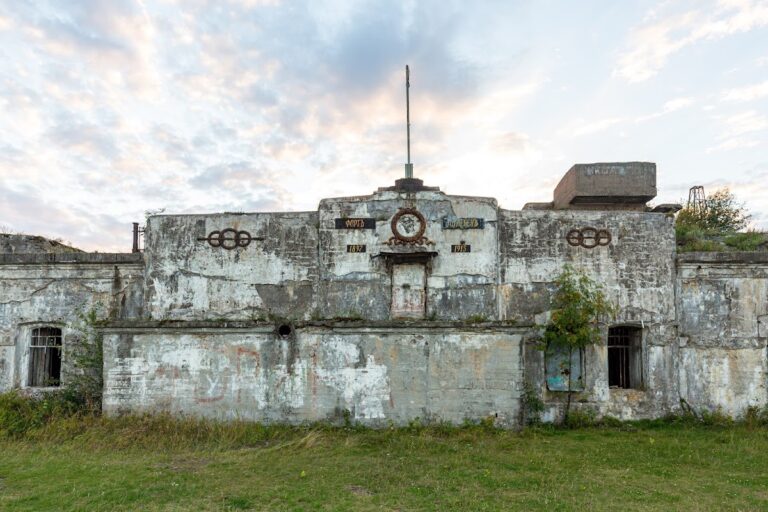
The surviving fort consists of ruins overgrown by forest, with much of the metal removed. Large defensive ditches remain clearly visible at strongpoints 1 and 2, while positions 7 and 8 retain a clearly defined glacis-like profile. A glacis is a sloping defensive surface intended to expose attackers to fire and reduce the effectiveness of a direct assault. The ruins also include an extensive tunnel system that is only partly accessible. Around the remains, clean sand and large boulders line the Gulf of Finland, and floating oil-transfer storage tankers can be seen on the horizon.
Nearby sites