Krasnaya Gorka Fort: Coastal Defence of Kronstadt and Saint Petersburg


Site at a Glance
- Rating
- 4.8
- Popularity
- Medium
- Country
- Russia
- Primary era
- Modern
- External website
- Open
- Eras represented
- Modern
- Civilizations
- Russian
- Site type
- Military
- Remains
- Fort
On this page12 sections
History
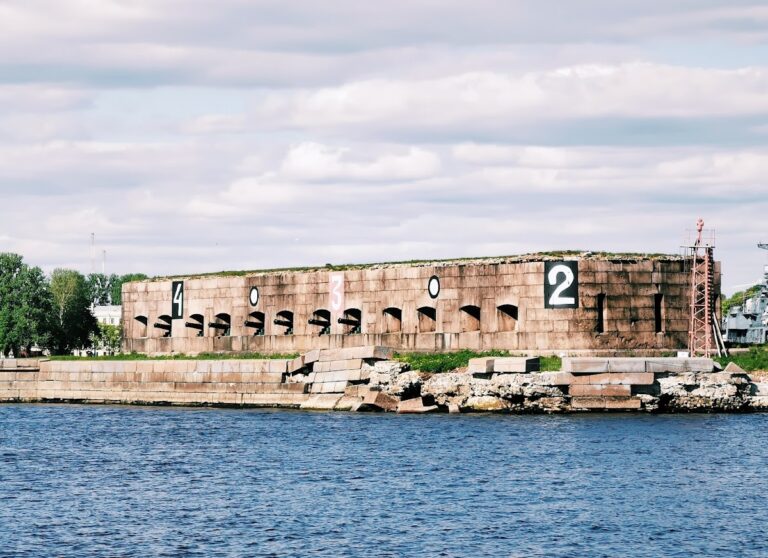
Krasnaya Gorka Fort is a coastal artillery fortress in Russia, on the southern shore of the Gulf of Finland opposite Kotlin Island and Kronstadt. Its modern fortification phase was built between 1909 and 1915 as part of the early twentieth-century expansion of the Kronstadt position. The fort protected the approaches to Kronstadt and Saint Petersburg from large enemy warships and formed part of a combined mine-and-artillery defence system.
Imperial origins and construction
The origins of Krasnaya Gorka are described as eighteenth-century, and the position was substantially modernized during the late nineteenth and early twentieth centuries. A foundation date of 1907 is associated with the modern fortification phase. Major construction began in 1909 under Major General Apollon Alekseyevich Shishkin, at the same time as work on Fort Ino. The new works entered service in early 1914 and were completed in 1915.
Also known as Alekseyevsky, the fort became one of the two principal coastal forts of the Kronstadt position of the Naval Fortress of Peter the Great. At the beginning of the First World War, its wartime establishment included 2,000 artillerymen, 2,000 infantrymen, and more than 500 personnel from other branches. The fort did not fight during that war, although its garrison had grown to 5,500 men by January 1917.
Revolution and the Russian Civil War
In 1918, the fort was mined because the German army was nearby. The planned explosion was cancelled, but the charges remained in place. During a severe storm on 19 August, several detonated. Powder magazines serving three Canet guns and four 254 mm guns exploded, killing the artillery crews, badly damaging the guns, and destroying one 254 mm gun. Canet guns were naval and coastal artillery pieces designed by the French engineer Gustave Canet and widely used by the Russian Imperial and Soviet fleets.
During the Russian Civil War, Krasnaya Gorka formed part of the defence of Red Petrograd. The Bolsheviks, the revolutionary socialist faction that seized power in 1917 and established the Soviet government, relied on the fort while fighting anti-Bolshevik forces known as the Whites. Krasnaya Gorka fired on a Finnish-held battery at Pummola on 20 November 1918 and on an enemy transport vessel on 29 June 1919.
On 13 June 1919, during General A. P. Rodzyanko’s Northern Corps offensive against Petrograd, the garrison mutinied against the Bolshevik government. The forts of Seraya Loshad and Obruchev joined the revolt. Naval gunfire and a landing force from the Baltic Fleet suppressed it on 16 June, with more than 600 12-inch shells fired at Krasnaya Gorka. The mutineers had also shelled Kronstadt and Red Baltic Fleet ships before the garrison withdrew to the White forces.
On 30 October 1919, Krasnaya Gorka fought an artillery duel with HMS Erebus, a British Royal Navy monitor designed for shore bombardment. The ship was giving delayed fire support to the advance of General Yudenich’s army. British aircraft attacked the fort 13 times between 29 September and 12 November, using 18 aircraft and dropping 176 bombs. The raids caused limited damage to internal structures, left the guns unharmed, killed two members of the garrison, and wounded 24.
In 1921, the fort’s guns were used against Kronstadt during the suppression of the anti-Bolshevik Kronstadt Rebellion. During the Winter War of 1939, they fired on Finnish positions across the Gulf of Finland. A Finnish Blenheim bomber attacked Krasnaya Gorka on 26 February 1940.
Second World War service
Krasnaya Gorka played a major part in the defence of the Siege of Leningrad and in maintaining the Oranienbaum Bridgehead, the Soviet-held coastal area west of Leningrad that served as a base for operations against German forces. On 31 August 1941, the fort’s 12-inch batteries fired on German troop concentrations near Koporye.
After German forces reached the Gulf of Finland near Strelna in September 1941, the fort supported the bridgehead and protected the shipping channel. Its guns engaged Finnish batteries that threatened Soviet ships and submarines, and this combat activity continued for approximately two years.
On 14 January 1944, Krasnaya Gorka opened fire on German positions at Gostilitsy and Dyatlitsy during the Soviet offensive to lift the siege of Leningrad. Operations continued until 27 January, when the encircled German Strelna-Peterhof grouping ceased to exist and German forces had been pushed 65 to 100 kilometres from Leningrad.
From 9 to 16 June 1944, the fort supported the artillery preparation for the breakthrough of the Finnish defensive line on the Karelian Isthmus. Railway artillery transports of the TM-1-14 and TM-1-180 types, which had arrived from Leningrad, also fired from the fort’s area. These volleys marked the end of Krasnaya Gorka’s combat activity.
Postwar use and heritage
In the first postwar years, the fort’s facilities were restored. Its older 6-inch Canet guns were replaced with modern 130 mm B-13 guns, a radar station was installed, and a new fire-control system was introduced in 1950. The fort was initially kept ready for combat, but its premises were later used as warehouses and its armament was dismantled.
Krasnaya Gorka was decommissioned in 1960 and partially demolished. It is a regional cultural heritage property of the Russian Federation and forms part of the UNESCO World Heritage property “Historic Centre of Saint Petersburg and Related Groups of Monuments.” The property, inscribed in 1990, includes the defensive installations and forts of Kronstadt.
The historical society Fort Krasnaya Gorka researches Second World War combat in the Leningrad region. In 2018, it helped alert authorities to a forgotten antitank minefield near Lebyazhye. Soviet sailors had installed the mines in August 1941, and they were later excavated and neutralized.
Remains
Main fortification complex
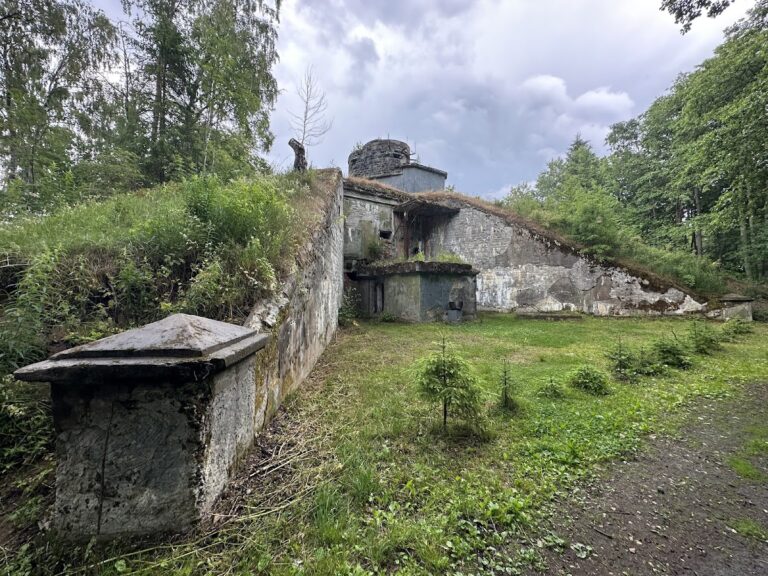
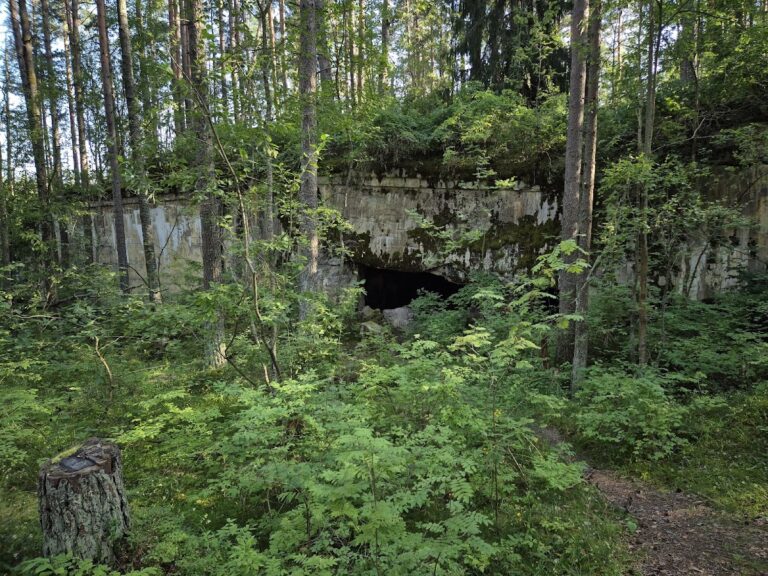
Krasnaya Gorka is a coastal artillery complex in which gun positions were linked by underground passageways called posterns. Subterranean structures surrounded the fighting positions, while ammunition was moved by railway. The project followed Konstantin Velichko’s design for a “Russian fort,” combining protected artillery works with defensive obstacles and concealed gun emplacements.
Gun positions and artillery
The principal armament included eight 280 mm howitzers, eight 254 mm Brink guns, six 152 mm Canet guns, four 305 mm guns in open mountings, and four 305 mm guns in twin turrets designed by A. G. Dukelsky. At one stage during the Civil War, the fort had 25 guns ranging from 76 to 305 mm. The complex also included a 305 mm gun on a railway transporter, a replacement 305 mm barrel, a 180 mm artillery installation, a 152 mm Canet gun, and a 130 mm naval artillery installation.
Protection and concealment
The concrete structures had roofs up to 183 centimetres thick. Corrugated iron and I-beams formed part of the protective system and were intended to reduce the effects of concrete spalling, when fragments break away from a structure under bombardment. The rear of the fort was secured by a substantial belt of field and permanent fortifications, a minefield, barbed-wire obstacles, and a ditch.
Camouflage was incorporated into the construction. A belt of iron “bushes,” painted to match the surrounding vegetation, screened the gun positions. The entrance and memorial structures are also part of the documented complex.
Outlying and railway installations
Seraya Loshad
The outlying fort of Seraya Loshad was built about 8 kilometres west of Krasnaya Gorka to cover the approaches to the main fort. Its armament included smaller 6-inch Canet guns and a battery of 120 mm Vickers guns. Seraya Loshad later joined Krasnaya Gorka and Obruchev in the 1919 mutiny.
Railway artillery and later military features
The wider complex included 305 mm guns mounted on railway transporters, including the TM-1-180 and TM-3-12 types. A command-and-rangefinding post survives among the military features associated with the fort, along with a KS-1 Kometa cruise missile shown in profile.
After decommissioning, the fort was partly demolished, its armament was removed, and some internal spaces were reused as warehouses. These alterations form part of the present physical history of the surviving coastal defence complex.
Nearby sites