Senningen Castle: A Luxembourg Government and Conference Venue


Site at a Glance
- Rating
- 4.1
- Popularity
- Very Low
- Country
- Luxembourg
- Primary era
- Modern
- Eras represented
- Modern
- Civilizations
- Unclassified
- Site type
- Domestic
- Remains
- Castle
On this page10 sections
History
Senningen Castle is a late-nineteenth-century revival-style castle in Luxembourg, created by transforming a former paper-mill owner’s residence at Senningen. Its eclectic design includes neo-Gothic wings, and its history reflects the industrial development of the Senninger Brook, later military and intelligence uses, and its continuing role in government and international affairs.
Watermills and the paper industry
Senningen’s low-lying landscape, abundant springs, and fast-flowing Senninger Brook supported watermills from at least the Middle Ages. By the early eighteenth century, one mill belonged to Guillaume La Payrade, an early-eighteenth-century mill owner, who joined Luxembourg printer and bookseller André Chevalier in seeking to establish a paper works. Letters patent issued in 1721 authorized the two partners to create a paper mill there.
In 1737, Pierre Bourgeois, a French entrepreneur from Mantes, acquired the mill. A fire destroyed the installation in 1750, after which Bourgeois rebuilt it and constructed a residence on the property. The mill remained an operating industrial site into the nineteenth century. It employed 18 workers in 1815, and in 1824 Luxembourg printer, bookseller, and publisher Jacques Lamort acquired the works and modernized the installation.
Production expanded during the nineteenth century as the mill adopted mechanization and the Senninger Brook was canalized to improve the water supply. An engraving made around 1834 by Nicolas Liez, a Luxembourg artist and engraver, depicts the Lamort paper mill and preserves a visual record of the earlier industrial complex.
Transformation into a castle
Economic difficulties and conflicts within the owning family brought the mill’s operation to an end in 1882. That same year, French industrialist Ernest Dervaux acquired the property. He demolished the paper mill, transformed the owner’s residence into the present castle, and created the surrounding landscaped park and pond. The building took its late-nineteenth-century eclectic, revival-style character during this transformation.
Wartime, military, and intelligence uses
During Germany’s occupation of Luxembourg from 1940 to 1944, the castle served as a convalescent home for artists under the Goebbels Foundation, a Nazi-era organization associated with Joseph Goebbels, Germany’s propaganda minister. After the war, the Luxembourg Army used the building for one of its units from 1952 to 1968.
The castle was later converted into the state’s communications centre. It housed services concerned with communications security and cryptography, the practice of protecting information by encoding it. During the Cold War, the castle hosted meetings in 1971 and 1972 of a secret allied committee connected with the Stay-behind network. This network consisted of clandestine resistance and intelligence structures intended to operate if a hostile power occupied a Western European state. The castle was also reportedly a base for a Stay-behind organization and may have contained a second intelligence archive.
Government and international functions
A conference centre, with a press room and interpreter cabins, was added around 1990 and 1991. Senningen Castle then hosted European Council meetings during Luxembourg’s European presidencies in 1991 and 1997. The European Council brings together the heads of the European Union’s member states or governments.
The castle underwent comprehensive renovation between 2004 and 2006. It is owned by the Luxembourg State and is used for government meetings, official meetings, receptions, government retreats, diplomatic gatherings, and international conferences. On 24 May 2007, it hosted Russian President Vladimir Putin and Luxembourg Prime Minister Jean-Claude Juncker during Putin’s official visit to Luxembourg.
Remains
Castle and landscaped grounds
Castle building
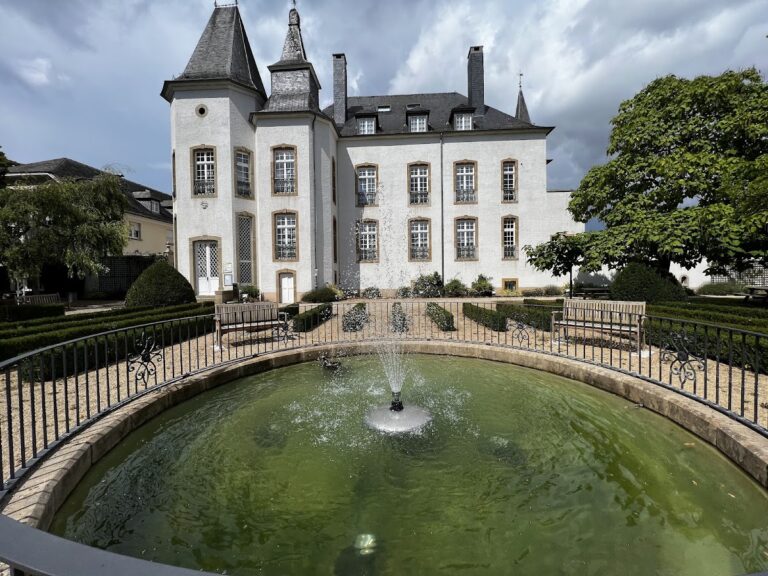
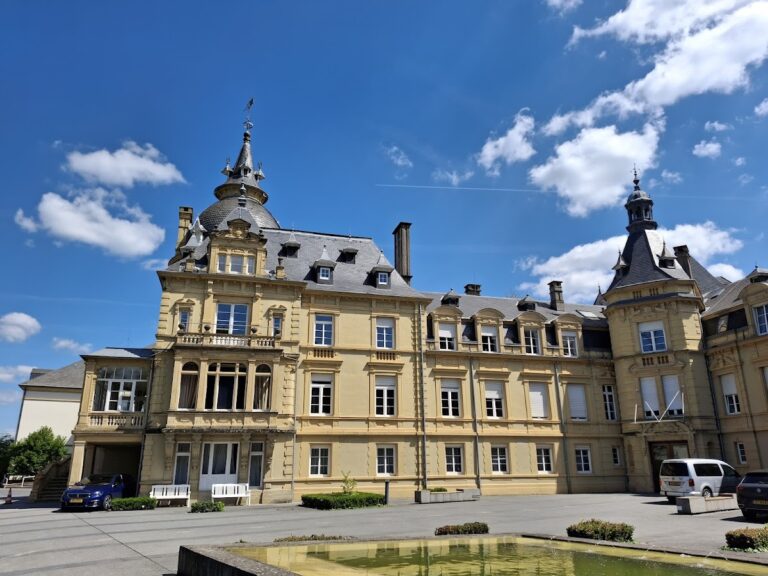
Senningen Castle is an eclectic late-nineteenth-century building formed from the former mill owner’s residence. Its revival-style architecture incorporates neo-Gothic wings, which reinterpret medieval Gothic forms. The castle largely survives in this form, despite its later conversion for military, communications, governmental, and conference functions and the comprehensive renovation carried out between 2004 and 2006.
Park and pond
The castle stands within an extensive landscaped park containing a pond or lake with a fountain. Ornamental and partly exotic planting shapes the grounds, which include approximately 100 tree species and California redwoods. The park and water feature were laid out after Ernest Dervaux acquired the property in 1882 and replaced the industrial complex with a castle estate.
Former paper-mill site
The earlier paper mill was powered by the Senninger Brook, the local watercourse that drove the mills at Senningen. During the nineteenth-century modernization associated with Jacques Lamort, the brook was canalized as part of the expanded installation. The mill was demolished in 1882, while Nicolas Liez’s engraving from around 1834 provides a view of the complex before its removal.