Seligenstadt Abbey: A Benedictine Monastery in Germany
Site at a Glance
- Rating
- 4.8
- Popularity
- Low
- Country
- Germany
- Primary era
- Early Modern
- External website
- Open
- Eras represented
- Medieval, Early Modern, Modern
- Civilizations
- Carolingian, German, Holy Roman Empire
- Site type
- Religious
- Remains
- Monastery
On this page20 sections
History
Seligenstadt Abbey is a former Benedictine abbey in Seligenstadt, Germany, founded around 828 during the Carolingian period by Einhard, the Frankish scholar and biographer of Charlemagne. It stood beside the Main, near the ruins of the Seligenstadt royal palace, and remained a religious institution until its secularization in the early nineteenth century.
Foundation and early religious community
In 815, Louis the Pious, emperor of the Carolingian Empire and son of Charlemagne, granted the settlement then called Obermulinheim to Einhard. After the death of his wife Imma in 830, Einhard became the first abbot of the community he had established there.
Einhard acquired the relics of the early Christian martyrs Marcellinus and Peter in Rome under circumstances that remain unclear. He first kept them at Steinbach before transferring them to Seligenstadt. Their relics, understood as physical remains or associated objects connected with saints, became the devotional focus of the new foundation. Einhard organized a clerical community to care for their cult and for pilgrims, and construction of the Basilica of Saint Marcellinus and Saint Peter began around 830.
Evidence for the period from approximately 850 to 1000 is scarce. Around 1000, the clerical foundation was probably converted into a Benedictine monastery. Benedictine communities followed the Rule of Saint Benedict, which emphasized shared religious life, prayer, and disciplined work.
Imperial and ecclesiastical authority
The monastery was directly subject to the emperor until 1002, when Henry II granted it as a fief to Henry I, bishop of Würzburg. Henry III granted the abbey immunity, market, coinage, and customs rights in 1045. In 1063, Henry IV transferred it as a proprietary monastery to the archbishop of Mainz, placing it under the authority of an ecclesiastical lord. Seligenstadt remained within the territorial rule of Mainz until its dissolution.
From 1051 to 1122, the archbishops of Mainz also served as abbots of Seligenstadt in personal union. In 1208, Pope Innocent III granted the abbot the right to wear an episcopal mitre. The abbey belonged ecclesiastically to the Archdiocese of Mainz, the archdeaconry of Saint Peter and Alexander in Aschaffenburg, and the Mainz-Bamberg order province. The archbishop controlled its property and finances and had to approve the election of its abbot.
Economic power and conflicts with Seligenstadt
Seligenstadt became an economic and political center with possessions and donations on both sides of the Main. Its oldest surviving rent register, dating from around 1000, lists income from more than 40 places. The abbey’s property extended along the Main to Trennfurt, into the Freigericht and Vorspessart, the Wetterau, the Rhine-Main region, the edge of the Odenwald, and the Upper Rhine Plain. Its vineyards lay on the southern slope of the Hahnenkamm near Alzenau-Horstein, while external economic administration was organized through the Seligenstadt district bailiwick.
Despite this wealth, the abbey did not become territorially independent. It remained part of the Mainz territorial state from the eleventh century. Its parish rights extended across Seligenstadt, Steinheim am Main, Gross-Auheim, Alzenau, Michelbach, Klein-Krotzenburg, Krombach, Stockstadt am Main, Geiselbach, and Dieburg.
In 1255, Archbishop Gerhard of Mainz incorporated Seligenstadt’s town parish into the abbey. This intensified disputes between the monastery and the town over forced labor, taxes, homage, judicial authority, property, and economic interests. A separate conflict over rights in the Seligenstadt Forest lasted until 1755, when Archbishop Johann Friedrich Karl von Ostein settled it. His own hunting rights had been seriously affected by the dispute.
War, reform, and renewed prosperity
The abbey was required to help maintain the town wall and participate in Seligenstadt’s defense. These obligations added to its financial difficulties during the late Middle Ages. Attacks by Frankfurt town soldiers, armed conflicts with the lords of Rödelheim and the garrison of Gelnhausen, and the Mainz collegiate feud forced the sale of monastic property and weakened the community.
In 1481, Archbishop Diether von Isenburg required Seligenstadt to join the Bursfeld Congregation, a fifteenth-century reform association of Benedictine monasteries. The abbey remained within the congregation until secularization. Non-nobles were admitted, and the assets of the abbot and the community were consolidated, strengthening the abbey’s finances and reputation.
Townspeople allied with peasants attacked and plundered the abbey in 1525 during the German Peasants’ War, a widespread revolt against social, economic, and religious grievances. During the Thirty Years’ War, the complex was repeatedly plundered and damaged, and the monks were expelled.
A renewed period of prosperity began in the late seventeenth century. The convent building, chapter house, and monks’ cells were rebuilt in 1685. The building now called the Old Abbey, which contained the abbot’s residence and administrative rooms, followed in 1686. A new prelature, the principal administrative and residential building of the abbey, was constructed in 1699.
Secularization and later history
During the War of the Austrian Succession in 1743 and the Coalition Wars from 1792, different belligerent forces repeatedly used the monastery as quarters. Until 1803, the abbey also provided social, medical, and cultural services for the surrounding region.
Troops of Landgrave Louis X of Hesse-Darmstadt occupied the monastery in 1802 and dissolved it as a religious institution. Its inventory was auctioned, including about 42,000 liters of stored wine, which produced the highest proceeds. Some property was sold and the remainder transferred to the state. The archives, a library of 5,500 books, and 126 paintings were moved to Darmstadt. The last 20 monks received pensions, while three monks and the abbot were allowed to remain for life.
The former abbey church was transferred to the Roman Catholic parish in 1812. State authorities and the judiciary used the remaining monastic buildings as official premises until the 1960s. The complex has remained in state ownership since secularization and belongs to the State of Hesse. The State Palaces and Gardens of Hesse has administered it since 1948.
From the 1980s onward, the complex was progressively repaired and restored, with its late seventeenth- and eighteenth-century flourishing providing the historical model. On 20 June 2025, the roof structure of an outbuilding burned completely, causing approximately one million euros in damage.
Remains
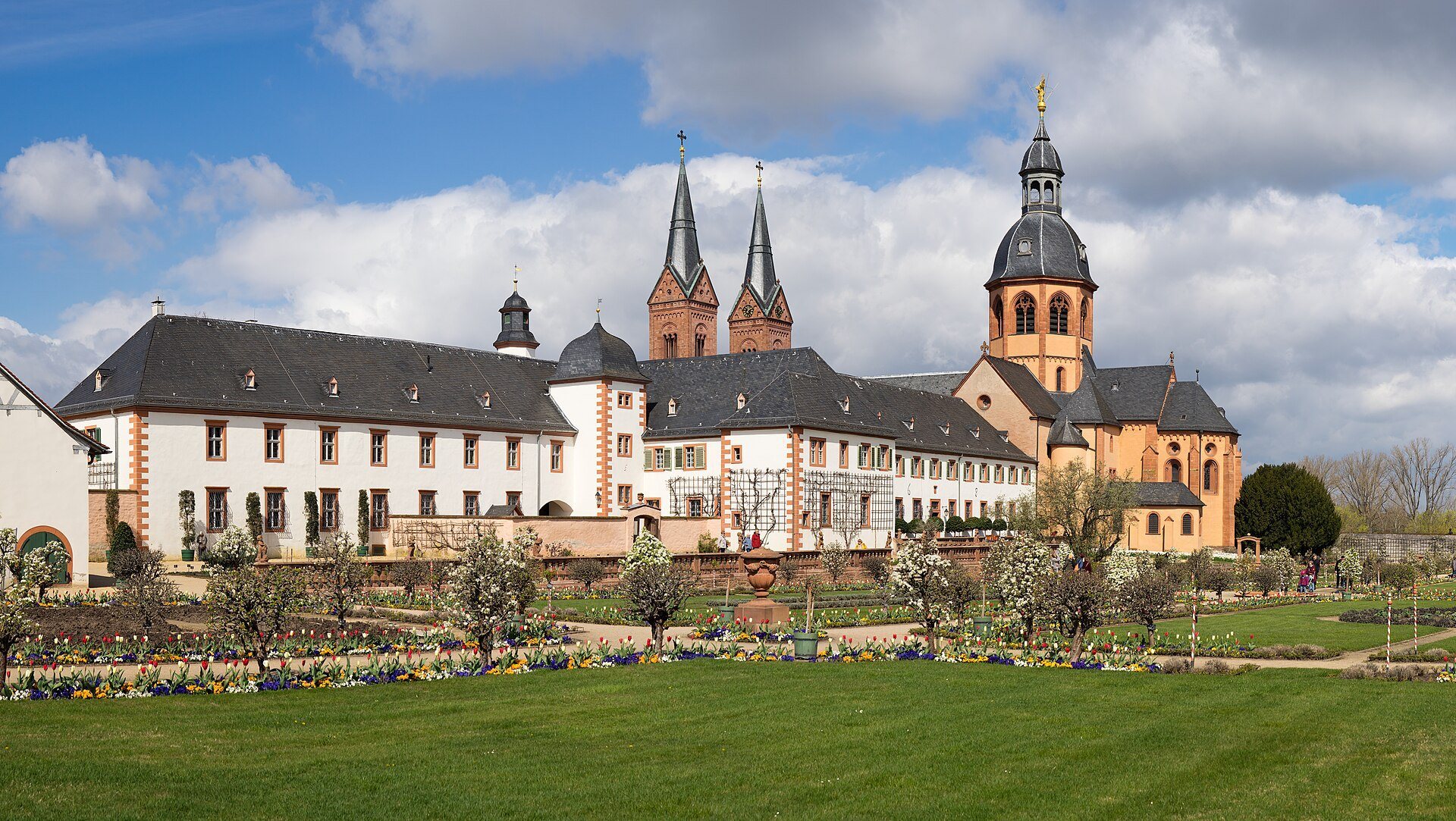
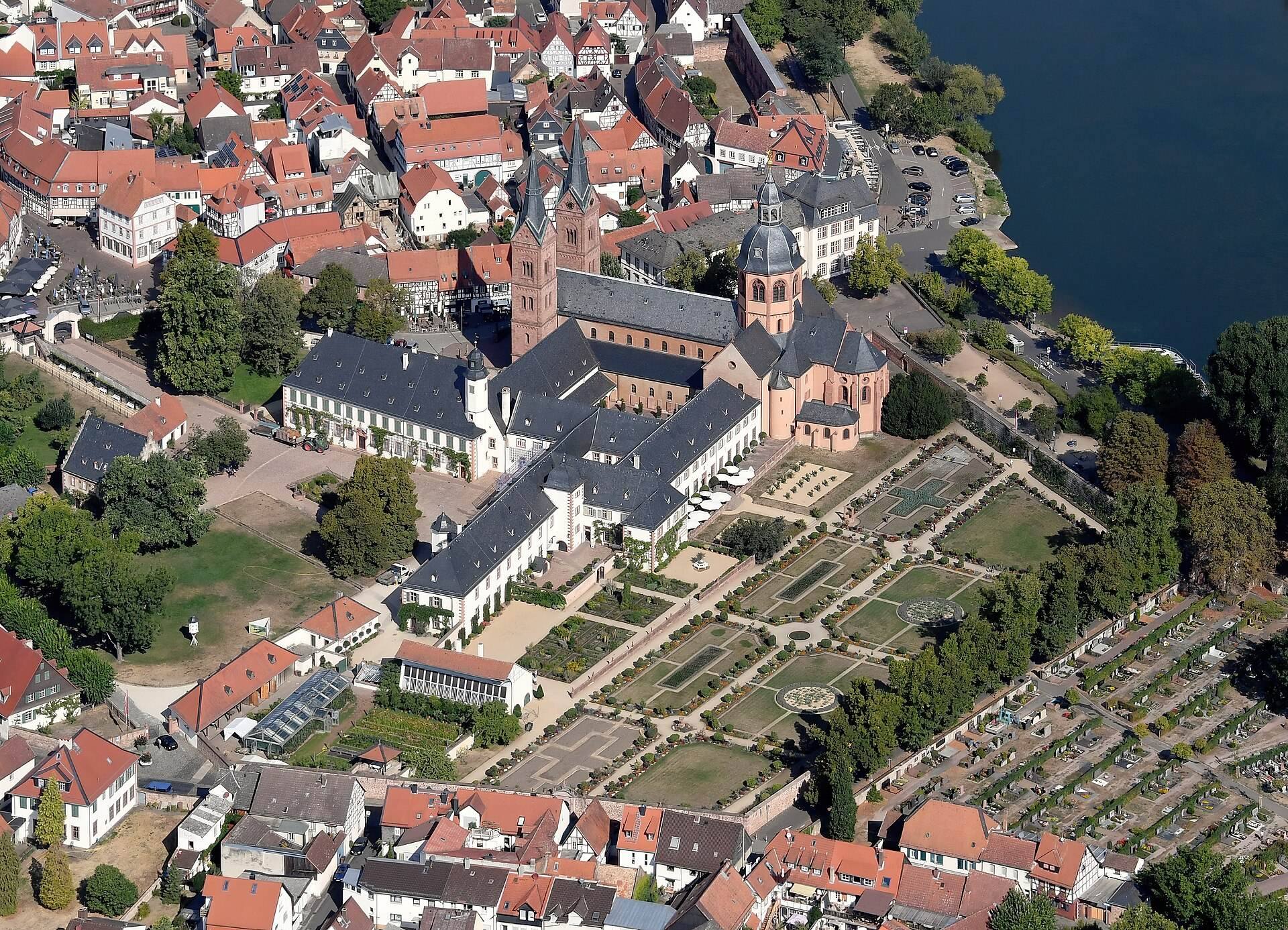
The monastery complex occupies the bank of the Main beside the ruins of the Seligenstadt royal palace. Its original ninth-century arrangement is known only in part through the church, while the oldest surviving building fabric dates from the eleventh century. Most of the visible complex reflects rebuilding after the Thirty Years’ War and the Baroque transformation that followed.
Church and monastic courtyard
Basilica of Saint Marcellinus and Saint Peter
The former abbey church incorporates the site of the early medieval church begun around 830. Only a few fragments of the original Carolingian building survive, but the basilica remains one of the oldest parts of the complex.
Gateway and courtyard
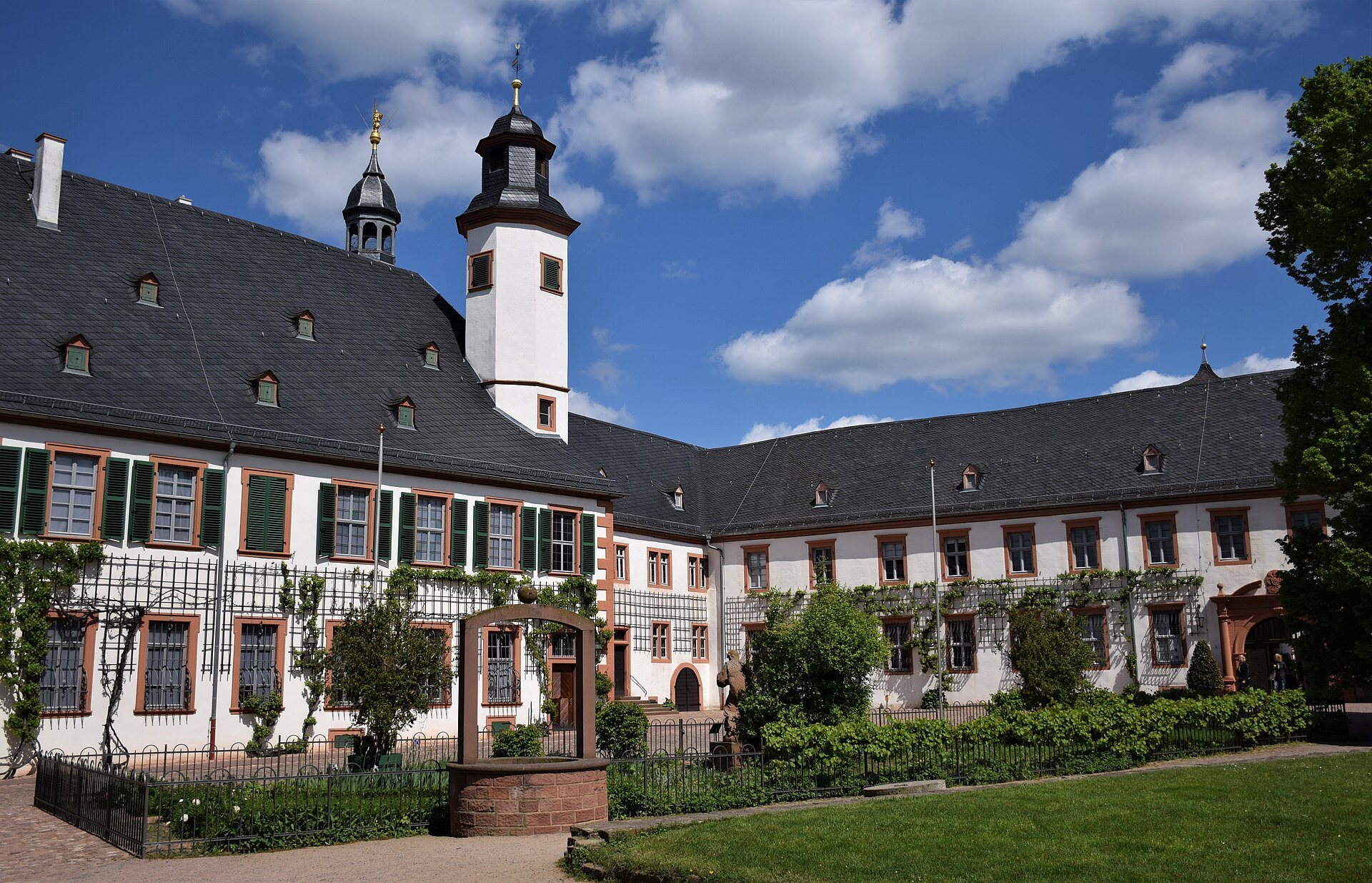
The enclosed complex is entered from the west through a Baroque gateway leading into the monastery courtyard. At its center, the Engelsgärtchen was created in 1995. It contains a Baroque statue of the Virgin Mary surrounded by angels and saints.
Service buildings
Former barns along the southern edge of the courtyard now house the municipal library. Other surviving service buildings include a bakery with a Frankish stone oven, a washhouse, and a dovecote built in 1992. A grain mill dating from 1574 also survives among the economic buildings and was restored to working order as a water mill in 1993.
Residential and administrative buildings
Prelature
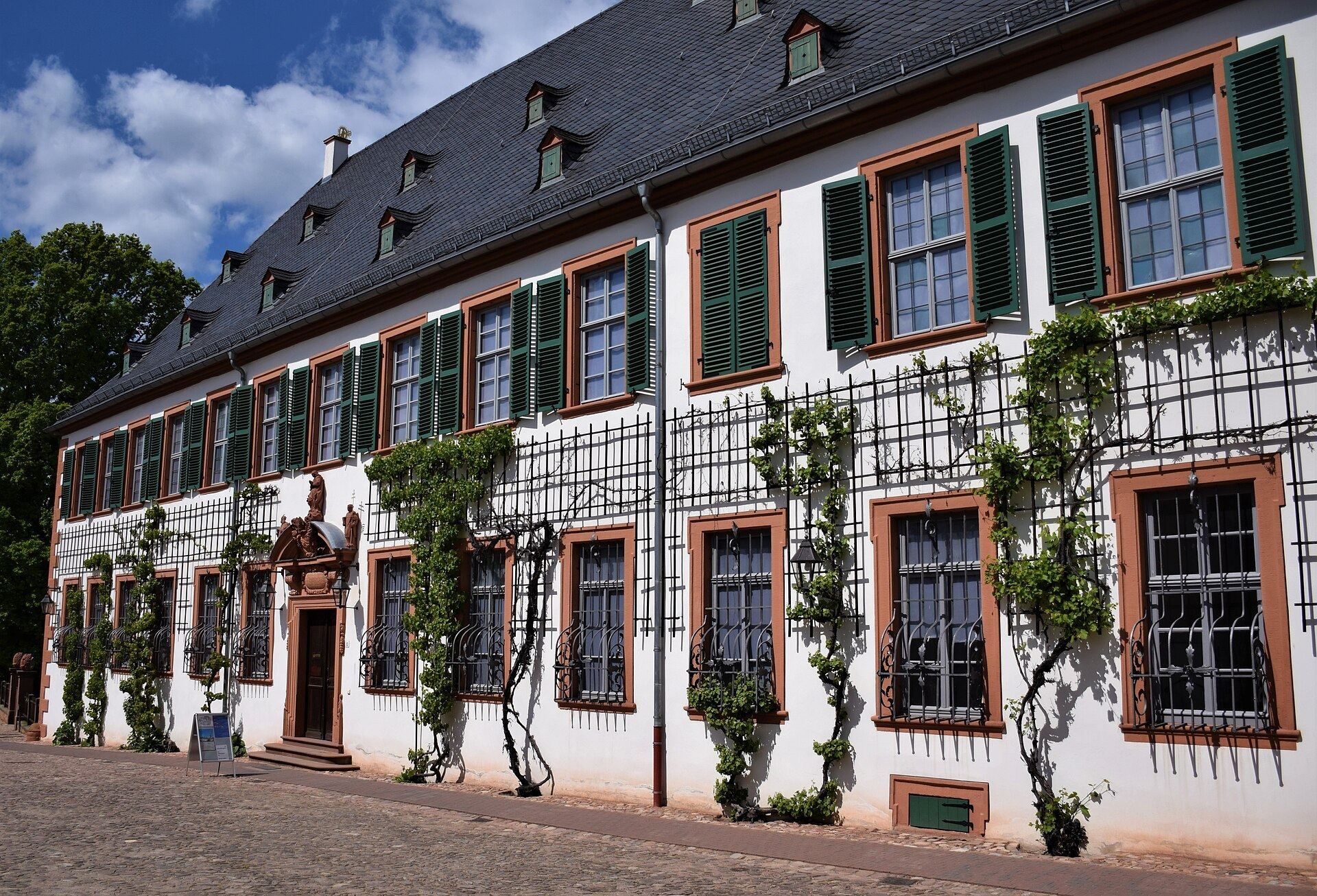
The 1699 prelature stands outside the cloister in the wing parallel to the basilica’s southern nave. Its ground floor contains the former abbot’s residence, Baroque wall and ceiling frescoes, and the Kaisersaal apartment. Guest accommodation lies above, together with a library room painted around 1731 and a small exhibition on the abbey’s history.
Kitchen and summer refectory
The same wing contains the kitchen building, whose courtyard window was used to provide meals to people in need. The summer refectory, dated to 1620, was converted from a former granary and contains illusionistic paintings by Giovanni Francesco Marchini. A hospital building connects the kitchen and convent buildings.
Old Abbey and pharmacy
A second wing extends southward at a right angle. Its courtyard side is formed mainly by the Old Abbey, while its garden side includes the convent building and a long eastern wing facing the convent garden. The former pharmacy, established by Abbot Petrus IV in 1720, was reconstructed in its original location in the Old Abbey in 2002. An adjoining apothecary garden contains approximately 200 medicinal herbs.
Cloister and collections
Only two wings of the cloister survive on the side away from the courtyard. The covered walkway contains a red-sandstone fountain. The convent and hospital buildings house the RegioMuseum, whose collections cover the Roman period, the history of the monastery and town, and local ethnography. Large vaulted cellars beneath them, once used for wine, now serve as a lapidarium, a display area for stone architectural fragments and sculpture, and as event spaces.
Convent garden and water castle
Baroque garden
The approximately 10,000-square-meter convent garden lies east of the monastery. Originally used for fruit, vegetables, and herbs, it was reshaped by the abbots for representational purposes in the late seventeenth century. From 1986, it was reconstructed as a productive garden in Baroque-park forms using documentary evidence and excavation findings.
The garden is arranged as a parterre, a formal garden divided into geometric beds. Its broderie beds form ornamental patterns resembling embroidery, and a fountain dating from around 1720 stands at the center. Flowering container plants and citrus trees occupy the garden, while a probably 1757 orangery with an inclined glazed southern wall provides winter shelter and maximizes light. The layout gives a direct view of the basilica’s eastern side, including its crossing tower and choir.
Water castle
The water castle was probably built around 1700 or 1705 by Abbot Franziskus II Blöchinger on the site of an older structure. It served as a garden house for the abbots’ early modern courtly festivities. Its late medieval castle design includes a moat, drawbridge, and four small corner towers, all decorative features because the building no longer had a military function.
Images and historical associations
Hermann Velte painted a view of the Seligenstadt monastery garden on the eastern wall of the complex between 1940 and 1942, following a print from 1713. The original wall painting had been lost. The background of Matthias Grünewald’s Stuppach Madonna, painted around 1516, may also depict Seligenstadt, possibly the monastery garden. A beehive corresponding to the one shown in the painting has been installed in the garden.