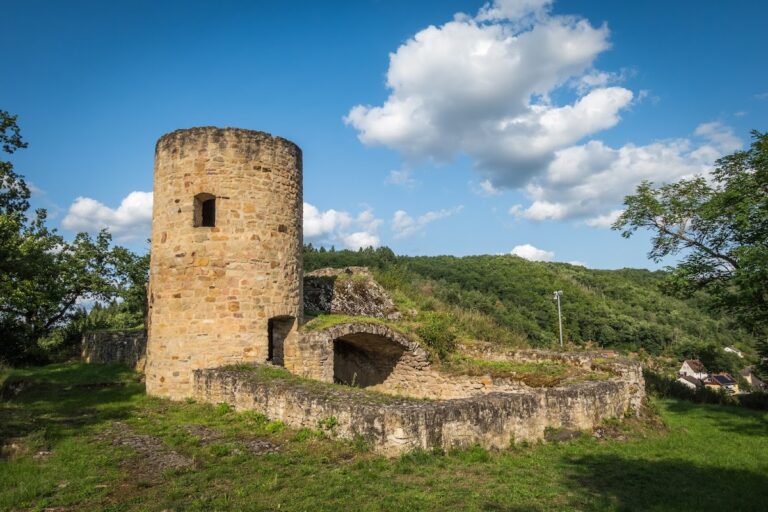
Schmidtburg: A Medieval Hill Castle and Administrative Seat


Site at a Glance
- Rating
- 4.8
- Popularity
- Low
- Country
- Germany
- Primary era
- Medieval
- External website
- Open
- Eras represented
- Medieval, Early Modern
- Civilizations
- Holy Roman Empire
- Site type
- Military
- Remains
- Castle
On this page9 sections
History
Schmidtburg is a ruined hill castle in Germany, traditionally said to have been built in 926 by the Frankish noblemen Franco, Hunpert, and Norpolt to defend against Hungarian incursions. It may have occupied the site of fourth-century Roman ruins, although that possibility remains unconfirmed. Above the Hahnenbach valley in the Hunsrück, the castle became an ancestral seat of the medieval Wildgraves.
The Early Castle and the Wildgraves
The first secure documentary reference to Schmidtburg dates from 1084, when the castle was associated with its new owner, Emicho. His son, Emicho II, inherited it and later adopted the name Comes silvestris, Latin for “count of the forest.” This title gave rise to the designation Wildgrave, used by the comital dynasty that held Schmidtburg among its ancestral castles and territories.
Territorial divisions within the family in 1258 and 1277 produced several Wildgrave lines. Disputes between the Schmidtburg and Kyrburg branches eventually led to the castle being transferred as a fief to Balduin, the Elector and Archbishop of Trier. When the Schmidtburg line died out, Balduin reclaimed the castle as a reverted fief. The Wildgraves tried repeatedly to recover it through a series of feuds, but their efforts failed by 1342.
The Electoral Trier Period
Schmidtburg then became a territorial castle of the Electorate of Trier, the state ruled by the archbishop-electors of Trier, and the seat of an administrative office. Its official, known as an Amtmann, governed the surrounding office district on behalf of the territorial lord. During the fourteenth century, numerous castle men, resident knights responsible for service and defense, lived in houses within the complex.
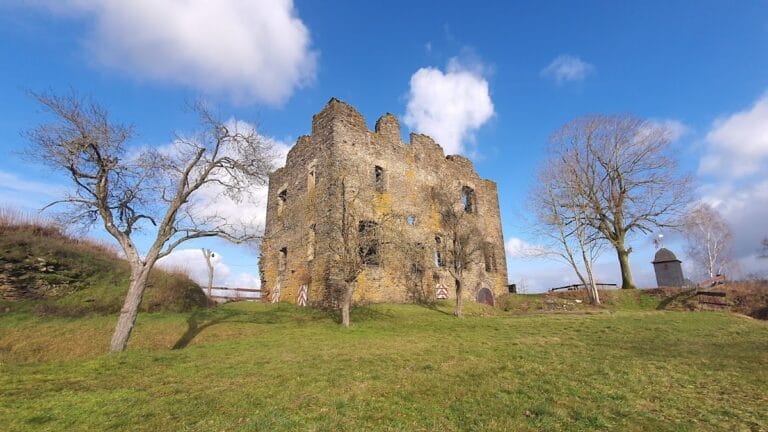
Most of these knightly residences were abandoned during the fifteenth and sixteenth centuries. The Schenk family of Schmidtburg remained in the lower castle and enlarged its residence in the northwestern corner into a largely independent complex. The lower castle nevertheless declined during the sixteenth century. French troops destroyed the remaining fortifications in 1688 during the War of the Grand Alliance, a European conflict fought from 1688 to 1697.
After the destruction, an administrative presence continued at Schmidtburg. A residential building and an ancillary economic building remained for the office-holders, and the Electoral Trier office was administered from the castle until the end of the eighteenth century. The ruin is also possibly connected with Johannes Bückler, known as Schinderhannes, a German outlaw active around the turn of the nineteenth century. His alleged use of the castle as shelter while fleeing the gendarmes of Kirn and Mainz remains uncertain.
Remains
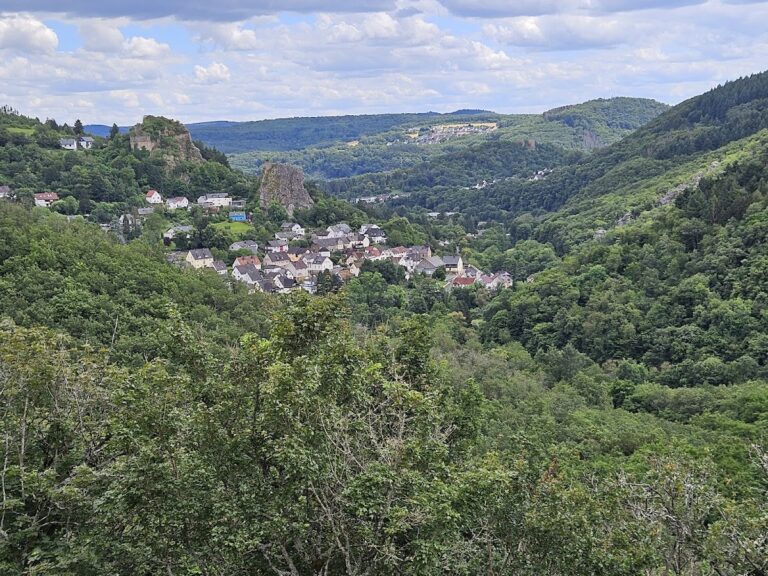
Schmidtburg occupies a river bend about 321 metres above sea level above the Hahnenbach valley. The extensive ruin is divided into an upper castle and a lower castle, forming one of the largest castle complexes in the surrounding area. Across the valley are the Celtic Altburg and the abandoned slate mine at Herrenberg.
Upper and Lower Castle
Upper Castle
A ditch separates the upper castle from the rest of the complex. Several residential buildings and a keep once stood within this part of the site, and excavations located the remains of the keep. The upper castle later served as the residence of the Electoral Trier official responsible for the Schmidtburg administrative office.
Lower Castle
The large lower-castle area contained numerous houses for the castle men. In its northwestern corner, the Schenk family expanded its residence into a largely independent complex. These residences formed the principal domestic development of the lower castle before many were abandoned during the fifteenth and sixteenth centuries.
Surviving Structures
Administrative Buildings
Following the seventeenth-century destruction, a residential building and an economic building remained for the administrative officials. The complex also includes hewn steps leading toward the upper castle and a tower associated with the present castle administration. Together, these surviving elements form part of the castle’s later administrative fabric within the wider ruin.