Schloss Wartenstein: A Medieval Castle and Administrative Estate in Germany


Site at a Glance
- Rating
- 4.6
- Popularity
- Low
- Country
- Germany
- Primary era
- Early Modern
- External website
- Open
- Eras represented
- Medieval, Early Modern
- Civilizations
- Holy Roman Empire
- Site type
- Domestic
- Remains
- Castle
On this page7 sections
History
Schloss Wartenstein is a former castle in Germany, located north of Kirn in Rhineland-Palatinate and built around 1357 above the Hahnenbach Valley in the municipal area of Oberhausen near Kirn. The medieval castle was founded by the knight Tilmann von Steinkallenfels, principal heir to the Heinzenberg possessions, and was first called Wartel. Its history reflects the feudal system, in which a superior lord granted property to a vassal in return for defined obligations.
Foundation and Feudal Transfers
In 1357, Tilmann built the new castle between Kallenfels and Hennweiler. Two years later, he transferred it to Archbishop Boemund of Trier as a fief for 800 gulden. Through marriage, the castle passed in 1381 to Tilmann’s son-in-law, Dietrich I von Manderscheid. Dietrich was forced to abandon it in 1409 during a feud, and Archbishop Werner of Trier enfeoffed Johann von Schwarzenberg with the castle in 1414.
Ownership subsequently became divided among several families. One part remained with the Schwarzenbergs until the family died out in 1583. Johann von Warsberg, the son-in-law of the last Schwarzenberg, then received that share as a fief. Another portion passed in 1428 to Iliane von Thune, widow of the knight Johann von Löwenstein, and in 1441 to her son Wolfram.
Alterations and Electoral Trier
In 1461, Dietrich, Lord of Manderscheid, and Dietrich, Count of Manderscheid and Lord of Dune and Sleiden, sold their half of Wartenstein Castle to the Elector of Trier, Count Adolf of Nassau-Saarbrücken, and Wirich von Daun-Falkenstein. The Elector of Trier was the archbishop of Trier, who also ruled as a prince of the Holy Roman Empire and took part in choosing the emperor. Between 1461 and 1469, the new holders altered the walls, wine press house, stables, and bridge. Johann von Schwarzenberg served as the jointly appointed administrative official.
After Heinzenberg Castle fell into ruin, its chapel was transferred to Wartenstein in 1464 with papal permission. The share held by the Count of Nassau-Saarbrücken and Wirich von Daun was later acquired by the lord of Kriechingen and Pittigen. His son Johann received it as a fief from Archbishop Richard of Trier in 1519.
Occupation and Administrative Role
Count Sebastian von Falkenstein, Lord of Oberstein and Bruch, forcibly occupied the castle in 1566. Following the death of Ludwig von Schwarzenberg in 1583, Electoral Trier seized all the shares. Johann von Warsberg challenged this action and in 1585 demanded enfeoffment with the entire castle. He received it, but had to grant Electoral Trier the rights of homage, to open and use the castle, military authority, compulsory transport service, and a property tax. The right to open a castle allowed the territorial lord to use it, including for military purposes.
At this time, Wartenstein served as the administrative center of the Amt of Weiden. An Amt was a territorial administrative district. The district included Weiden, Herborn, and Hahnenbach, as well as shares in Niederhosenbach.
Restoration and Present Interpretation
The Verbandsgemeinde Kirn-Land took over the estate in 1993 under a heritable building-rights agreement. Extensive restoration followed, addressing the partly ruined building fabric. In spring 2006, the castle opened a “Forest and Nature” educational exhibition and an information center for the Soonwald-Nahe Nature Park. The annual Lohmacher Festival demonstrates the historical stripping of oak bark for tanning in May, while a castle festival takes place on the second weekend of September.
Remains
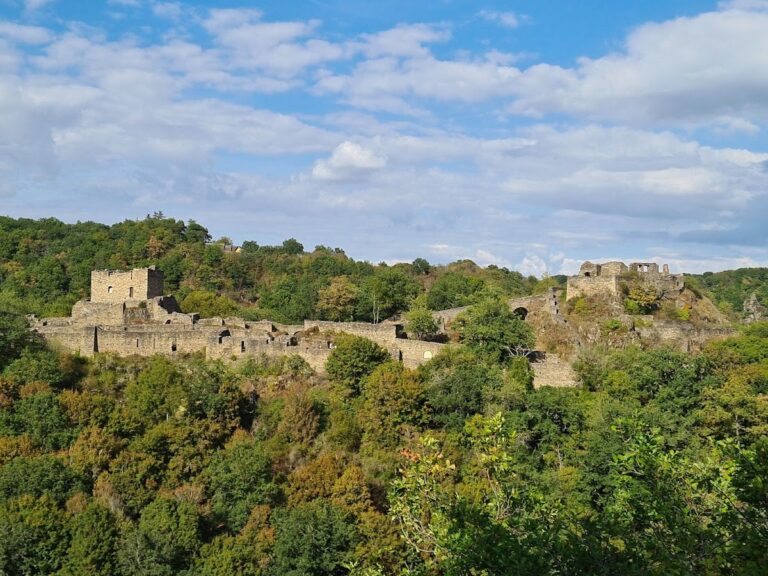
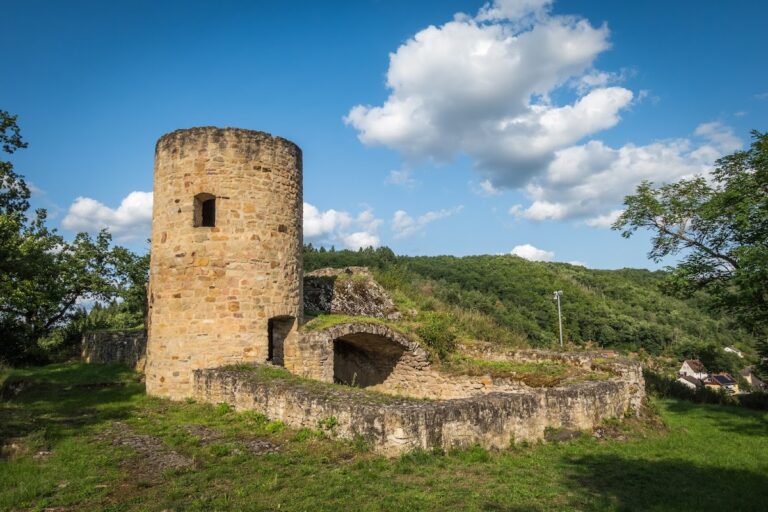
The original castle stretched for almost 130 meters along the ridge above the Hahnenbach Valley. Most of that medieval complex has not survived, while the remains of a residential bergfried, the principal defensive tower of a medieval castle, mark part of the earlier structure. The present residential castle occupies the site of the former ring wall and consists of a two-story rubble-stone building constructed in 1704 and 1728.
Castle Buildings and Exhibitions
The former stables and the Cavalier House now contain an exhibition on coppice woodland and the harvesting of tannin-rich oak bark. Coppice woodland is repeatedly cut back to produce new growth, while tanning bark, also called tanbark, contains tannins historically used to make leather. Three woodland dioramas show endangered animals such as the hazel grouse and wildcat, along with characteristic plants. The vaulted cellar presents large illustrations with rocks and fossils to explain the prehistoric geological forms of the surrounding region.
A forester’s room was created for Karl von Pidoll, the castle’s last resident. It presents stories and anecdotes about his life and work as castle and forest administrator for the von Warsberg family. The castle’s nature trail is used during the Lohmacher Festival to demonstrate bark stripping and the production of tanning bark.