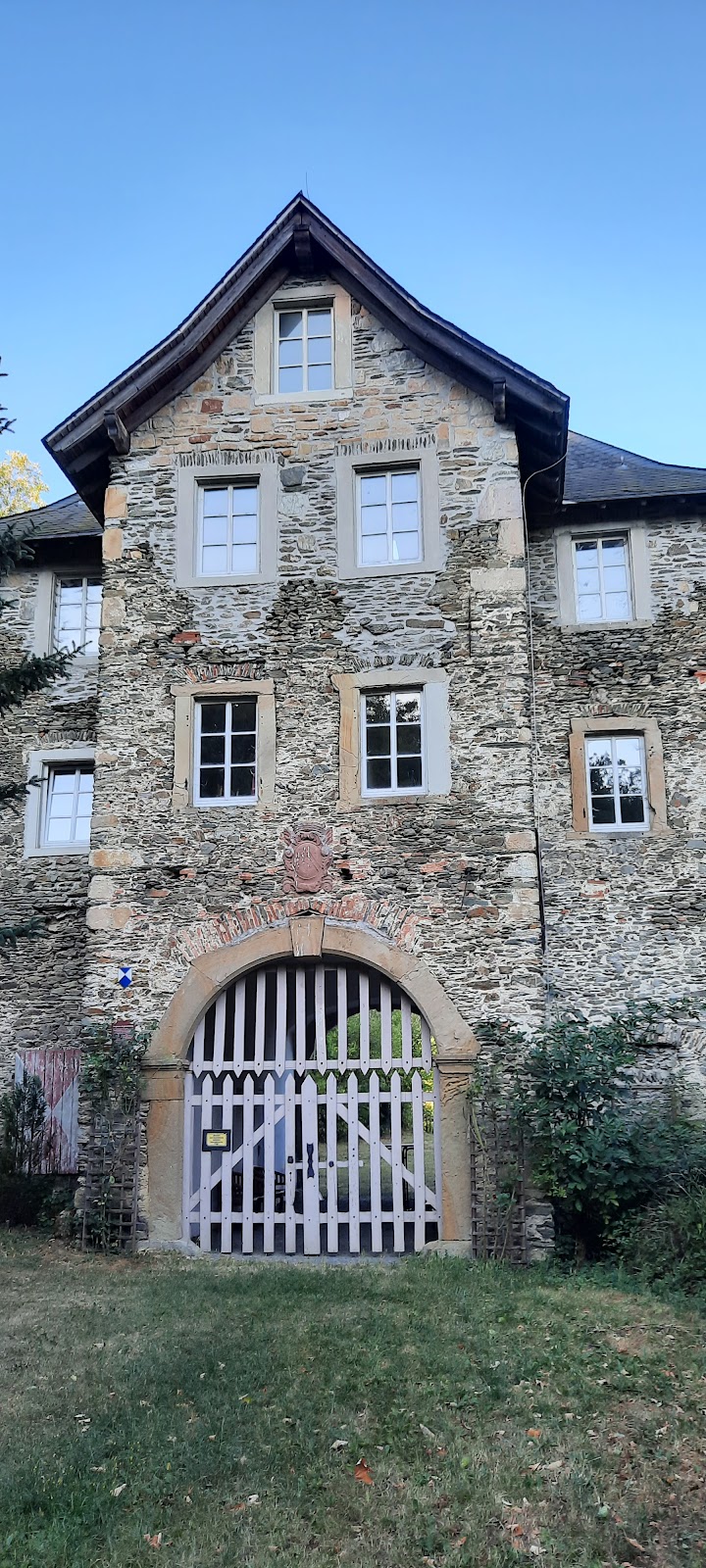
Burg Koppenstein: A Medieval Hilltop Castle Ruin in Germany


Site at a Glance
- Rating
- 4.7
- Popularity
- Very Low
- Country
- Germany
- Primary era
- Medieval
- External website
- Open
- Eras represented
- Medieval
- Civilizations
- Holy Roman Empire
- Site type
- Military
- Remains
- Castle
On this page7 sections
History
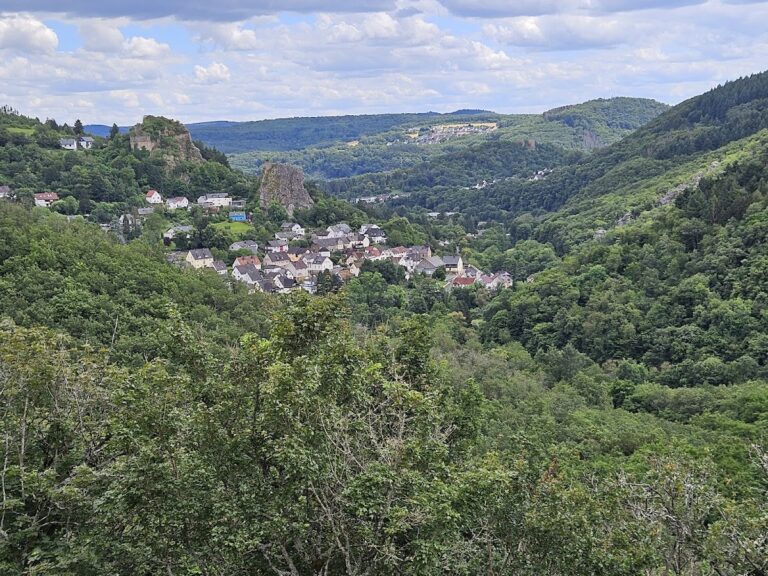
Burg Koppenstein is a medieval hilltop castle ruin in Germany, near Henau in Rhineland-Palatinate. The Counts of Sponheim built the surviving castle after 1325, making it part of the network of territories and feudal rights held by this medieval comital dynasty in the Rhineland. Its position above the Kellenbach valley gave the castle a commanding setting in the western Soonwald.
Before and during the Sponheim period
Koppenstein mountain was mentioned as early as the twelfth century. Ditches and stone ramparts indicate that activity on the site may have preceded the surviving castle, although the earlier settlement phase is distinct from the later construction by the Counts of Sponheim. A settlement developed at the foot of the castle and received town rights in 1330.
A noble family took the name von Koppenstein from the castle. Its line descended from an illegitimate son of Count Johann II of Sponheim-Kreuznach, who died in 1340. The family received important castle-related and other feudal grants from the County of Sponheim, linking its status to the political and landholding structure of the region.
Decline, reuse, and inheritance
The castle and the settlement below it were abandoned and had begun to decay no later than the Thirty Years’ War, the European conflict of 1618 to 1648 that caused widespread military and demographic disruption in the German territories. At the beginning of the nineteenth century, Burg Koppenstein was also associated with the division of loot from the robbery at Otzweiler and from another robbery carried out by Johannes Bückler, known as Schinderhannes, an outlaw associated with robberies in the Rhineland.
The last male member of the Koppenstein family, Jakob Adolf von Koppenstein, died in 1768 and named his nearest relative, Damian Freiherr Schenk von Schmidtburg, as heir. Most of the Koppenstein property consequently passed to the Schmidtburg family. In 1759, Jakob Adolf had returned the family’s Sponheim feudal grants to the County of Sponheim; they were later granted to his cousin Franz Karl von Hacke, son of Baron Ludwig Anton von Hacke.
The ruin and its castle district now belong, together with Gemünden Castle, to descendants of the Schmidtburg family, the Barons von Salis. The family history is also represented by the Koppenstein coat of arms, which was checkered in blue and gold and included a standing raven in a red upper-right field. The arms appear on the Auwach epitaph on the south side of Speyer Cathedral.
Remains
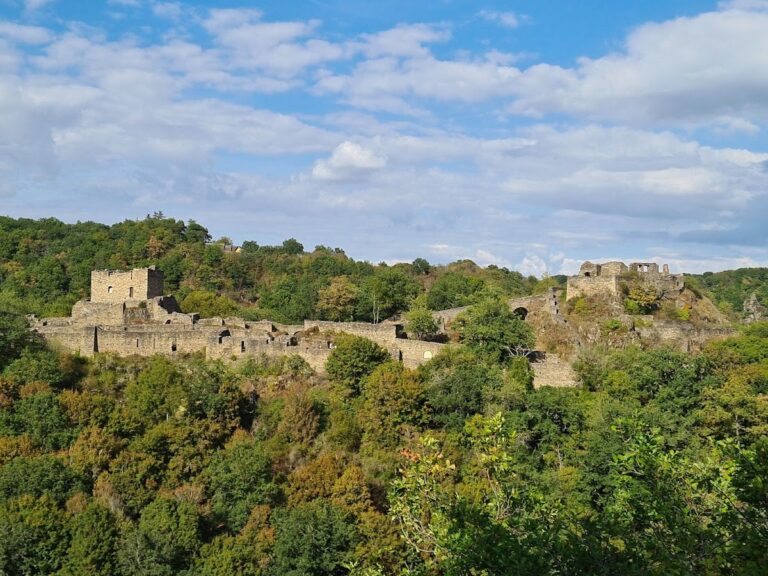
Burg Koppenstein occupies a hilltop at approximately 554.9 metres above sea level on Koppensteiner Höhe, above the Kellenbach valley in the western Soonwald of the Hunsrück. The ruin lies about two kilometres south of Gemünden and twelve kilometres south of Simmern. Its surviving fabric is concentrated in the principal fortified tower and the foundations of the castle, while sparse foundation walls mark other buildings and the settlement at the foot of the hill.
Castle structures and defenses
Pentagonal keep
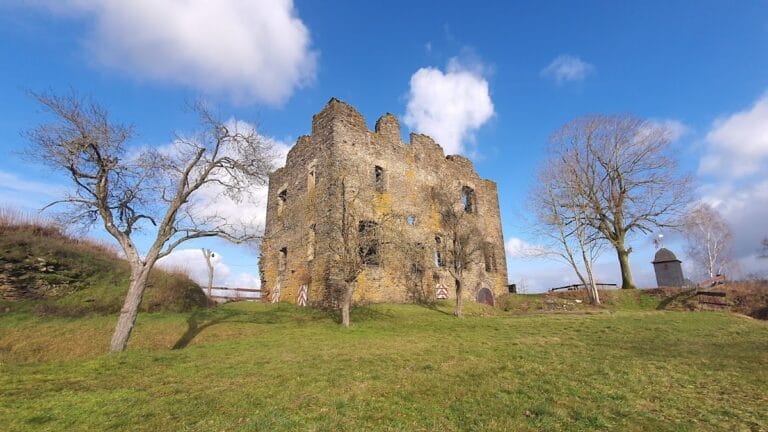
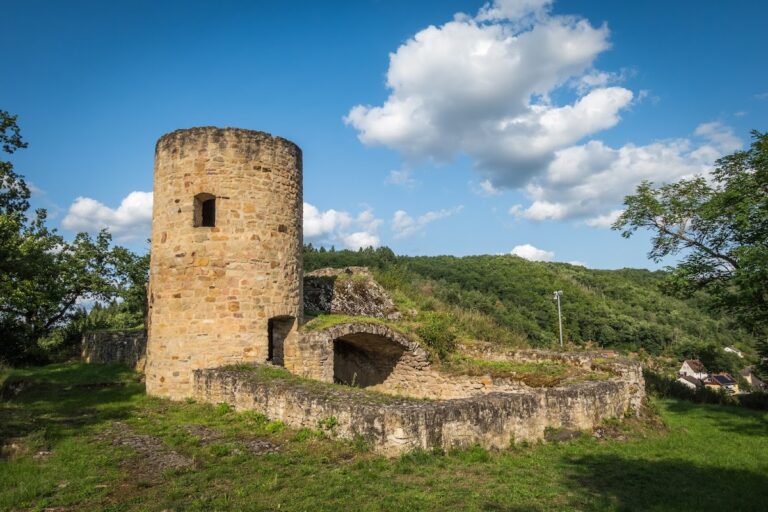
The keep is pentagonal and approximately 20 metres high. As the principal fortified tower, it served as a strong defensive structure and refuge rather than as the castle’s ordinary residential quarters. It is the best-preserved part of Burg Koppenstein and remains climbable, with a broad view over the surrounding landscape.
Ditch and foundations
A substantial castle ditch encloses the hilltop, reaching up to 10 metres in depth and, in places, up to 20 metres in width. Inside the defended area, foundations and sparse wall remains preserve the positions of the castle’s other buildings. The settlement below survives only through similarly limited remains and foundation walls, leaving the keep and earthworks as the clearest elements of the site’s physical layout.