Thurnhof Castle: A Renaissance Castle in Austria
Site at a Glance
- Popularity
- Low
- Country
- Austria
- Primary era
- Early Modern
- Eras represented
- Medieval, Early Modern
- Civilizations
- Habsburg, Holy Roman Empire
- Site type
- Military
- Remains
- Castle
On this page9 sections
History
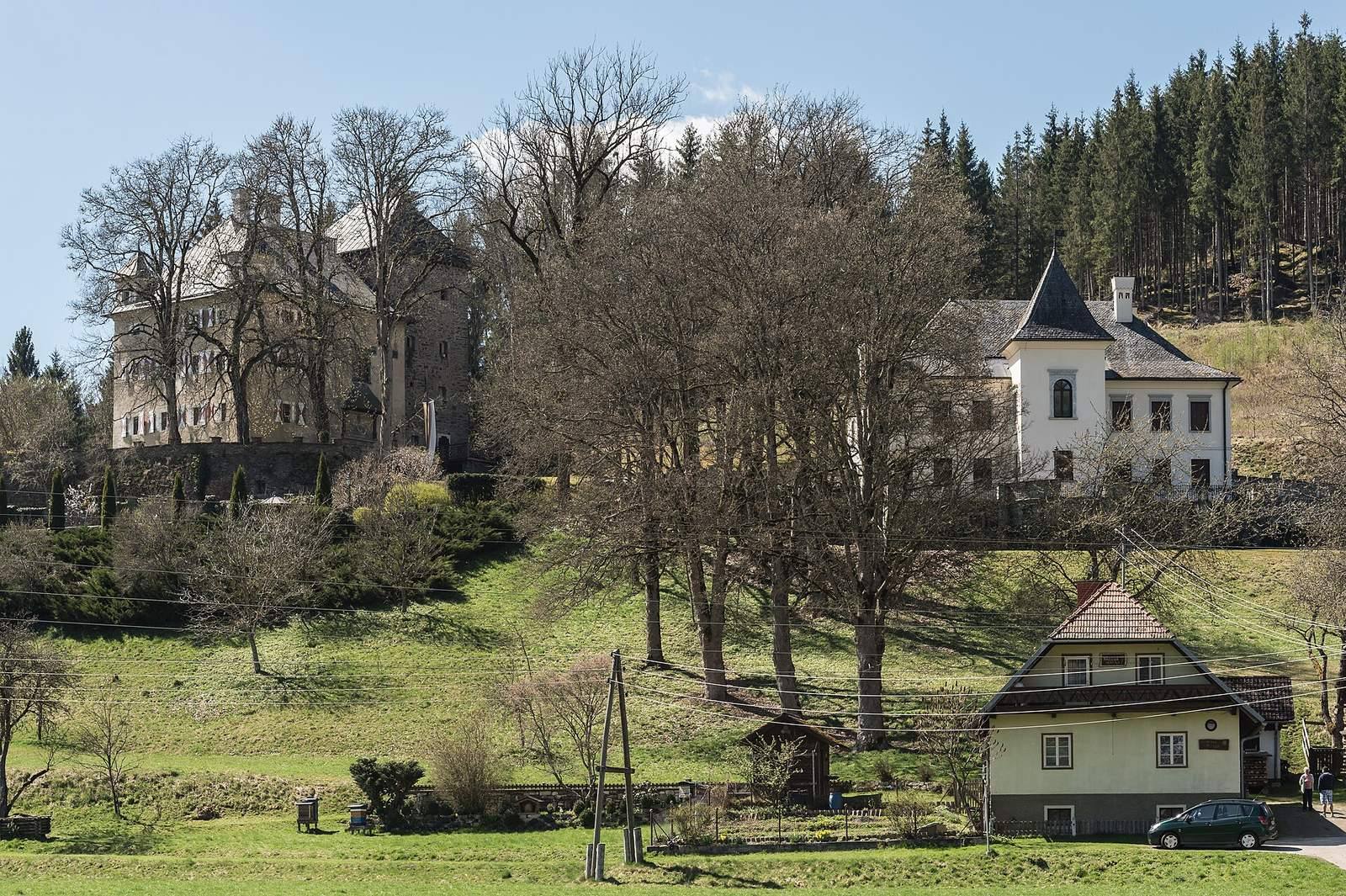
Thurnhof Castle is a Renaissance castle west of Zweinitz in Austria, on an estate first recorded in 1140. Renaissance architecture drew on forms and artistic traditions associated with classical antiquity. The castle itself appears in records from the early 13th century.
Early estate and castle
The 1140 record calls the estate Pregrat, later written Prägrad, a name meaning roughly “area before the castle.” It may have referred to a residence in front of the main castle, which may itself have been called Thurnhof. The record identifies Meinhalm de Praegrat as a retainer of the Bishopric of Gurk, a Catholic diocese in Carinthia. He carried out administrative duties for the bishopric, including overseeing church lands and forests in the region. In 1178, Meinhalm and his son Herbort were both named as retainers of the bishopric.
By the early 13th century, Thurnhof was a fief of the Bishopric of Gurk, meaning land held in return for service or allegiance. Records from 1246 and 1269 name Engelbert de Turris as lord of the castle, though his identity is otherwise unknown. The Hofman von Wald family held the estate during the 14th and 15th centuries. When its last member died, possession returned to the bishopric.
Jochner and Egger ownership
The Jochner family became lords of the estate after 1550. Veit Jochner, a magistrate and legal representative for the cathedral chapter, the clergy associated with the cathedral and its bishop, held it from 1585 to 1618. He commissioned improvements to the tower and construction of a residence, which his family named Thurnhof. In 1619, his son Christoph returned the castle to the Bishop of Gurk because of severe financial difficulties.
Around 1700, Paul Egger Jr., a councilor from Leoben, took over the estate and renewed the castle’s interior. The property then remained in the Egger counts’ family for roughly two centuries. After Paul’s death, his nephew, the lawyer Ferdinand Egger (1693–1753), inherited the castle. It passed to Ferdinand’s son Maximilian Thaddäus von Egger, then, under a partition agreement dated 22 February 1799, to Maximilian’s eldest son, Franz von Egger (1768–1836). Franz’s son and universal heir, Gustav von Egger (1808–1884), inherited after his death.
Later ownership and protection
A Hungarian timber company, Uilaky-Hirschler & Sohn, bought the property around 1890. Karl Funder acquired it in 1899, and it remained in the Funder family until Franz Wilhelm Treppo purchased it in 1989. Thurnhof remains privately owned and occupied by its owners. The Republic of Austria protects the castle as a monument.
Remains
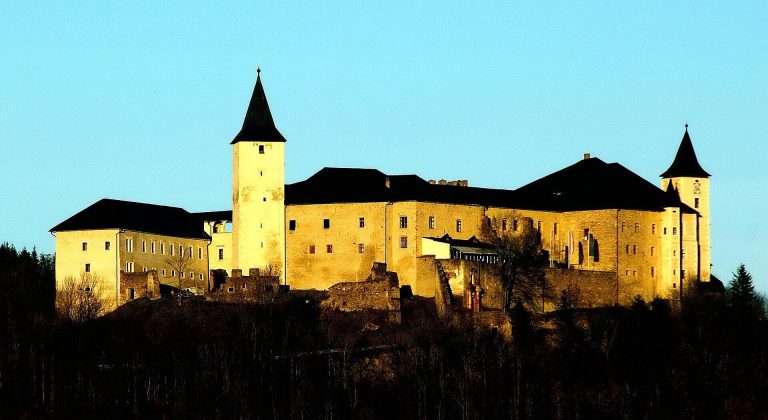
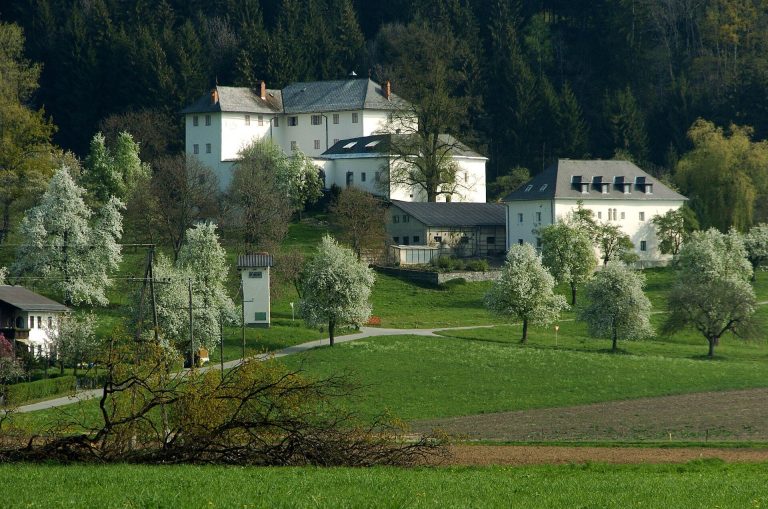
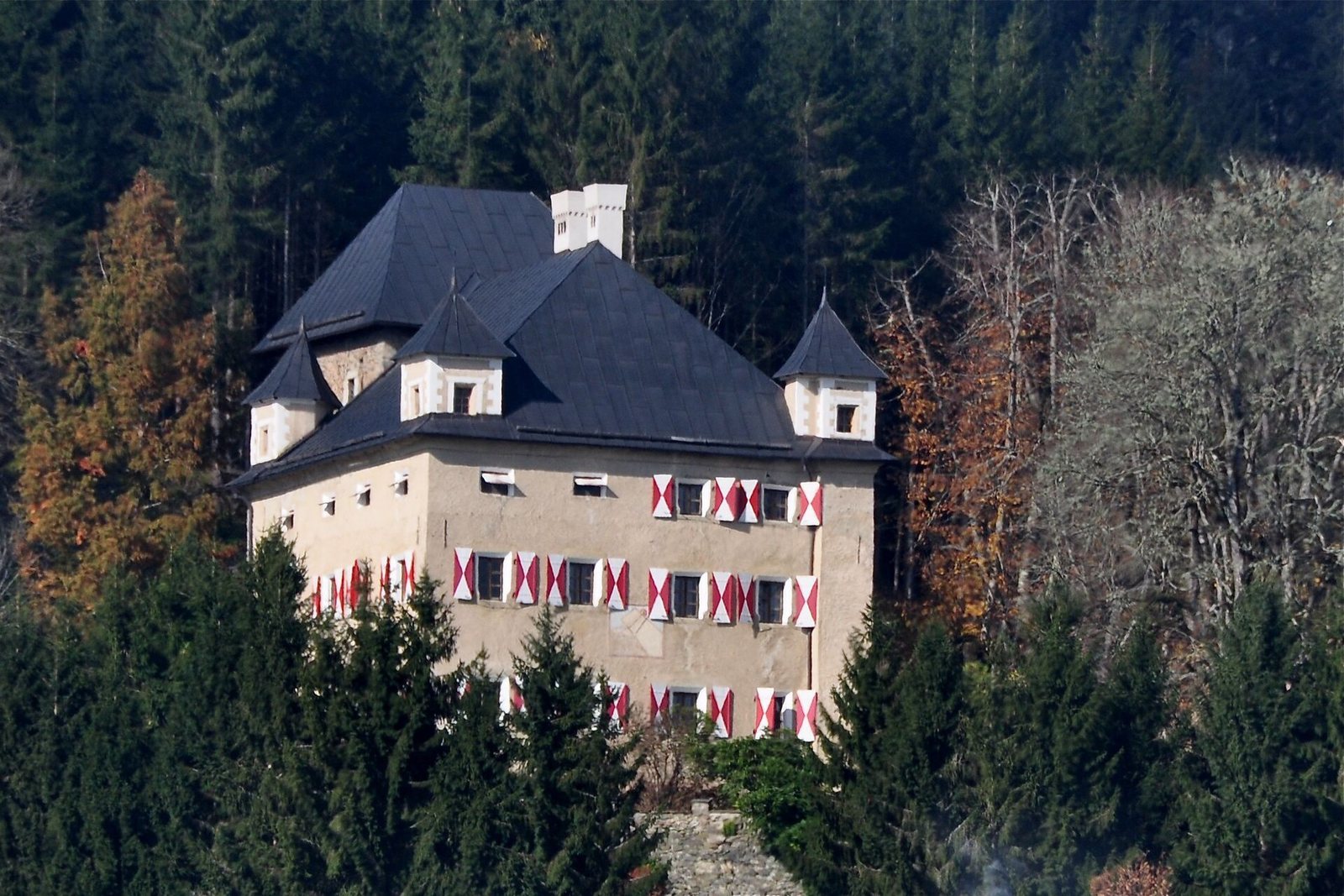
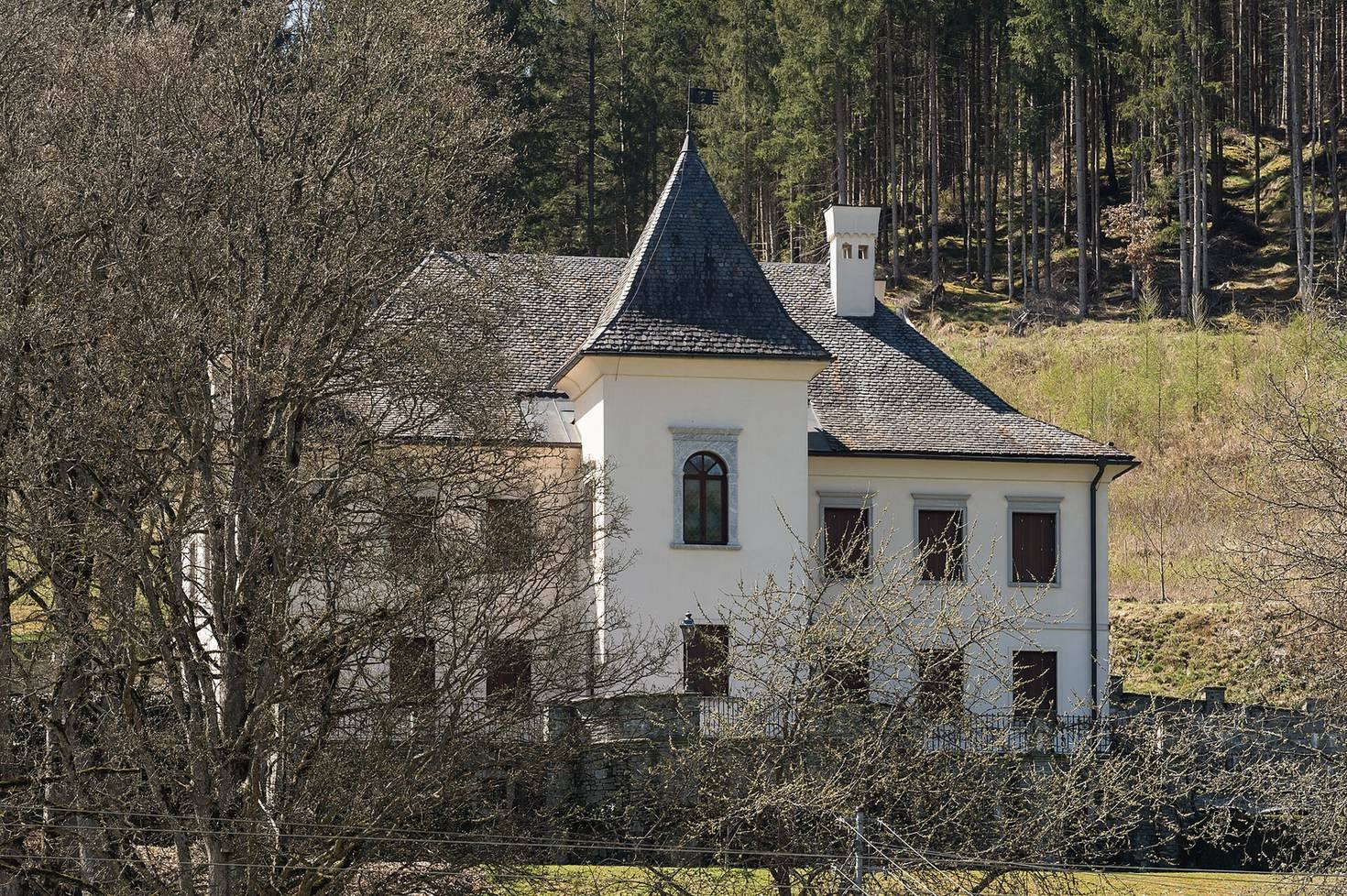
Thurnhof stands on a small terrace above the north bank of the Gurk River, west of Zweinitz, with a position overlooking the valley. The almost cube-shaped, well-preserved building has four facade bays and three or four storeys, depending on the side. A small turret rises at each roof corner. The uppermost storey is lower than those below it and has smaller windows; it served as a storage floor.
Medieval tower and defensive features
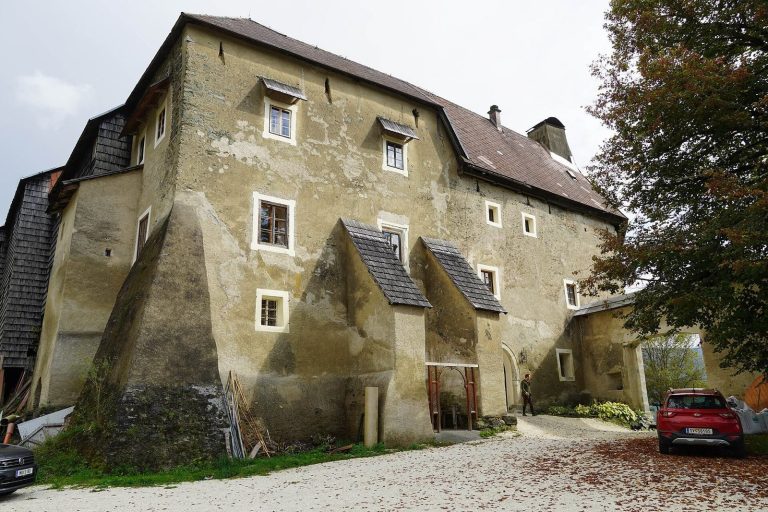
The oldest part of the structure is a massive defensive tower dating to around 1400, formerly the castle’s keep, or principal defensive tower. A residential building was added to its east side in the 16th century, replacing an earlier residence that had been destroyed. Windows were later opened in the tower’s lower floors. On the valley-facing side, a battlemented wall provides protection.
Renaissance exterior
Entrance portal
The heavy entrance portal, dated 1560, is built of rusticated masonry, using blocks with deliberately rough or emphasized faces. Its arch has a lion-mask keystone, the central stone at the top. Above the portal are a wall painting on plaster and a relief of the coats of arms associated with Veit Jochner and his wife, Barbara née Raidhaupt. Columns flanking the painting bear the date 1585, recalling concerns about the Ottoman Empire, whose expansion was a source of military anxiety in central Europe. The Jochner and Raidhaupt arms have faded, and the other figures are almost lost.
Windows and openings
Renaissance paired windows survive on the south side and above the portal. Other window openings were made at a later date.